
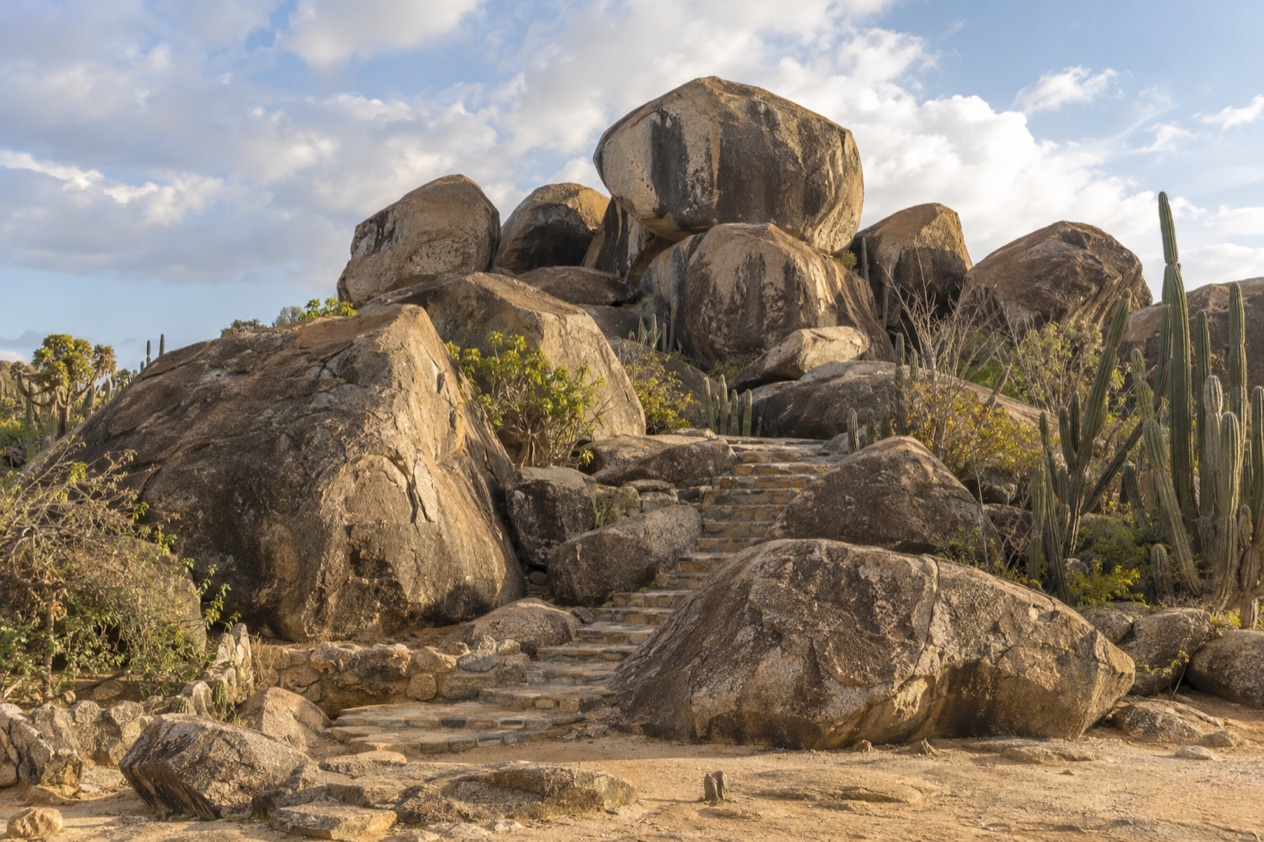
Past the last houses off the road to Santa Cruz, the flat, dry land suddenly heaves up into a heap of enormous boulders, balanced on one another as if a giant had stacked them and wandered off. Cacti lean from the cracks, lizards flick across the sun-warmed stone, and the wind that sweeps the whole island hums between the rocks. Casibari is a visit built around wandering, climbing and looking out, and it suits anyone who wants Aruba’s interior after a few days at the beach.
Is visiting the Casibari Rock Formations worth it?
Yes, especially for travelers who like to move around and see a landscape from above, and for families, couples and photographers who want a change from the resort coast. Casibari gives you a handful of memorable hours of scrambling, pausing and gazing, and it asks for very little planning in return.
What sets it apart from other rock sites on the island is the way you use it. Here you climb stairways carved into the stones themselves and walk winding trails between the boulders, so the visit feels like exploring a small stone village rather than looking at a monument from a fence.
Ayo Rock Formations, in Paradera, are a different kind of stop, known for original rock drawings and for having been a sacred place for Aruba’s original inhabitants. Casibari is about the climb and the panorama. Ayo is about the story written on the stone. Both are open for visitors to climb and explore, so together they make a pleasing pair of rock-themed outings.
There is also a quiet curiosity in the stone. These are tonalite boulders, and geologists still puzzle over how they came to sit here, alone in the desert terrain. You do not need to understand the science to feel the strangeness of it. It is enough to stand at the base of a boulder the size of a house and wonder how it got there.
What to see at the Casibari Rock Formations
The boulders and the trails between them
The first impression is of scale. Rounded, weathered tonalite blocks rise out of the desert floor, some leaning together to form shady-looking nooks and narrow passages. Tonalite is an igneous rock, a cousin of granite, and its pale gray surface turns warm gold or rosy brown as the light shifts through the day.
Winding trails run between the rocks, and you can follow them without any fixed route in mind. Look at the cracks and ledges, where cacti and other tough desert plants take root, and at the lizards that treat the sunniest stones as their own. Birds sometimes cross overhead, and the wind makes a low sound as it threads through the gaps.
The carved stairways
The signature of Casibari is its stairways, cut right into the stone so that you climb the formation itself. They lead from the base up through the heap of boulders toward the highest rocks, and each turn gives a slightly different frame of the surroundings. Some steps pass under overhangs, others open onto small platforms where people stop to catch their breath and look around.
The climbing is part of the fun, and the simple rule is this: Casibari is open for visitors to climb and explore. Take your time on the stone, since sand and dust can collect on worn steps, and let people coming the other way pass at the narrow places.
The view from the top
At the summit you get sweeping 360-degree views of the island, from the coastline to the inland hills. Aruba is small and mostly flat, so a modest rise of stone feels like a real lookout. You can pick out the scrubby plain, scattered houses and the line of hills in the distance, with the sea shimmering at the edge of the picture.
This is the place to slow down. Stand where the wind is strongest, turn a full circle and let your eyes find the differences between the green patches, the pale ground and the blue horizon. It is also where most photographs are taken, and the open sky gives a clean backdrop for portraits.
The snack bar and the rest stop
At the site, the BBQ Bar & Grill offers snacks, cold drinks and shaded seating, which makes a natural pause before or after the climb. Free Wi-Fi is available at the site too, handy for sharing a view or looking up what to do next.
A cold drink in the shade after scrambling over sun-warmed rock is one of the small pleasures of the visit. It also gives you a spot to sit while the rest of your group finishes exploring at its own pace.
Hours, tickets and rules
Casibari is a place you explore on foot, outdoors, among the rocks, and its main rule is a welcoming one: visitors are free to climb the stairways and explore the formations. The trails and the carved steps are there to be used, and the summit is part of the visit rather than something to look at from below.
The rock formations in Aruba are open for climbing and exploring, and that applies to Casibari as well as to Ayo in Paradera. Think of the whole outing as a hands-on walk through stone, with the climb to the top as its high point.
Beyond that, treat the place as you would any natural landmark. Stay on the trails and stairways, and leave the rocks, plants and small wildlife as you found them. The boulders have stood here for a very long time, and they look best without marks or litter.
How to get to the Casibari Rock Formations
Casibari sits in a residential area just off the main road to Santa Cruz, near Oranjestad. That puts it in the middle of the island’s interior rather than on the shore, so the approach takes you away from the resort strips and past ordinary neighborhoods before the boulders appear.
Oranjestad is the nearest base, and the road toward Santa Cruz is the one to follow. Once you reach the residential area, the rock pile is hard to miss, since nothing else on the flat land rises like it. Visitors staying elsewhere on the island can treat Casibari as an outing into the center, a different Aruba from the beach scene.
If you are also heading to Ayo Rock Formations, they are located at G2J3+8CQ in Paradera, a code you can enter into a map app. Keep that in mind when you plan, because the two sites are separate stops in different places, and each deserves its own unhurried visit.
When to visit the Casibari Rock Formations
For the island in general, the best time to visit runs from February to August, and that is a good guide for Casibari too. Peak season falls from December to April, so a trip in those months overlaps with the busiest stretch of the year on Aruba, while the later part of the best-time window sits outside it.
Time of day matters more than month for a place like this. The rocks are exposed, the terrain is desert, and the island is dry and windy, so you are climbing in open sun.
Early in the day and late in the afternoon, the light is softer, the stone is less hot to the touch and the views take on warmer colors. Midday brings the harshest glare, which flattens photographs and makes a climb feel longer.
The trade wind blows from the east all year, so expect a breeze at the top whatever the season. It cools the climb, and it also means a hat can disappear over the edge if it is not fastened. Late-day light is a favorite for photographs, with long shadows between the boulders and a golden wash over the hills in the distance.
Tips for your visit
Wear shoes with a good grip, since you will be on stone steps and uneven rock, and bring something to drink. A camera or phone is almost essential, because the summit view is the reward. Sunglasses help against the glare off the pale boulders. Plan to spend long enough to wander the trails, climb to the top and sit for a cold drink at the BBQ Bar & Grill.
Casibari combines well with other stops close by. Things to do nearby are within one mile, including Cadushi Ink Tattoos, Bright Bakery and Divi Re-Skin, so you can pair the climb with a bakery stop or a look at the neighborhood. For a second rock outing, Ayo Rock Formations in Paradera add rock drawings and a sacred-site history to the day.
Families will find plenty to hold a child’s attention, from lizards on the stones to the feeling of climbing a natural fortress, though you know your group best, so go at the pace of the slowest climber. The carved stairways are a real climb, and travelers who prefer not to scale steps can still enjoy the base, the trails and the snack bar. The Wi-Fi at the site means you can share the view as soon as you reach it.
Good to know before you go
The U.S. State Department rates Aruba Level 1, ‘Exercise normal precautions,’ and says Aruba is generally a safe destination for travelers, with petty crime the main concern in popular tourist areas.
Casibari is an outdoor stop on a small, sunny island, so the usual habits apply: water, sun protection and a steady pace on the rock. Keep an eye on your belongings when you are scrambling, as petty crime is the main concern in popular tourist areas. Take your time, enjoy the views and let the strange stone landscape do the rest.
Sources
- Aruba Tourism Authority, Casibari Rock Formations (https://www.aruba.com/us/explore/casibari-rock-formations), checked October 9, 2026
- Aruba Tourism Authority, Rock formations (https://www.aruba.com/us/explore/rock-formations), checked October 9, 2026
- Aruba Tourism Authority, Best time to visit (https://www.aruba.com/us/our-island/one-happy-island/when-is-the-best-time-to-visit-aruba), checked October 9, 2026
- U.S. Department of State, Aruba Travel Advisory, Level 1, issued August 19, 2026 (https://travel.state.gov/content/tsg_aem/us/en/home/international-travel/travel-advisories/destination.abw.html), checked October 9, 2026
To plan your stay
- Best Time to Visit Aruba: Weather by Month, Peak Season and Festivals
- Where to Stay in Aruba: Palm Beach, Eagle Beach, Oranjestad and All-Inclusives
- Aruba Airport (AUA): Arrival, Getting to Your Hotel, U.S. Preclearance and Departure
- Know Before You Go to Aruba: Entry Forms, Money, Water and Local Customs