
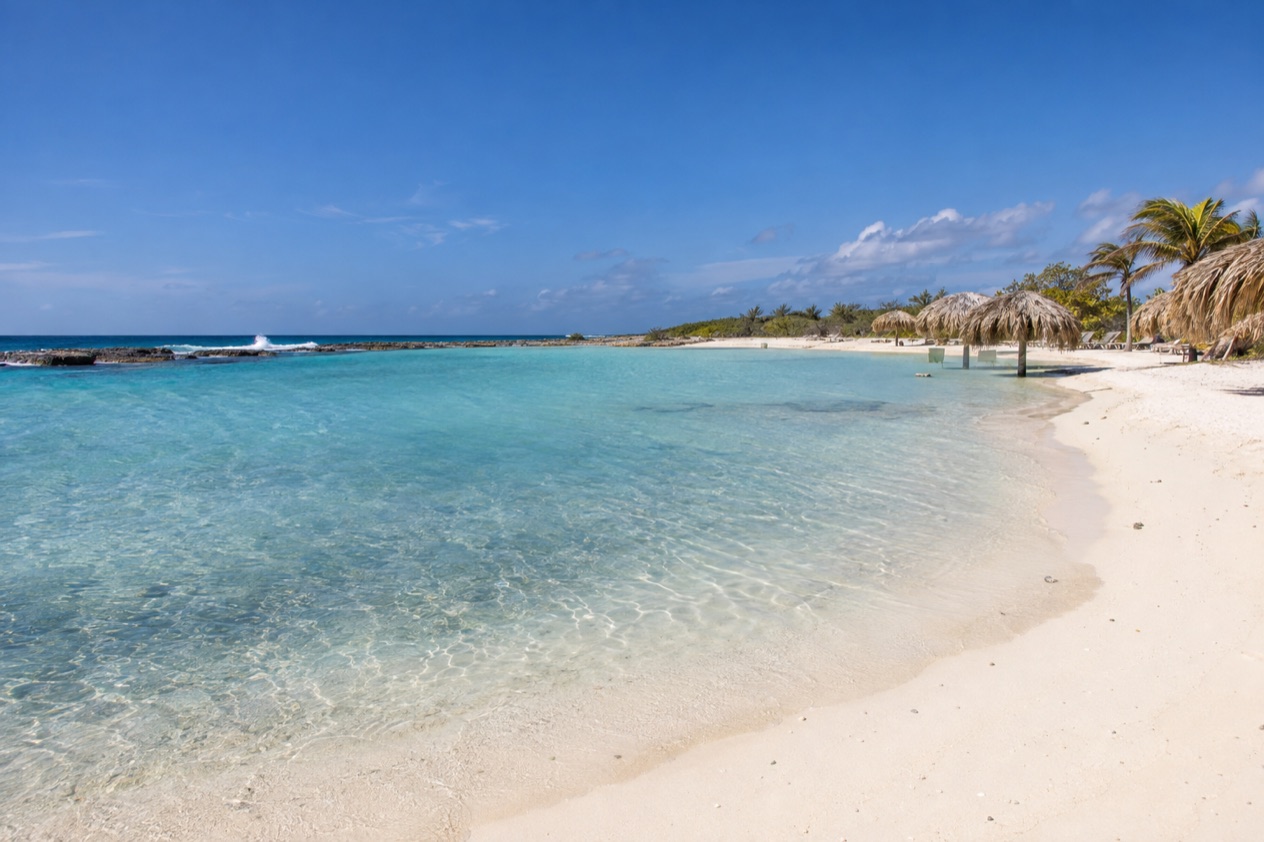
The first thing you notice at Baby Beach is how far out the swimmers stand, waist-deep and still chatting, with small children paddling in a bay that looks more like a big turquoise pool than an open sea. Colorful huts throw patches of shade on the sand, the smell of grilled meat drifts from the stands, and the pace is that of a long family afternoon. This is the southern tip of Aruba near San Nicolas, a day at the water for families and anyone who likes to wade in without hurry.
Is visiting Baby Beach worth it?
Yes, especially if you travel with small children or simply like shallow water you can walk into for a long way. The beach is described as ideal for families with small kids, and the shallow bay lets swimmers wade far from shore and still touch the bottom. That gentle slope is the whole point of the place, and it is what gave the beach its name.
What sets it apart from the resort strips on the other side of the island is the setting and the rhythm. The southern end of Aruba is far from the high-rise hotels, and the day here feels closer to a neighborhood outing than a resort afternoon. The bay opens toward the ocean at one end, which adds a snorkeling spot to a beach otherwise made for wading.
The trip is also part of the appeal. From the Palm Beach hotels it is about a 45-minute drive, which turns the beach into a proper outing with a plan: a swim, a grilled lunch, a snorkel, then a look at the neighboring cove.
If your ideal vacation day involves long hours at the same stretch of sand and a meal within walking distance, it is well worth the ride. If you prefer a beach with a long boardwalk and a row of beach bars, the northwest coast is a different experience entirely.
Some history sits behind the scenery. San Nicolas grew around the oil refinery that shaped southern Aruba for decades, and the quiet bays at this end of the island were part of that company-town life. Today the refinery era is a backdrop, and the bay is simply where local families and visitors come to swim.
What to see at Baby Beach
The shallow bay
The bay is the main attraction, and it asks for nothing but a pair of feet. Water stays shallow so far out that adults and children can wade a long distance and still touch the sea bottom. Watch the bathers spread across the bay, parents standing guard with a hand on a floating toy, and teenagers walking out until they are small dots on the turquoise.
Children are the stars here, as the name suggests. Look for sandcastle builders at the water’s edge and the huts lined along the shore, where families set up with coolers and towels for the day. Complimentary huts are provided for sun protection, so you can step out of the sun without paying for shade.
Snorkeling where the bay meets the ocean
At the point where the bay opens out to the ocean, Baby Beach offers snorkeling. This is the part of the visit where the water changes character, since you leave the sheltered shallows and look down on rocks and the small fish that gather around them. Stay within the marked snorkel area, which is the safety rule for visitors here.
Gear can be rented on the beach for a fee, and a local dive shop nearby rents snorkel and dive gear too. That makes the snorkel a spur-of-the-moment decision: you can decide after a morning of wading that you want to see what lies beyond the shallows. Bring a snorkel-minded friend if you can, because the view is best shared.
The food stands and Big Mama’s Grill
Lunch is part of the sight. A refreshment stand serves hamburgers and hotdogs, the simple food of a beach day, and Big Mama’s Grill offers BBQ and seafood platters for a longer, sit-down meal. The smell of the grill carries across the sand and often decides the hour at which families leave the water.
Order a platter, find a table in the shade and watch the bay while you eat. It is the kind of meal that stretches out, with cold drinks, a plate of seafood and children running back to the water between bites. Places to eat and drink, a public bathroom and public transport round out what the beach provides.
Rodger’s Beach next door
Rodger’s Beach lies about a minute’s drive from Baby Beach, a narrow strip of powdery white sand on a bay with clear, calm water protected for swimming. Fishermen anchor their colorful boats here, which gives the cove an authentic, working feel that the family beach next door lacks. The boats make the best photographs of the day.
During the week the beach is very quiet and suits reading or a slow swim. On weekends it is often filled with local families, so the mood changes completely between a Tuesday and a Sunday. Next to it a local dive shop rents snorkel and dive gear and has a shower and a restaurant, handy for rinsing off before the drive back.
Hours, tickets and rules
Baby Beach is a public beach with a public bathroom, places to eat and drink, and public transport. What you pay for is what you choose to add: beach beds, windscreens and snorkel gear are available for a rental fee, while the huts that give shade are complimentary. The meals at the refreshment stand and at Big Mama’s Grill are the other cost of the day.
The rules that matter are few and simple. Snorkelers should stay within the marked snorkel area where the bay opens out to the ocean, and this is the one safety instruction the beach gives. Beach attire should only be worn on the beaches or by the pool, so pack a cover-up and a shirt for the stop at a restaurant or shop on the way home.
Sunscreen is the other rule. Aruba has banned sunscreens containing oxybenzone since 2019, and visitors are encouraged to use mineral-based reef-safe sunscreens, which are more likely to be biodegradable and gentler on the environment. Sunscreen can be bought on the island from local companies such as Aruba Aloe and Arubalife Organics, so you can pick some up if your bottle at home does not qualify.
How to get to Baby Beach
Baby Beach is in the southern part of Aruba, close to San Nicolas, and the drive from the Palm Beach hotels takes about 45 minutes. That is the only travel time to plan around, and it is long enough that most people treat the beach as a full outing rather than a quick stop. Public transport is listed among the amenities of the beach, so a ride without driving is part of the picture.
If you drive yourself, a few local road habits help. There are no turns on red in Aruba, which surprises many U.S. drivers, and at intersections without road signs traffic from the right has the right of way. Keep both in mind on the roads that lead south toward San Nicolas, where junctions can come without much warning.
The road south is a pleasure of its own. As you leave the hotel area the scenery turns drier and more open, with cactus and low scrub, and the sense of distance from the resort strip grows with every mile. Plan the outing as a day, with the beach as the center and Rodger’s Beach, a snorkel or a seafood platter around it.
Once you arrive, everything is gathered close together. The bay, the refreshment stand, Big Mama’s Grill and the public bathroom are all part of the same stretch, and Rodger’s Beach is only a minute’s drive away. After a morning of wading, moving between the two coves is a small errand, and the dive shop next to Rodger’s Beach is there if you forgot your gear.
When to visit Baby Beach
The best time to visit Aruba in general runs from February to August, and that is a good guide for a beach day too. Peak season on the island falls from December to April, which is when hotels are at their busiest, so a trip to the southern end in those months overlaps with the island’s high season. The months from May to August fall outside that peak while still sitting in the good stretch.
Time of day matters more than month for comfort. Morning gives soft light on the water and the best chance to wade out before the sun climbs, while the hours around midday are when the huts and the shade of the grill earn their keep. Late afternoon turns the bay gold, and it is the nicest hour to linger over a drink after the day’s swimming.
The day of the week changes the mood at the neighboring cove. Rodger’s Beach is very quiet during the week and is often filled with local families on weekends, so choose a weekday for reading and a slow swim, and a weekend if you enjoy a lively, local atmosphere. A visit that combines Baby Beach and Rodger’s Beach can lean one way or the other depending on the day.
If your dates are fixed, do not worry about the season too much. The bay, the snorkel area and the grill are there whatever the month, and the shallow water is the same in February as in August. Choose the hours rather than the month, and pack for sun in all of them.
Tips for your visit
Pack for a full day. A hat, a rash shirt or cover-up and a mineral-based reef-safe sunscreen cover the sun, and a towel and a change of clothes are useful because beach attire belongs on the beach. Running water in Aruba is safe to drink, locally called sweet water, so a refillable bottle from the hotel saves a trip to the stand.
Plan on most of a day, since the pleasure here is in staying put. A morning in the shallows, a lunch of BBQ or seafood at Big Mama’s Grill and an afternoon snorkel at the opening of the bay make a natural rhythm. Rent a beach bed or a windscreen if you want comfort, or settle under one of the complimentary huts.
For combining, Rodger’s Beach is the obvious partner, a minute’s drive away, with its fishing boats, powdery sand and clear water. The dive shop beside it rents snorkel and dive gear and has a shower and a restaurant, a good place to end the day. Neither stop needs a plan, only a little time.
Families are the beach’s natural audience. Small children can splash in shallow water while adults stay within reach, and the food and bathroom are close by, so the logistics are simple. For snorkelers, stay inside the marked area where the bay opens out to the ocean, and keep the shallow bay for the youngest swimmers.
Good to know before you go
The U.S. State Department rates Aruba Level 1, ‘Exercise normal precautions,’ and says Aruba is generally a safe destination for travelers, with petty crime the main concern in popular tourist areas.
Bring cash and cards for the rentals and the meals, and keep a bag with your valuables close, since petty crime is the main concern in popular tourist areas. Put a cover-up in your bag for the stop on the way home, because beach attire stays on the beaches. Sunscreen should be reef-safe and free of oxybenzone, and it is sold on the island if you need it.
Sources
- Aruba Tourism Authority, Baby Beach (https://www.aruba.com/us/explore/baby-beach), checked October 9, 2026
- Aruba Tourism Authority, Rodgers Beach (https://www.aruba.com/us/explore/rodgers-beach), checked October 9, 2026
- Wikivoyage, Aruba (travel guide) (https://en.wikivoyage.org/wiki/Aruba), checked October 9, 2026
- Aruba Tourism Authority, Best time to visit (https://www.aruba.com/us/our-island/one-happy-island/when-is-the-best-time-to-visit-aruba), checked October 9, 2026
- Aruba Tourism Authority blog, Responsible guest (https://www.aruba.com/us/blog/how-to-be-a-responsible-guest-protecting-arubas-beaches-and-marine-life), checked October 9, 2026
- U.S. Department of State, Aruba Travel Advisory, Level 1, issued August 19, 2026 (https://travel.state.gov/content/tsg_aem/us/en/home/international-travel/travel-advisories/destination.abw.html), checked October 9, 2026
To plan your stay
- Best Time to Visit Aruba: Weather by Month, Peak Season and Festivals
- Where to Stay in Aruba: Palm Beach, Eagle Beach, Oranjestad and All-Inclusives
- Aruba Airport (AUA): Arrival, Getting to Your Hotel, U.S. Preclearance and Departure
- Know Before You Go to Aruba: Entry Forms, Money, Water and Local Customs