
FLORIDA · WITH KIDS · 27.7° N
The Florida moment nobody packs for happens in a rental car parking lot, bags loaded, a seven-year-old waiting by the door. At home the booster stays in the car until third grade. In Florida the state stopped requiring one on that child’s sixth birthday, and the counter you just walked away from applies Florida law, not the one you drive under all year.
That gap sets the tone. Florida is generous to children in ways first-time families rarely expect: beaches that are free and staffed by lifeguards, a national park priced by the vehicle, forts that wave anyone under sixteen straight through. What it asks for in return is attention in two places, the water and the calendar, and it puts neither of them on a sign.
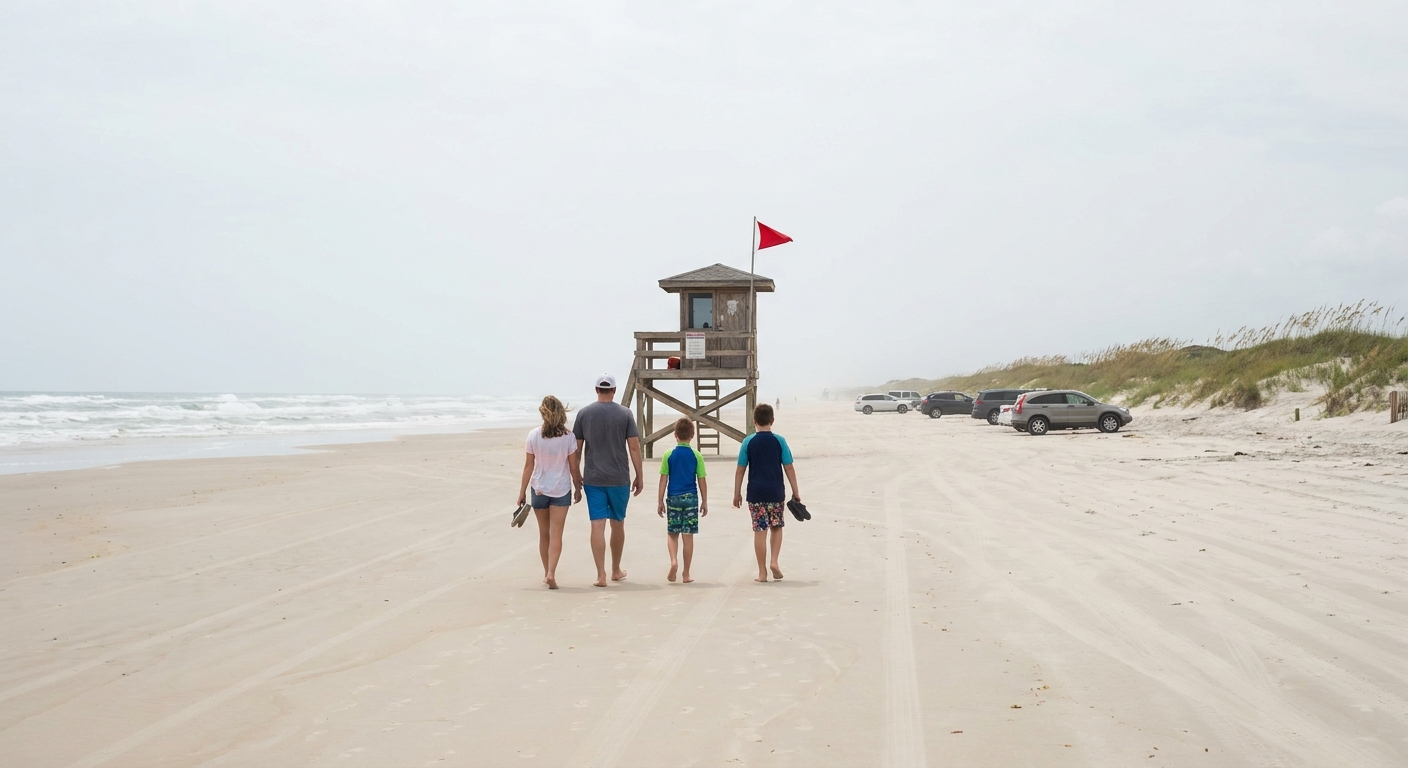
FLORIDA WITH KIDS · THE FAMILY BRIEF
Learn the flag colors and the rip current rule before the first swim, keep the booster you would use at home, and Florida becomes one of the easiest warm-weather trips in the country with children.
DRY SEASON: NOV–APR · CAR SEAT LAW ENDS AT AGE 6 · SEAT BELT UNDER 18 IN EVERY SEAT
Go for: free lifeguarded beaches, alligators seen from a boardwalk railing, forts and museums that cost a child $5 or nothing, and a wildlife park you enter by the carload.
Think twice before: booking the Dry Tortugas ferry or driving Miami to Key West and back in a day with young children. Both are all-day commitments with no early exit.
Statutes: Florida Legislature · Water: National Weather Service Miami · Wildlife: FWC · Fees: NPS · full sources at the end
On this page
- Car seat rules for a 7-year-old in FloridaThe booster requirement ends at 6
- What the beach flag colors meanFive flags, and the purple one
- Free beaches with lifeguards and restroomsLummus Park and South Pointe
- Swimming where alligators liveDesignated areas, daylight only
- Children’s admission prices$5 at Vizcaya, free at the Castillo under 16
- Florida with a toddler, or with a teenagerWhat each age can carry
- Best months for a family tripNovember to April, plus the summer hours
- The two longest days in the stateThe Dry Tortugas ferry and the Keys drive
One Florida is missing from all of that. We hold no checked figure on Disney, Universal or SeaWorld, so that trip gets planned somewhere with real numbers behind it. Everything below is the rest of the state, starting in the rental car parking lot and ending with a summer schedule that works.
Florida car seat laws: the booster requirement ends at age 6
| Child’s age | What Florida law requires | Statute |
|---|---|---|
| Through age 3 | Separate carrier, or the manufacturer’s integrated child seat | s. 316.613(1)(a) |
| 4 through 5 | Carrier, integrated seat or booster | s. 316.613(1)(a) |
| 6 through 17 | Safety belt, in every seat of the car | s. 316.614(4)(a) |
Florida Statutes s. 316.613(1)(a) is short about it. Every operator transporting a child aged 5 years or younger must provide protection by properly using a crash-tested, federally approved child restraint device. For children aged through 3 years, that device has to be a separate carrier or a vehicle manufacturer’s integrated child seat. For children aged 4 through 5, a carrier, an integrated seat or a child booster seat all satisfy the statute.
The booster requirement therefore ends on the sixth birthday. That floor sits lower than the one many American parents carry in their heads, since a good number of states hold a booster until age 8 or until a child reaches 4 ft 9 in. We have not compared the fifty states one by one, so treat that as a caution rather than a scoreboard. Fit decides safety anyway: a belt across the collarbone and low on the hips, not a birthday.
The belt rule reaches further than the seat rule. Under s. 316.614(4)(a), it is unlawful to operate a motor vehicle unless each passenger and the operator under the age of 18 is restrained by a safety belt or by a child restraint device. Every seat counts, back row included, on the fifteen-minute run to the beach with three cousins in the car.
All of which turns into one sentence worth rehearsing before you reach the counter: does this car come with a booster for a six-year-old, and what model is it? Reserving a seat and receiving one are two different events on a busy morning at the airport. Families who travel with their own seat skip the negotiation and know the history of the harness their child is sitting in.
Florida beaches with kids: reading the flags and spotting a rip current
| Flag | What it means |
|---|---|
| Double red | Water closed to the public |
| Red | High hazard |
| Yellow | Medium hazard |
| Green | Low hazard, exercise caution |
| Purple | Dangerous marine life, flown alongside another flag |
Five colors, and the fifth behaves differently. Purple does not replace the flag beside it, it joins it: green and purple together mean calm water with something in it worth avoiding. Double red is not a strong suggestion, it means the water is closed to the public. Children learn the set in about a minute, and a child who can name the flag will point at it before you do.
Now the trap. No law compels a Florida beach to fly any flag at all, and the absence of flags does not assure safe water. An empty pole tells you nothing about the surf, only that nobody was assigned to raise anything that morning. Plenty of the prettiest stretches on the Gulf and the Atlantic have no pole, no guard and no bulletin, and they can still have a rip running.
A rip current is a narrow channel of water flowing away from shore, usually 10 to 30 yards wide. Narrow is the operative word, because it is what makes the escape possible. The National Weather Service advice runs word for word: swim parallel to the shore, or float beyond the breakers and then swim in. Say that sentence to your children in the parking lot, before anyone touches the water, not after.
It deserves that priority. Since 1979, rip currents have claimed more lives in South Florida than any other weather-related hazard combined, hurricanes, tornadoes and lightning included. Families arrive braced for the storm season and the wildlife, and the quiet green-flag afternoon is the one that carries the statistic.
On an unfamiliar beach the routine takes two minutes. Find the pole and the lifeguard stand first, then set the towels where the stand stays visible from the water. Ask the guard where the current is running that morning, since they track it hour by hour. Then repeat the parallel rule out loud, and agree on a swimming limit that a parent can see from a sitting position.
Which Florida beaches are free, and where the dry sand is private
Lummus Park, the strip fronting Ocean Drive between 5th and 15th Streets in South Beach, is free and open 24 hours, with lifeguards on duty, public restrooms and picnic tables. For a family day, that covers the whole list. South Pointe Park is also free to enter, though its lot starts at $2 an hour and charges a $20 flat day rate at weekends and on public holidays. The Miami Beach trolley runs free from 8 a.m. to 11 p.m. on five routes, which is how families in Miami avoid the lot entirely.
Access has a line drawn through it. Florida Statutes s. 163.035(2) prevents a local government from adopting or keeping a customary use rule over any portion of a beach above the mean high-water line without a judicial declaration. Wet sand below that line stays public. Dry sand above it can belong to the property behind it. For a family setting up an umbrella, a cooler and a shade tent, the difference is real: the public strip is the one the tide keeps taking back. On the beaches named above the question never arises.
Alligator safety with kids in Florida: FWC rules and swimming
Alligators are found in all 67 Florida counties, which includes the retention pond behind a supermarket and the lake at the end of a rental street. FWC gives four instructions and they are short: never feed an alligator, keep your distance, keep pets on a leash and away from the water, and swim only in designated swimming areas during daylight hours. That last clause is written for children. Dusk at an unmarked lake edge is the combination to decline, however still the water looks.
For an animal somewhere it should not be, the nuisance hotline is 866-FWC-GATOR, 866-392-4286. At a golf pond or a canal bank the practical version is a fixed distance and three rules a child can repeat back: no wading, no food thrown in, no going after the ball. Boardwalks do the viewing better in any case, and the Anhinga Trail in the Everglades puts alligators a few feet below a railing. Our safety guide covers the rest of the state’s wildlife.
Florida kids’ admission prices: museums, forts and state parks
| Place | Children | Adults |
|---|---|---|
| Vizcaya, Miami | $5 for ages 6 to 12 · free under 6 | $20 during restoration |
| Ernest Hemingway Home, Key West | $7 · free under 6 | $19 |
| Castillo de San Marcos, St. Augustine | Free, 15 and under | $15, 16 and over |
| Fort Zachary Taylor, Key West | $2.50 on foot or by bicycle | $6.00 per vehicle, up to eight people |
| Everglades National Park | Covered by the vehicle fee | $35.00 per private vehicle, 7 days |
Read down the child column and Florida looks cheap for families. Vizcaya asks $5 for ages 6 to 12 and nothing under 6. The Hemingway Home in Key West charges $7 for children and nothing under 6, against $19 for an adult. Castillo de San Marcos admits anyone 15 and under free, so a family of four with two school-age children pays two adult tickets at $15 and walks in.
The Everglades applies the same logic at a larger scale. Entry is $35.00 per private vehicle, valid seven consecutive days, a per-vehicle fee rather than a per-person one, so a family of five pays exactly what a couple pays. Individual entry on foot or by bicycle is $20.00, making the car the cheaper door for any group. Seven days covers the Anhinga Trail and the Shark Valley loop on separate mornings without a second payment.
Two kinds of prices stay unquoted. We hold no checked figure for Disney, Universal or SeaWorld, not a ticket, not an opening hour, not a height rule, and a park day planned on guesswork goes badly. The child fare on the Dry Tortugas ferry, the cost of a rental car seat and family hotel rates fall in the same unverified bucket. Everything in the table above came off the operator’s own page in September 2026, and the cost guide handles the wider budget.
Florida with toddlers, school-age kids and teenagers
With a toddler, the free layer of the state carries most of the day. The Metromover costs nothing and takes a stroller through Downtown Miami and Brickell. The beach trolley runs free until 11 p.m. Shark Valley’s guided tram covers the whole loop without a mile of walking. What collapses instead: long museum afternoons, anything outdoors between noon and four in summer, and any plan that depends on a nap happening in a moving car seat.
At seven the day turns on distance rather than attention span. Shark Valley is a 15-mile paved loop, and a child riding it meets the observation tower at the halfway point with the entire return still to come. A boardwalk, an hour on a fort’s ramparts and a lifeguarded afternoon suit that age better than a three-hour drive. In peak season, December through April, the park advises arriving before 10 a.m. or after 3 p.m., and the early slot is also the cooler one.
Teenagers reopen the closed days. The Dry Tortugas crossing turns into the best day of the trip, snorkeling gear included in the fare. The full bike loop becomes reachable in one morning. So does the Overseas Highway with a passenger counting mile markers down from 126, and Key West after dark, once bedtime stops writing the schedule. The things-to-do guide has more of that register.
The Dry Tortugas ferry with kids, and the 155-mile drive to Key West
The Yankee Freedom III leaves Key West daily at 8 a.m., check-in before 7:30, for the 70-mile crossing to Dry Tortugas. The 2026 adult fare is about $250 and includes park entry, snorkeling gear, breakfast and lunch. One crossing goes out and the same hull brings everyone back, so the day has no shorter version. A child who has had enough by one o’clock still has Fort Jefferson and a sea passage ahead.
The drive down has the same character in slow motion. Counted from Miami, the run is roughly 155 miles and close to four hours without stopping, six to eight once you stop for anything at all. Split over two days it becomes a pleasure: a night in the middle Keys, a swim at a state park, the last stretch in the morning. Our road trip guide does the same arithmetic over a longer route.
There is no safe place to pull over on the Seven Mile Bridge, and that is exactly where children ask to stop. The substitute waits at the Marathon end, where a restored two-mile span of the old bridge is open to walkers and cyclists with a car park at its foot. Same water, same horizon, and somewhere to put your feet on the ground.
Both days share one trait: once begun, they cannot be cut short. Anything with a single departure, a single return and nothing in between belongs early in the trip, when everyone still has reserves, and never on the morning after a late flight. Apply the rule to any boat tour with a fixed return time and the family calendar mostly writes itself.
Best months for a Florida family trip, and best time of day in summer
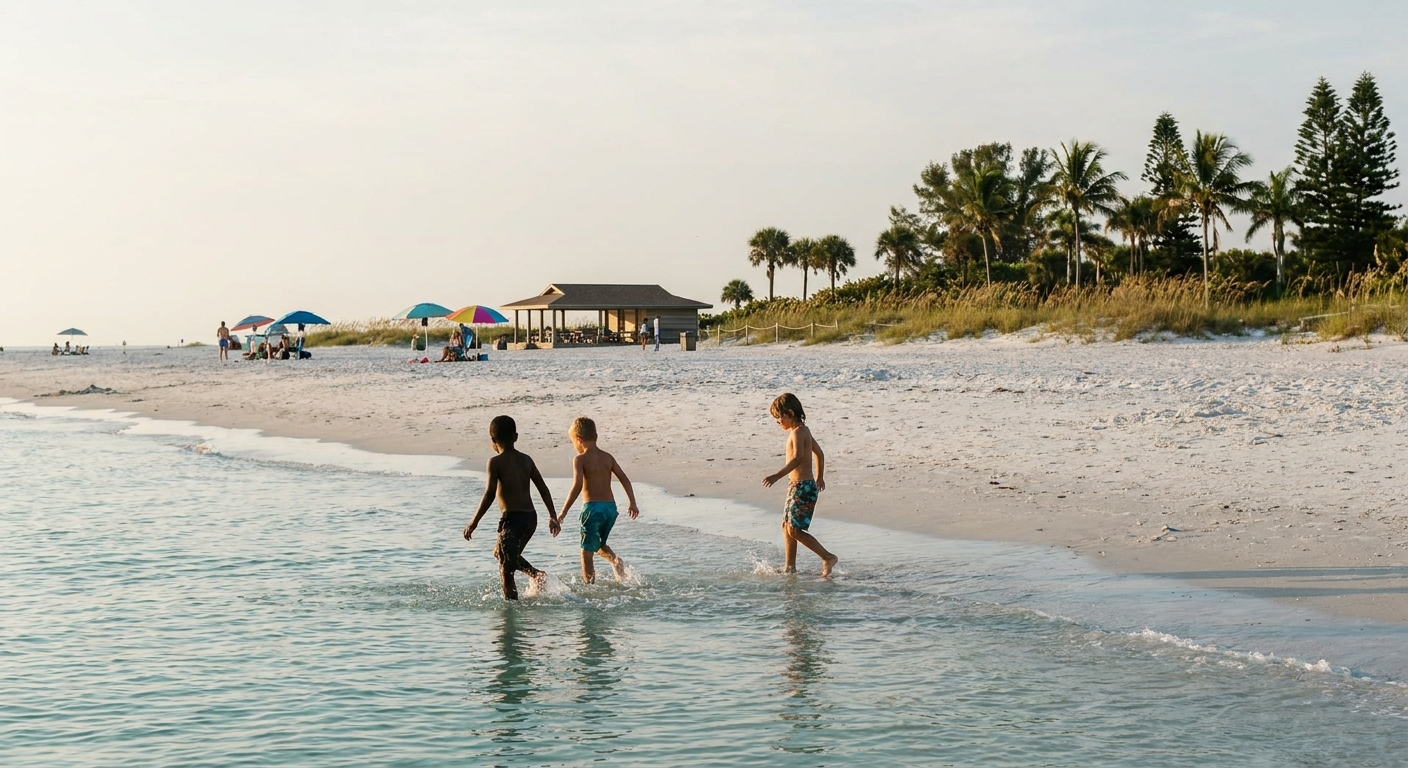
The dry season runs November through April, roughly 65°F to 80°F, and it earns its reputation with families: outdoor plans hold, wildlife concentrates around what water is left, evenings need no jacket. Hurricane season is June 1 to November 30, peaking on September 10, with most activity between mid-August and mid-October. Room rates trace the mirror image, lowest August to October and highest February to April. The month-by-month verdict takes it further.
Summer is not closed, it is differently timed. Highs in South Florida sit near 90°F with humidity between 85 and 90 percent, and the afternoon thunderstorm arrives with enough regularity that families build around it instead of hoping. Lightning clears a beach and a pool at the same moment, and the wait is nobody’s to negotiate. The heat index, not the thermometer, is what a four-year-old feels.
A summer day that works gives the middle away. Out by seven for the beach or a boardwalk, into shade and water by eleven, indoors through the early afternoon while the storm does its business, back outside around four or five when the sand cools and the light softens. Floridians have run that schedule for generations. It turns the hardest month of the year into an ordinary one.
The last word
The decisions that matter here all get made before anyone is wet: the flag colors learned in the parking lot, the parallel rule said out loud, the booster kept even though the statute stops asking at six. The rest is easier than most parents expect. A single Metrobus or Metrorail ride costs $2.25 with fares capped at $5.65 a day, route 150 from the airport carries luggage racks, and the beach trolley costs nothing at all. Florida hands families a great deal for free. It just leaves the water rules to you.
Sources & data for this guide
- Child restraint devices, ages and permitted equipment · Florida Statutes s. 316.613 · checked Sep 8, 2026
- Safety belt requirement for every passenger under 18 · Florida Statutes s. 316.614(4)(a) · checked Sep 8, 2026
- Beach warning flags, purple flown alongside, no duty to fly any · Florida Statutes s. 380.276 and Volusia County Beach Safety · checked Sep 8, 2026
- Rip current width, escape advice and the South Florida fatality ranking since 1979 · National Weather Service, Miami office · checked Sep 8, 2026
- Alligators in all 67 counties, the four rules and the nuisance hotline · Florida Fish and Wildlife Conservation Commission · checked Sep 8, 2026
- Lummus Park and South Pointe Park access, lifeguards and parking rates · City of Miami Beach · checked Sep 8, 2026
- Mean high-water line and customary use · Florida Statutes s. 163.035 · checked Sep 8, 2026
- Children’s and adult admission · Vizcaya, Ernest Hemingway Home, NPS Castillo de San Marcos, Florida State Parks · checked Sep 6 and 7, 2026
- Everglades entrance fees, Shark Valley loop and peak-season arrival advice · NPS Everglades · checked Sep 7 and 8, 2026
- Dry Tortugas ferry schedule and 2026 adult fare · Yankee Freedom and NPS Dry Tortugas · checked Sep 8, 2026. The child fare is not verified and is not quoted here.
- Overseas Highway distances, mile markers and the old bridge walkway · Florida Keys · checked Sep 8, 2026
- Free Metromover and trolley service, fares and daily fare cap · Miami-Dade Transit and City of Miami Beach · checked Sep 8, 2026
- We hold no verified figure on theme parks, rental car seat charges or family hotel rates, and this guide states none. Hours and prices change · check operators when you book.