
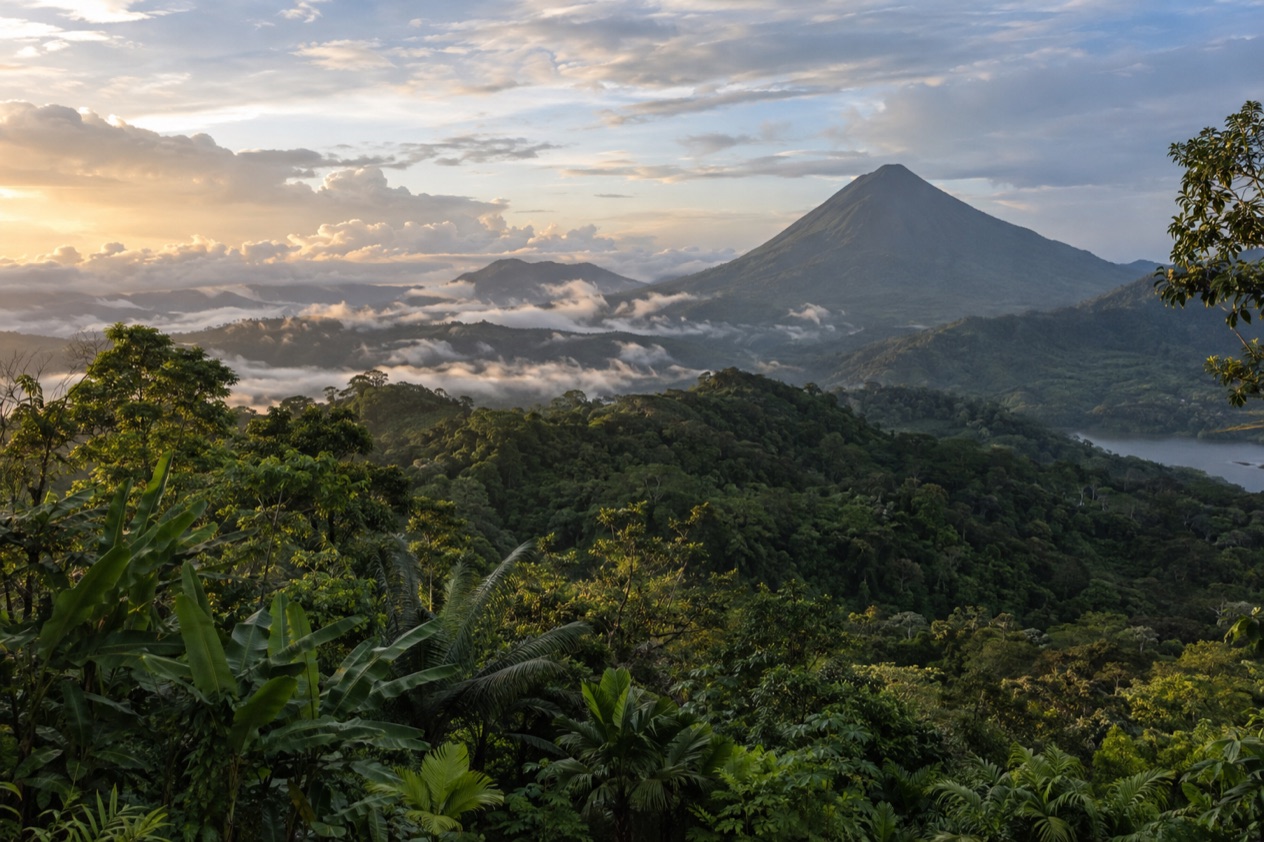
Somewhere on the second afternoon, you are floating in a warm river below the Arenal cone while the clouds slide down its flank and the first rain taps the leaves overhead. A few days later the same trip has you walking under dripping ferns in a cloud forest, then sharing a beach path with a troop of capuchin monkeys. This route links three of the country’s best-loved landscapes, a volcano town, a misty mountain and a Pacific park, for first-time visitors with one week.
Is 7 Days enough for Costa Rica?
Yes, one week is enough for a first taste of Costa Rica, as long as you accept that you are choosing a few places and not the whole country. The route here suits couples, friends and families who want volcano views, forest walks, wildlife and a beach, without a different bed every night. It is built around one arrival airport, San Jose, and a loop that never doubles back more than it must.
What you get is a good cross-section. The northern lowlands bring hot springs, waterfalls and the Arenal Volcano. The Tilarán mountains bring a cloud forest, hanging bridges and night walks.
The central Pacific coast brings white-sand coves, a small national park crowded with monkeys and sloths, and the unhurried rhythm of a beach town. Between them lie long drives on winding roads, which is why the days are grouped in pairs and not spread thin.
What the week leaves out is just as important. The Caribbean side, with Puerto Viejo and its reggae, bicycles and Afro-Caribbean cooking, and the canals of Tortuguero, needs its own days, since the Caribbean follows a different weather pattern from the Pacific and the trip there takes most of a day.
Vacations in the Nicoya Peninsula’s surf towns, including Tamarindo, Samara, Nosara and Santa Teresa, take a different shape, centered on waves, yoga and sunsets. The remote rainforest of Corcovado on the Osa Peninsula and the multi-day climb of Cerro Chirripo are further trips still.
If you land in Liberia instead of San Jose, the Guanacaste beaches become the natural base and the loop below changes shape, as the last section explains. For most first visits, though, San Jose is the simplest start and finish, because its airport sits next to the capital and the main roads fan out from the Central Valley.
A final word on pace. Costa Rican roads are slower than the map suggests, and rain can make them slower still. Treat each travel day as half a day of sightseeing at most, and the week will feel generous instead of rushed.
The itinerary stage by stage
Days one and two: San Jose to La Fortuna and Arenal
Pick up your transfer or rental car at the airport and head north the same day. The drive to La Fortuna, a little town nestled below Arenal Volcano, takes roughly three hours.
For most travelers who make it by late lunch, a casado is the welcome, and rice, beans, plantain, salad plus chicken, fish or beef on one plate is the everyday meal across the country. Many people then settle into a hot spring, where the water runs warm after a long day of travel.
The full second day belongs to the volcano.
Mornings are the best chance of a clear cone and a look at Lake Arenal, because the clouds often cover the summit by midday. Afternoons suit the waterfall, the hanging bridges or the lake.
Sleep in or just outside La Fortuna, in a small hotel or lodge with a view of the cone if you can find one. The town has plenty of sodas (small family restaurants) and a leafy central park where evenings are social. Plan to leave after breakfast on the third day, since the next move is a long one.
Days three and four: Monteverde Cloud Forest
From La Fortuna you can drive the road around Lake Arenal, or take the boat-and-van transfer across the lake, which takes about the same time. The road ends on a steep, partly unpaved stretch up into the Tilarán mountains, so allow for slow going.
Monteverde, the payoff, sits by the town of Santa Elena, where cooler air often turns misty and dense forest teems with ferns, orchids and mosses. Bring a light rain jacket and a warm layer, since this is a different climate from the lowlands you just left.
Day four is for the forest itself. Within the Monteverde Cloud Forest Reserve, a foggy highland woodland thrives, home to abundant epiphytes and hummingbirds plus the resplendent quetzal, the bird visitors hope a guide will help them find at dawn. Once you leave the reserve trails, hanging bridges offer a way across the canopy, or you can zip-line above the treetops, so make your choice based on whether your group would rather walk in quiet or go for an adrenaline rush.
When darkness settles in, local guides take you walking to look for frogs, insects and birds that are resting. These are chances, not promises, but a good guide with a flashlight can find astonishing things on a single branch. Sleep in Santa Elena or in one of the lodges tucked into the hillsides, and have coffee grown on these slopes before you set off.
Days five to seven: Manuel Antonio and the Pacific
Day five is mostly the move south. From Monteverde, drive down to the Pacific coast and continue south to Manuel Antonio.
On the central Pacific coast, tucked among hills and beaches and just below the town of Quepos, Manuel Antonio surrounds one of the country’s most visited national parks. Arrive by late afternoon, find a hillside hotel with an ocean view and watch the light turn orange over the water.
Day six is for the park. In Manuel Antonio National Park, a compact preserve, wooded paths and coves of white sand let you spot monkeys and sloths frequently near the trails.
It is common to spot white-faced capuchins, squirrel monkeys, iguanas and raccoons in and around it, and guests are requested not to feed them. Walk the trails in the cooler morning, then spend the afternoon on a cove beach. Check local swimming conditions that day and stay close enough to your kids to reach them in an instant.
The last day is a morning on the beach or a slow breakfast with the monkeys passing the terrace, followed by the drive back to San Jose and its airport, about three to three and a half hours. If your flight leaves in the afternoon, sleep near the airport the night before or leave early, because traffic and rain can stretch the drive.
Getting between stops
| Leg | How | Time |
|---|---|---|
| San Jose airport area to La Fortuna | Road | About 3 hours |
| La Fortuna to Monteverde | Road around the lake | About 3 to 4 hours |
| La Fortuna to Monteverde | Boat and van across Lake Arenal | About 3 to 4 hours |
| Monteverde to San Jose | Road | About 3.5 to 4.5 hours |
| San Jose to Manuel Antonio | Road | About 3 to 3.5 hours |
| Jaco to Manuel Antonio | Road | About 2 hours |
| San Jose to Jaco | Road | About 1.5 to 2 hours |
A rental car gives the most freedom on this route, and shared shuttles and private transfers cover the same legs if you prefer not to drive. The times above are rough, and they grow in traffic or rain. During the green season, certain roads may be closed by landslides, and some beaches and rural spots can only be reached with a four-wheel-drive vehicle, so before you head out, ask your lodging about road conditions.
If you drive, plan to stay off rural roads after dark, and keep your eyes open at intersections, where vegetation or other obstacles can block the view. That is one more reason to leave each morning after breakfast and arrive well before evening. The long Monteverde leg, with its steep and partly unpaved last stretch, is the one to start earliest.
The two international gateways are Juan Santamaria (SJO), near San Jose, and Daniel Oduber Quiros (LIR), at Liberia in the northwest. For this route SJO is the one to use, and an open-jaw ticket is not needed since the loop returns to the capital.
What to book before your 7 Days in Costa Rica
Book the lodging first, above all in Monteverde and Manuel Antonio, where the best small hotels are few and fill with travelers on the same loop. Fix the nights and the order of the stops, and keep the activities loose until you see the weather. Rain in the green season usually comes in the afternoon, so tours that depend on views are best placed in the morning.
Next come the experiences that rely on a guide. In Monteverde, the early-morning search for the resplendent quetzal and the guided night walk both go with a guide, and many travelers like one for the day walk too, since a trained eye finds the sloths, hummingbirds and epiphytes you would pass. Hanging bridges and zip-lines run as organized outings. Ask your lodge to arrange them once your dates are set.
For each park and reserve, check the official booking page before you go and reserve entry in advance whenever required. Check the same things before visiting any volcano, since access rules differ from one volcano to the next and clouds usually cover the summit by midday. Do not plan the trip around seeing a crater or a summit.
Leave some things open on purpose. A free afternoon in La Fortuna lets you swap a hot spring for a waterfall if the weather turns. A flexible morning in Manuel Antonio lets you choose between the park, a quiet beach and a boat outing. And leave the last evening empty so a late road or a flight change does not break the plan.
Before booking flights, check the entry basics. Check that your passport remains valid for the whole trip, and bring along a return ticket or evidence that you will continue on to another country. Proof of yellow fever vaccination is required for travelers arriving from certain countries in South America or Africa.
Adapting the route
Seasons shape the week more than anything else. Around the Pacific side and the Central Valley, things remain largely dry from about December through April, and then a lush, wet stretch arrives around May to November, with rain usually falling in the afternoon.
In the dry months the beaches are at their sunniest and Manuel Antonio is busier. In the green months the forest is lush, mornings are the best time for views, and landslides can block some roads.
A shorter trip
With fewer days, drop Monteverde and keep La Fortuna and Manuel Antonio, or choose just one base. The central Pacific coast near the capital is the simplest short stay.
Jaco, a lively beach town with a long dark-sand beach, is close to San Jose, and its beach break works for beginners as well as experienced surfers, making it a classic first surf stop. The scarlet macaws of Carara National Park, which sits close to the Tarcoles River, draw birders because these birds frequently take flight at first light and at day’s end.
From Jaco, Manuel Antonio is an easy continuation down the coast. This pairing leaves out the mountains but keeps the monkeys, the sunsets and a surf lesson, with much less time on the road.
A longer or different trip
With extra days, add Uvita below Manuel Antonio, which is about an hour from it. Here you’ll find the gateway to Marino Ballena National Park, where the beach forms a whale tail shaped sandbar when the tide goes out. Between about December and April, and then again between about July and October, humpback whales come to this coast, so on a boat trip you might see them during either stretch.
If you would rather head to the Caribbean, trade the Pacific portion for Puerto Viejo de Talamanca, an easygoing town whose beaches include Playa Cocles and Punta Uva, or for Tortuguero, which you can get to only by boat or small plane. Green sea turtles nest there mainly from about July to October, and the night walks are done with a licensed guide. The Caribbean side gets rain all year, so pack accordingly.
Families and a slower pace
Families with young children can slow the pace by choosing two bases instead of three. Keep children within arm’s reach on any beach. If you want calmer conditions, Samara, which lies on the Nicoya Peninsula, rests along a broad curving bay shielded by an offshore island and a reef, and its mellow surf draws families and people trying surfing for the first time.
For a slower trip, choose two bases instead of three, such as La Fortuna and a Pacific beach, and let the days be long breakfasts, a hot spring and one guided outing. If you land in Liberia, Tamarindo, about an hour from the airport, offers surf lessons and a lively main street, and the surf and yoga towns of Nosara and Santa Teresa suit travelers who want a barefoot week by the sea.
Good to know before you go
The U.S. State Department rates Costa Rica Level 2, ‘Exercise increased caution,’ due to crime; it says petty crime is common throughout Costa Rica and that violent crime also affects tourists, including armed robbery, homicide and sexual assault.
Pack for several climates: light clothes for the lowlands and the coast, a warm layer and a rain jacket for Monteverde, and sunscreen and sturdy sandals for the beach. Since petty theft happens all over Costa Rica, stash your valuables where they cannot be seen when you leave your car parked or spend time at the beach. Whatever the month, leave a little slack in each travel day, because Costa Rican roads reward patience and an early start.
Sources
- U.S. Department of State, Costa Rica Travel Information, Traveling and transportation (https://travel.state.gov/content/travel/en/international-travel/International-Travel-Country-Information-Pages/CostaRica.html), checked October 8, 2026
- U.S. Department of State, Costa Rica Travel Information, Entry and exit requirements (https://travel.state.gov/content/travel/en/international-travel/International-Travel-Country-Information-Pages/CostaRica.html), checked October 8, 2026
- U.S. Department of State, Costa Rica Travel Advisory, issued April 1, 2026 (https://travel.state.gov/content/travel/en/traveladvisories/traveladvisories/costa-rica-travel-advisory.html), read via the State Department open data API on October 8, 2026
To plan your stay
- Best Time to Visit Costa Rica: Dry and Green Seasons, Weather by Region and Festivals
- Where to Stay in Costa Rica: Beach Towns, Cloud Forest, Volcano Views and Which Base Fits Your Trip
- Costa Rica Airports: San Jose or Liberia? Beaches, Drive Times and Getting to Your Hotel
- Know Before You Go to Costa Rica: Entry Rules, Money, Getting Around and Local Customs