
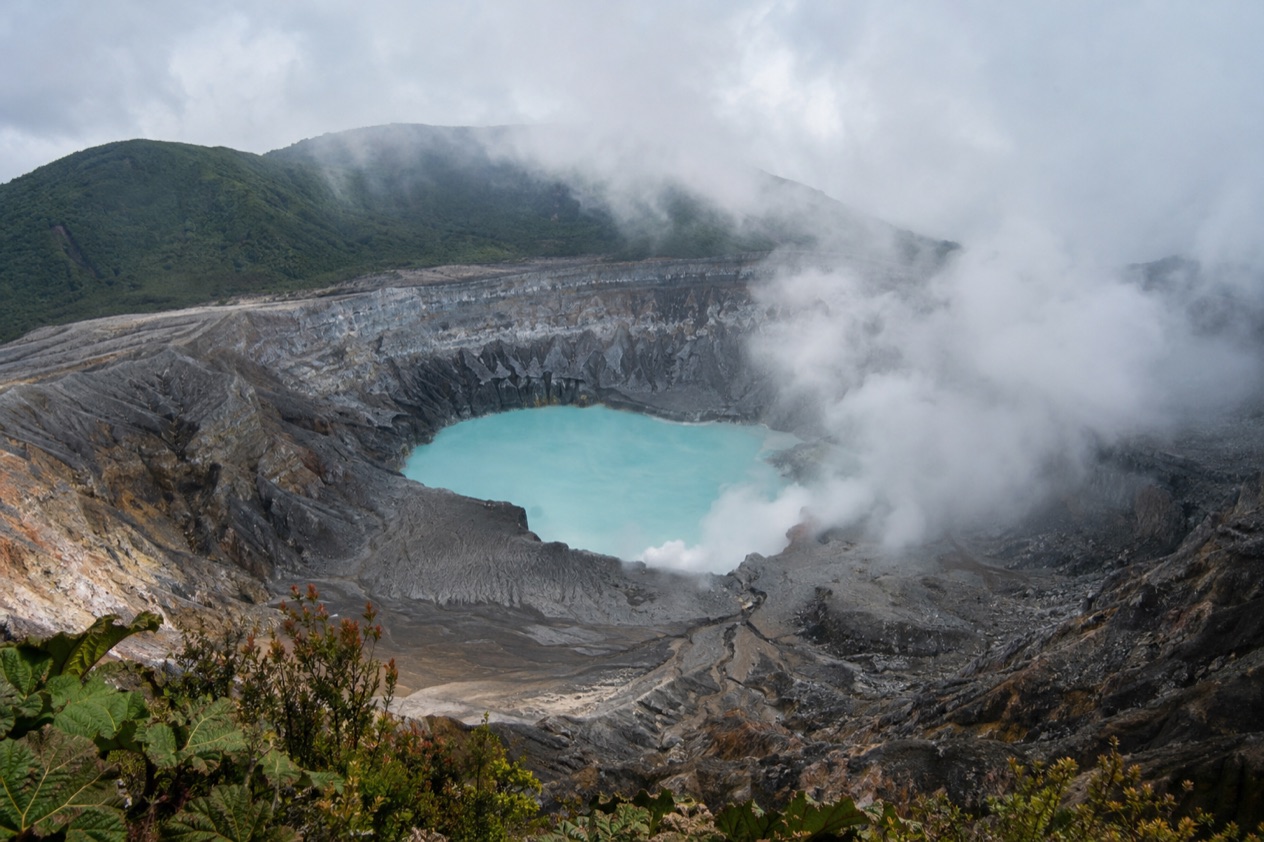
The road up to Poas winds through strawberry farms, fern nurseries and roadside stands in Poasito, and then the air turns cool and damp as the clouds close in. At the top, a path leads to a railing and a drop into a huge crater, where a turquoise lake sits in a bowl of pale rock and white vapor drifts off the slopes. It is a short, high-altitude visit to a living volcano, easy to pair with the farm country around it.
Is visiting Poas Volcano worth it?
Yes, if you want to stand at the edge of an active crater without a long hike, and it suits families, first-time visitors to Costa Rica and anyone with a half day to spare from San Jose. The reward is the sight of a vast, steaming pit with an acid lake at the bottom, and it is more striking than most photos suggest when the clouds part.
What sets Poas apart from the other volcanoes in the region is how close it is to the capital and how much of the show is in the crater itself. Nearby peaks such as Barva, Chompipe and Cerro Cacho Negro are quieter, forested summits, good for the cool air and the birds but without a gas-streaming lake.
Poas is the one where the ground feels alive. Gas and water vapor rise from fumaroles on the inner cone, and the smell of sulfur can reach you on the wind.
The honest caveat is the weather. The summit is often clearer in the morning before the clouds roll in, but a view is never guaranteed, and some visitors stand at the railing looking at a wall of white.
If that happens, the surrounding towns give the trip a second life, with berry stands, bakeries and cheese shops all along the road. Come for the crater, accept the clouds as part of the mountain, and enjoy the drive either way.
What to see at Poas Volcano
The main crater and its turquoise lake
The crater is the reason everyone comes. It measures about a mile across and plunges roughly a thousand feet, a pale gray and yellow bowl with a milky blue-green lake at the bottom. The color comes from the acidity and the dissolved minerals, and the water can look different from one visit to the next, from jade to nearly white.
Look for the plumes of vapor along the walls and listen for the hiss of gas. Wind direction decides how much you smell the sulfur. Mornings give you the best chance of a clear view, while later in the day clouds often fill the bowl and hide it completely.
The fumaroles of the inner cone
Rising from the crater floor is the inner cone, where large amounts of gas and water vapor escape through fumaroles. From the viewpoint you see them as thin white threads and drifting clouds against the rock. They are a reminder that the volcano is still working, not a postcard that stays the same.
Since 1989 the volcano has released more gas, and the resulting acid rain has damaged plants in some parts of the park and on farms nearby. You can see it in the stunted, bare trees near the crater, a vivid lesson in what a volcano does to its neighbors. Bring a camera with a zoom to pick out the details across the gap.
Botos lagoon and the cloud forest
Botos is a cold lagoon in an old crater, filled only by rainfall and draining toward the Caribbean through the Angel River, a tributary of the Sarapiqui. It sits in cloud forest, a mossy, dripping world of ferns, bromeliads and twisted trees that feels a world away from the barren crater rim.
It is a quiet counterpoint to the main viewpoint, a place to see still water and listen for hummingbirds and other mountain birds. Stay on the marked paths, and check the park’s official page for which trails are open when you go, since conditions at an active volcano change.
Hours, tickets and rules
The park keeps one simple schedule, open every day, with the gates closing in mid-afternoon. Entry is by online reservation only, so you plan the visit before you leave San Jose rather than turning up at the gate.
| Site | Open |
|---|---|
| Poas Volcano National Park | Every day, 8 a.m. to 3:30 p.m. |
Tickets are bought and reserved online through the SINAC ticketing service, which handles many of the country’s national parks. For hiking in national parks, the rules call for registering with the park, holding an entry permit and using a certified tour operator. The Costa Rica Tourism Institute keeps a list of certified tour guides for anyone who wants one.
How to get to Poas Volcano
Poas rises above the Central Valley within a couple of hours’ drive of San Jose, and the route ends in the small town of Poasito, where signs point the way to the volcano. There are three main ways to drive up from the capital, and all of them are pretty, passing through coffee country and farmland.
Via Alajuela and Route 712
The most direct route takes the highway from San Jose to Alajuela, then Route 712 up to Poasito through Itiquis and Fraijanes. You follow the signs to the volcano as the road climbs and the air cools. Fraijanes is a good place to notice the change, with its strawberry stands and country restaurants.
Another version leaves Alajuela through San Juan and Sabana Redonda before joining Fraijanes and continuing to Poasito. It is a quieter way up, and it suits those who like to watch the farms and villages go by.
Via Heredia and Varablanca
The third route heads through Heredia, climbing up through Barva de Heredia and Varablanca to reach Poasito. It takes you across the slopes of the Barva volcano area and through high, misty farmland, a different side of the mountains. It also makes a nice loop if you go up one way and come down another.
Whichever way you choose, plan to arrive in time for the morning, since the park closes in the afternoon and the best views come early. Mountain roads are slower than the distance suggests, and fog can reduce visibility near the top.
When to visit Poas Volcano
Go in the morning. The park opens at 8 a.m., and the summit is often clearer before the clouds roll in, so the first hours are your best chance of seeing the lake. Later in the day the crater tends to fill with cloud, and a trip that starts at midday can end at a white wall.
As for the months, the drier season runs roughly from December to April, when San Jose sees fewer rainy days. January brings about seven days of measurable rain and April around ten, so mornings are more likely to be dry then. Even so, a mountain of this height makes its own weather, and nothing guarantees a clear view.
The green season is wetter. July has rain on most days, and October is the rainiest of the months here, with measurable rain on nearly every day and some heavy downpours. In those months the clearest window is early morning, and afternoons are more likely to be soggy. The trip is still possible, and the farms and forests are at their greenest, but bring a rain jacket and flexible expectations.
Temperatures in San Jose stay mild all year, with afternoons in the mid-70s and nights in the low 60s. The summit, at a much higher elevation, is cooler, breezier and damper than the valley below, so dress for a different climate than the one you left in the city.
Tips for your visit
Dress in layers. The valley can be warm while the summit is cool and wet, so a light jacket, a rain shell and closed shoes make the morning more comfortable. Bring sunscreen as well, since the sun at high altitude can be strong in the gaps between clouds.
Book your reservation first, then build the day around it. Aim to be at the crater early, spend your time at the viewpoint and on the paths, and keep the rest of the day for the countryside. The volcano itself does not need a full day, so it combines easily with a stop at a strawberry farm, a cheese shop or a café in Poasito or Fraijanes.
A drive that loops up one route and down another gives you more scenery. You might go up through Alajuela and descend through Varablanca and Heredia, or the reverse, passing farmland and misty ridges. Families with children will enjoy the berry stands and the short, easy feel of the visit, and anyone who finds the altitude tiring can take it slowly and rest at the viewpoint.
If you want to learn more about the volcano and its wildlife, the Costa Rica Tourism Institute lists certified tour guides, and for hiking in national parks the rules call for a certified operator. Before you set out, look at the park’s official page for current conditions, since an active volcano can change what you are allowed to see.
Good to know before you go
The U.S. State Department rates Costa Rica Level 2, ‘Exercise increased caution,’ due to crime; it says petty crime is common throughout Costa Rica and that violent crime also affects tourists, including armed robbery, homicide and sexual assault.
Altitude and gas are the two things that set this visit apart from a day at the beach. The air at the summit is thinner and cooler, and the sulfur smell can be strong when the wind blows toward the viewpoint, so take your time and step back if you feel uncomfortable. As anywhere in the country, keep your belongings close and do not leave valuables in a parked car.
Sources
- Costa Rica Tourism Board (ICT), Poas Volcano National Park (https://visitcostarica.com/where-to-go/protected-areas/poas-volcano-national-park), checked October 8, 2026
- SINAC (Costa Rica national parks authority), online reservations (https://www.sinac.go.cr/ES/resvlinea/Paginas/default.aspx), checked October 8, 2026
- Open-Meteo / ECMWF ERA5, normals 1991-2020 computed for the grid cell at 9.9281N 84.0907W, checked October 8, 2026
- U.S. Department of State, Costa Rica Travel Information, Safety and security (https://travel.state.gov/content/travel/en/international-travel/International-Travel-Country-Information-Pages/CostaRica.html), checked October 8, 2026
- U.S. Department of State, Costa Rica Travel Advisory, issued April 1, 2026 (https://travel.state.gov/content/travel/en/traveladvisories/traveladvisories/costa-rica-travel-advisory.html), read via the State Department open data API on October 8, 2026
To plan your stay
- Best Time to Visit Costa Rica: Dry and Green Seasons, Weather by Region and Festivals
- Where to Stay in Costa Rica: Beach Towns, Cloud Forest, Volcano Views and Which Base Fits Your Trip
- Costa Rica Airports: San Jose or Liberia? Beaches, Drive Times and Getting to Your Hotel
- Know Before You Go to Costa Rica: Entry Rules, Money, Getting Around and Local Customs