
At first light on a Costa Rican trail, the forest is already loud: howler monkeys roaring somewhere in the canopy, toucans clacking, and a river running over stones the color of milk. Parks like these are the reason many travelers come at all, and they stretch from the cold crater rims of the Central Valley to the steamy coasts of the Caribbean and the Pacific. The country protects roughly a quarter of its land, so choosing where to spend your park days is the real puzzle.
What are the best national parks in Costa Rica?
The best parks are the ones that match what you want to see: volcano craters near San Jose, rainforest wildlife on the Pacific and Caribbean coasts, and misty cloud forest in the mountains. Costa Rica abolished its army in 1948 and put much of that energy into conservation, which is why even small parks here feel wild. Most visitors build a trip around three or four of them rather than trying to see everything.
Each region offers a different kind of day. Volcano parks are about views and cool air, rainforest parks are about animals, and coastal parks mix trails with beaches. Pick one of each kind and your days will feel varied rather than repetitive.
Volcano parks: Poas, Irazu and Arenal
Poas rises above the Central Valley within a couple of hours’ drive of San Jose, which makes it the easiest big volcano to fit into a trip. Its large active crater holds a turquoise acid lake, and the summit is often clearer in the morning before the clouds roll in. At 8,885 feet the air is cool, so a jacket belongs in the daypack even when the valley below is warm.
Irazu above Cartago is the tallest active volcano in the country, and the crater area can be cold and windy. On clear days you look down on a green crater lake and a landscape that feels closer to the moon than to the tropics.
Arenal, near La Fortuna, is the classic cone, and it has been quiet since 2010. People come now for short trails across old lava flows and forest, with views of the cone and of Lake Arenal on clear mornings.
None of these summits can be promised. Clouds often close in by midday, so go early and treat any view as a bonus. Arenal pairs naturally with La Fortuna’s hot springs and waterfall, which fill the rest of the day.
Rainforest and wildlife: Corcovado and Tortuguero
Corcovado, on the Osa Peninsula, protects one of the largest tracts of lowland rainforest on the Pacific side of Central America. It is a remote destination reached from Drake Bay or Puerto Jimenez, and that remoteness is the appeal. The park holds lagoons, marsh, mangrove swamps, rivers and wet forest, and walking there means heat, humidity, mud and the chance of tapirs, macaws and monkeys. It suits travelers who like their adventures a little rough.
Tortuguero sits on the northern Caribbean coast and has no roads in, so you arrive by boat or small plane. Mornings are spent gliding along the canals, watching for herons, caimans, monkeys and sloths from a quiet boat. The beach is known for the green sea turtles that nest there, a chance rather than a certainty and tied to the time of year. Expect rain at any season, since the Caribbean keeps its own calendar.
Manuel Antonio and Carara on the central Pacific
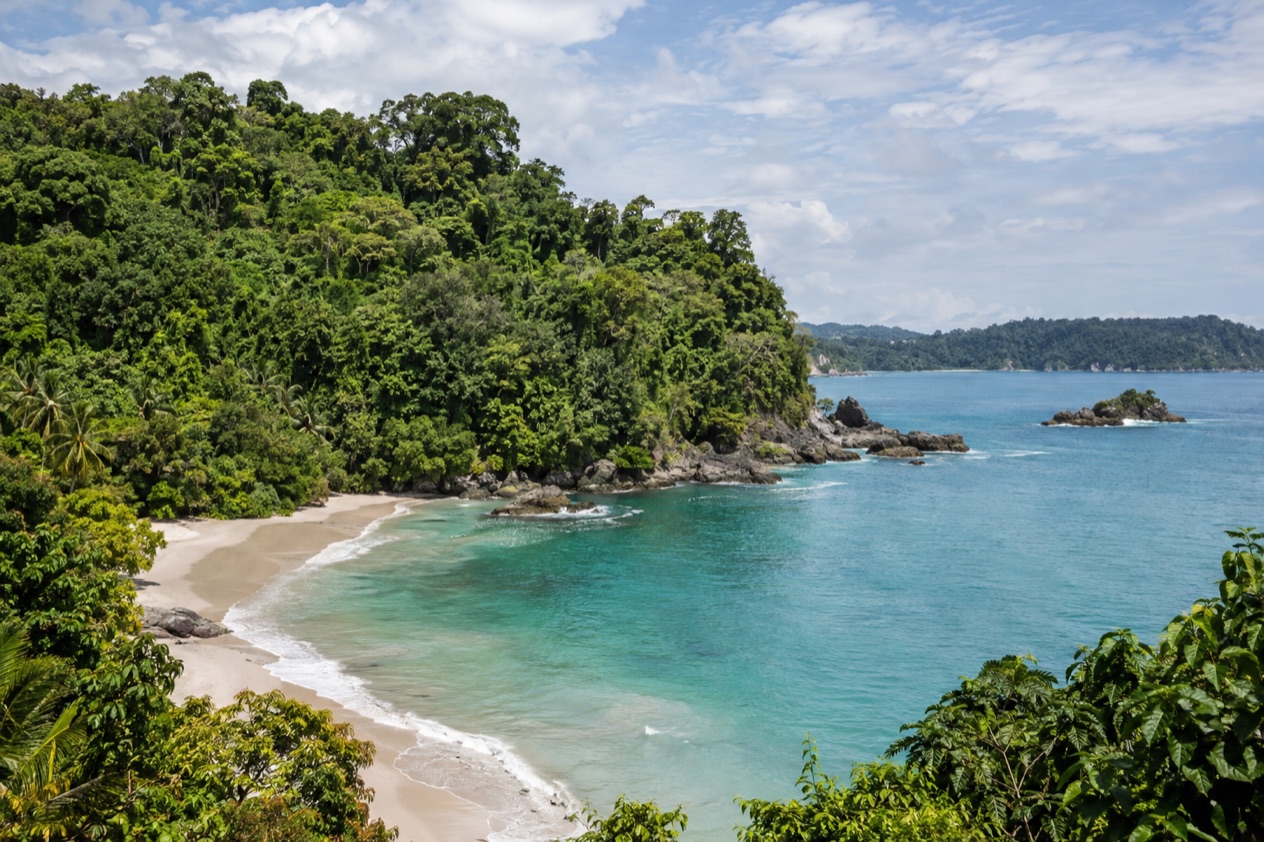
Manuel Antonio is a small park of forest trails and white-sand coves just south of Quepos, and it is one of the most visited in the country. Monkeys and sloths are often seen close to the paths, and white-sand coves break up the forested shoreline.
Carara lies near the Tarcoles River, a short drive north of Jaco. Its transitional forest is known for scarlet macaws, which are often seen flying at dawn and dusk, their red and blue wings loud against the sky. The Tarcoles River bridge nearby is a well-known spot to look down on crocodiles. Combine the two on one outing and you have a full morning of wildlife.
Cloud forest at Monteverde
Outside the national-park system, the Monteverde Cloud Forest Reserve is high in the Tilaran mountains around Santa Elena, where the air is cooler and often misty. The reserve’s forest is thick with ferns, orchids, mosses and epiphytes, and hummingbirds hover at every bright flower. Visitors also hope to see the resplendent quetzal, which is best looked for with a guide in the early morning.
The mood here is hushed, nothing like the loud lowland jungle. Trails drip with moisture, and views come and go with the cloud. It suits people who enjoy slow walking, birds and photography, and who do not mind wearing a rain layer.
Coastal parks: Cahuita and Marino Ballena
Cahuita, on the Caribbean coast, combines a forest trail along the shore with beaches and a coral reef. It is known for sloths and monkeys, and it is managed in close partnership with the surrounding community, which gives it a relaxed, local character. The walk follows the water, so you can alternate forest shade with a stop on the sand.
Marino Ballena protects a stretch of Pacific coast and sea near Uvita. It is known for humpback whales, dolphins and the whale-tail sandbar, which takes its shape at low tide. Whales are a seasonal chance, so ask a local operator what the sea is doing rather than counting on them.
Do you need to reserve a Costa Rica national park?
Yes, for many of the best-known parks you need to reserve online before you go. SINAC, the national parks authority, runs an online service for buying and reserving entry tickets to many parks, so the booking and the payment happen in one place. Rules change, so confirm the details for your park on its official page before you set your plans.
The parks listed here require online reservation. Where only certain sectors need it, the table says which.
| Park | Sector | How to book |
|---|---|---|
| Poas Volcano | Whole park | Online reservation |
| Irazu Volcano | Prusia and Crateres | Online reservation |
| Manuel Antonio | Whole park | Online reservation |
| Tortuguero | Cuatro Esquinas and Cerro Tortuguero | Online reservation |
| Chirripo | San Gerardo, San Jeronimo and Herradura | Online reservation |
| Tenorio Volcano (Rio Celeste) | Whole park | Online reservation |
| Rincon de la Vieja | Whole park | Online reservation |
| Carara | Whole park | Online reservation |
| Braulio Carrillo | Volcan Barva | Online reservation |
| Tapanti | Whole park | Online reservation |
| Los Quetzales | Whole park | Online reservation |
| Isla San Lucas | Whole park | Online reservation |
| Barra Honda | Whole park | By phone: 2659-1551, 8721-2444 or 8539-1010 |
Why it matters for a volcano day
Poas and Irazu are the two summits most travelers try from San Jose, and both sit on the list. That changes how you plan the day. You choose your park first, secure the entry, and then arrange the drive around it, rather than deciding at breakfast and hoping.
Since the summits are often clearer in the morning, an early slot is the one most people would want. Look at what the booking page offers before you commit the rest of your itinerary, and keep a second plan for the afternoon in case clouds win.
Rio Celeste, Rincon de la Vieja and Tenorio
In Guanacaste, Tenorio Volcano National Park is home to Rio Celeste, the river that turns milky turquoise where two streams mix. A trail leads past a waterfall to the spot where the color changes. Rincon de la Vieja, also in Guanacaste, has fumaroles, bubbling mud pots, forest trails and waterfalls, and its summit is often in cloud.
Both parks appear on the reservation list, so they need the same advance step as the volcanoes near San Jose. They are far enough from the Central Valley that most travelers plan them as part of a northwest loop, with a night or two nearby, so the reservation fits naturally into the rest of the booking.
Chirripo and Tortuguero need planning
Cerro Chirripo, at about 12,530 feet, is the highest peak in Costa Rica. Climbing it is a multi-day hike with a night at a mountain hut, and the park requires online reservation for its San Gerardo, San Jeronimo and Herradura sectors. This is the one park where the booking is part of the trip itself.
Tortuguero asks for online reservation for the Cuatro Esquinas and Cerro Tortuguero sectors. Because you reach the village only by boat or small plane, it makes sense to sort out the park entry while you are arranging the transport and the lodge.
Do you need a guide in a national park?
For hiking, the safety guidance says to register with the park, have an entry permit and use a certified tour operator. In practice that means a guide is part of how most visitors experience Costa Rica’s parks, and not only for safety. A guide knows where the sloth hangs, which tree the toucans like, and what the sound in the leaves is.
Even on short trails, a trained eye changes the walk. A sloth looks like a clump of leaves until someone points it out, and a guide often carries a spotting scope that brings a bird across a gorge into view.
Where a guide makes the day
Monteverde is the clearest case. The resplendent quetzal is a bird that visitors hope to see with a guide in the early morning, when it feeds in fruiting trees. Without someone who knows the forest, you may walk right past it, because it is quiet and sits still in the canopy.
The same holds at Manuel Antonio, Cahuita and Tortuguero, where monkeys and sloths are often seen close to the paths or from the water. Guided walks and canal trips are the way most visitors see animals, since guides know where animals have been that week. Families with children in particular enjoy having someone to answer questions.
Remote and high-mountain parks
Corcovado is the park where a guide matters most. It is remote, reached from Drake Bay or Puerto Jimenez, and its trails run through lowland rainforest, rivers and swampy ground. Treat a certified operator as part of the plan, and arrange the trip before you arrive on the Osa Peninsula.
Chirripo is a different challenge. The climb takes several days and includes a night in a mountain hut, so you want someone who can handle the logistics as well as the route. Check the park’s official page for what the operator and the permit must cover.
Short trails and viewpoints
At Poas and Irazu, the main event is the crater itself. The value of a guide here is explanation: how the acid lake formed, what the colors mean, why the weather turns so quickly. Your day with a guide may also include a stop for coffee or lunch on the mountain road.
At Arenal, the trails cross old lava flows and forest, and a naturalist can read the landscape for you, from the black rock to the first plants that took hold. At Rio Celeste, the explanation of why the water changes color is half the fun of the trail.
Which park fits which trip?
The park that fits your trip depends on how much time you have and what you want to see: volcanoes for a short stay near San Jose, beaches and monkeys for a coastal vacation, and remote rainforest for travelers with days to spare. Think about the base you are already using, because each park pairs best with the town nearest it.
A short stay around San Jose
With only a day or two in the Central Valley, Poas is the obvious volcano. It is within a couple of hours’ drive, and the crater with its turquoise lake feels like a real reward for an early start. Irazu above Cartago is the alternative, with cold, windy air and the chance of a green crater lake.
Both are better in the morning, so plan to sleep in the valley the night before. Afterward, a long lunch in a mountain town with local coffee makes a good second half of the day.
Families and easy walkers
Manuel Antonio is the natural choice for families. The park is small, the trails are forested and the coves are close, so no one has to hike all day to be rewarded. Monkeys and sloths are often seen close to the paths, which keeps children looking up.
Near La Fortuna, Arenal gives you short trails on old lava flows, and the waterfall nearby drops into a green basin reached by a long staircase. Families with small children should think about the climb back up. Keep children within arm’s reach near water at all times.
Wildlife and birdwatching
For birds, Carara and Monteverde are the pair. Carara gives you scarlet macaws at dawn and dusk, and Monteverde offers hummingbirds, epiphytes and the hope of a quetzal. Together they show how different the lowland and the mountain forest are, in only a few days.
For the widest range of animals, Corcovado and Tortuguero reward patience. Corcovado rewards travelers with days to spare, while Tortuguero rewards early mornings on the canals after a journey by boat or small plane. Remember that every sighting is a chance, never a promise.
Beaches, reefs and whales
If sand matters as much as trees, choose a coastal park. Cahuita has a forest trail along the shore, beaches and a coral reef, while Marino Ballena near Uvita has the whale-tail sandbar and humpback whales in their season. Both feel more relaxed than the volcano parks.
Currents can be strong on these coasts, and lifeguards are not on every beach. Ask your hotel or a local operator about the day’s conditions before you swim, follow any flags you see, and keep children close.
A rainy day or a cloudy summit
When the weather turns, Monteverde actually benefits, because mist is its normal mood and the forest looks best wet and dripping. Rincon de la Vieja has a good answer too, with mud pots and fumaroles that look dramatic under low cloud, though its summit is often hidden.
For a volcano day that goes gray, shift your attention from the horizon to what is underfoot. Ferns, lava rock, steam and birds still make a walk worth taking, and the nearby towns have hot springs and cafes for the afternoon.
Good to know before you go
The U.S. State Department rates Costa Rica Level 2, ‘Exercise increased caution,’ due to crime; it says petty crime is common throughout Costa Rica and that violent crime also affects tourists, including armed robbery, homicide and sexual assault.
Pack layers, because the same trip can take you from a cold, windy crater rim at Irazu to a hot coastal trail in a single day. Carry a rain layer for the afternoons. Rules for each park change, so confirm the current details, including any reservation, on the park’s official page before you travel.
Plan your park days with a little slack, since mountain roads and coastal tracks can be slower than they look on a map. A relaxed schedule leaves room for the unplanned moments, like a troop of monkeys crossing the trail or a river turning from clear to turquoise as you round a bend.
Sources
- Costa Rica Tourism Board (ICT), Poas Volcano National Park (https://visitcostarica.com/where-to-go/protected-areas/poas-volcano-national-park), checked October 8, 2026
- Costa Rica Tourism Board (ICT), Irazu Volcano National Park (https://visitcostarica.com/where-to-go/protected-areas/irazu-volcano-national-park), checked October 8, 2026
- Costa Rica Tourism Board (ICT), Tenorio Volcano National Park (https://visitcostarica.com/where-to-go/protected-areas/tenorio-volcano-national-park), checked October 8, 2026
- Costa Rica Tourism Board (ICT), Rincon de the Vieja Volcano National Park (https://visitcostarica.com/where-to-go/protected-areas/rincon-de-la-vieja-volcano-national-park), checked October 8, 2026
- Costa Rica Tourism Board (ICT), Corcovado National Park (https://visitcostarica.com/where-to-go/protected-areas/corcovado-national-park), checked October 8, 2026
- Costa Rica Tourism Board (ICT), Cahuita National Park (https://visitcostarica.com/where-to-go/protected-areas/cahuita-national-park), checked October 8, 2026
- Costa Rica Tourism Board (ICT), Chirripo National Park (https://visitcostarica.com/where-to-go/protected-areas/chirripo-national-park), checked October 8, 2026
- SINAC (Costa Rica national parks authority), online reservations (https://www.sinac.go.cr/ES/resvlinea/Paginas/default.aspx), checked October 8, 2026
- U.S. Department of State, Costa Rica Travel Information, Safety and security (https://travel.state.gov/content/travel/en/international-travel/International-Travel-Country-Information-Pages/CostaRica.html), checked October 8, 2026
- U.S. Department of State, Costa Rica Travel Advisory, issued April 1, 2026 (https://travel.state.gov/content/travel/en/traveladvisories/traveladvisories/costa-rica-travel-advisory.html), read via the State Department open data API on October 8, 2026
To plan your stay
- Best Time to Visit Costa Rica: Dry and Green Seasons, Weather by Region and Festivals
- Where to Stay in Costa Rica: Beach Towns, Cloud Forest, Volcano Views and Which Base Fits Your Trip
- Costa Rica Airports: San Jose or Liberia? Beaches, Drive Times and Getting to Your Hotel
- Know Before You Go to Costa Rica: Entry Rules, Money, Getting Around and Local Customs