
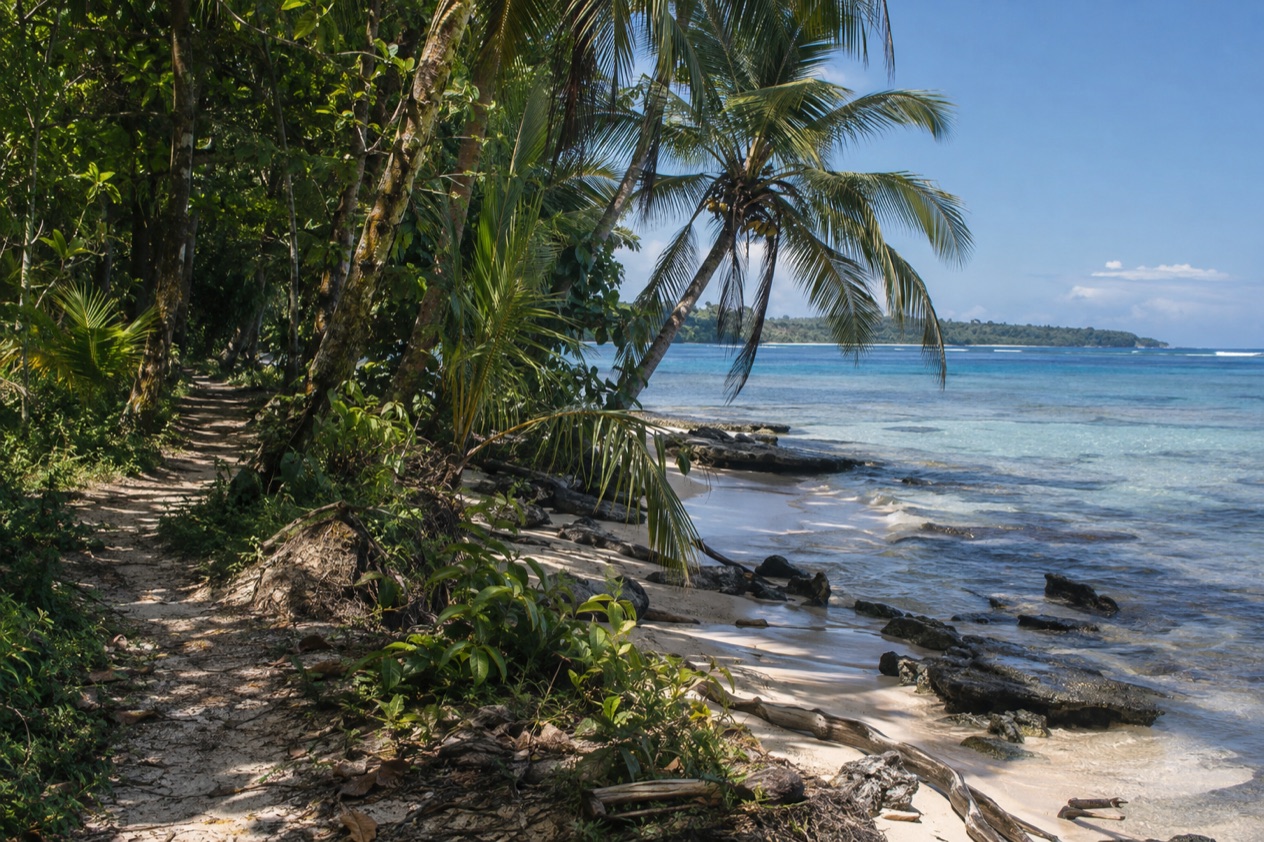
The trail starts almost at the edge of the sand, where the forest leans over the beach and the shade comes down like a curtain. Somewhere above, a sloth hangs motionless in a cecropia, and the Caribbean glints turquoise through the trunks. Cahuita National Park is a walk along the shore, with the reef offshore and the rainforest beside you, and it suits anyone who likes to go slowly.
Is visiting Cahuita National Park worth it?
Yes, it is worth it for travelers who like walking, wildlife and the sea more than a checklist of sights, and it works well for families and first-time visitors to Costa Rica. The park combines a forest trail along the shore with white sand beaches and a coral reef, and it is known for sloths and monkeys.
The main pleasure is the pace: stopping every few minutes because something moves in the branches.
Visitors may see raccoons, coatis, sloths, iguanas and lizards, and common black-hawks overhead. Eyelash vipers and rainforest hognosed pitvipers live here too, which is one more reason to watch where you put your hands and feet and to look closely before you step off the path. Part of the fun is that the animals are often at eye level or below, not high in a canopy.
What sets it apart from other Caribbean-side parks is the way it is run. Cahuita is a rare national park in Costa Rica with a close relationship to the surrounding community, an example of shared management between the community and the government for sustainable development.
The park also protects the most preserved coral reef in the Costa Rican Caribbean. Walking in from the village, you feel that the park belongs to the town, and the town to the park.
What to see at Cahuita National Park
The park is a ribbon of forest, sand and sea, and each stretch has its own mood. Most visitors take it in by walking, pausing at beaches and listening for movement in the trees.
The shoreline forest trail
The heart of the park is the path that follows the coast, running between the beach and the rainforest. Roots cross the trail, leaves rustle with lizards, and small clearings open to the water. This is where visitors most often look up and find a sloth, a troop of monkeys or a coati foraging along the edge of the path.
Walk quietly and slowly, and let your eyes adjust to the shade. Binoculars help, and so does stopping whenever you hear a branch crack. To hike in national parks, you should register with the park and have an entry permit.
White sand beaches and turquoise water
Beaches line the route, with pale sand and a sea that looks turquoise on clear days. They are places to stop, sunbathe and, for those who want to, swim. Sit beneath the palms, watch the surf and listen to the forest behind you, which keeps up its chorus even at midday.
Rip currents are very dangerous and cause several drownings of U.S. tourists each year, so treat the water with respect, stay close to shore and take any posted warnings seriously. Rip currents are very dangerous and cause several drownings of U.S. tourists each year.
The coral reef offshore
Just off the coast lies the best-preserved coral reef on Costa Rica’s Caribbean coast. From the beach you sense it as a change in the color of the water, with darker patches where the coral sits beneath the surface.
The reef is fragile and the community that helps run the park depends on it. Look and enjoy, and leave everything exactly where it is, from shells to coral fragments. Clarity depends on recent rain and wind, so the view varies from one day to the next.
Hours, tickets and rules
Playa Blanca opens early and closes later, so it suits an unhurried morning walk. Puerto Vargas keeps shorter hours and is closed on one Monday each month.
| Site | Open |
|---|---|
| Puerto Vargas sector | Every day, 8 am to 4 pm, except the first Monday of each month |
| Playa Blanca sector | Monday through Sunday, 6 am to 5 pm |
To hike in national parks, you should register with the park, have an entry permit and use a certified tour operator. The Costa Rica Tourism Institute provides a list of Certified Tour Guides. Visitors can hike the trails, enjoy the beaches, swim and sunbathe, and practice recreational sports. Rip currents are very dangerous, so be careful in the water.
How to get to Cahuita National Park
The park is reached through its two sectors, Playa Blanca on the village side and Puerto Vargas at the southern end.
Playa Blanca is the entrance that most visitors associate with the town of Cahuita, and it is the one to choose for a morning walk because it opens at 6 am. Puerto Vargas is the other way in and is the right pick if you prefer to start at the southern end of the park. Pick the sector that matches your day, and know that Puerto Vargas feels quiet and shut on one Monday each month.
The Playa Blanca and Puerto Vargas sectors close at different times. Think about where you want to end the day before choosing where to begin, and remember that the two sectors close at different times in the afternoon.
When to visit Cahuita National Park
Early morning is the natural time to go. Playa Blanca opens at 6 am, and the forest is busy with birds and movement while the air is still cool. Midday brings the heat and the full strength of the sun, a good moment for the beach, and the trail is quieter in the late afternoon before closing.
The Caribbean side keeps its own calendar. January brings highs near 79°F and many wet days, in showers that can come and go. April is a little warmer, with highs in the low 80s and fewer heavy downpours. July is wet, with rain on most days, and October is similar, with rain falling on most days and several heavy ones.
| Month | Avg high (°F) | Avg low (°F) | Precipitation (in) | Days with 0.10 in or more |
|---|---|---|---|---|
| January | 79.2 | 70.5 | 8.78 | 13.8 |
| April | 81.6 | 71.9 | 6.79 | 14.4 |
| July | 81.0 | 72.1 | 17.34 | 27.8 |
| October | 81.3 | 72.3 | 14.72 | 26.3 |
Pick a month by how you feel about rain. January and April have fewer wet days, so the forest and beach are easier to plan around. July and October are green, damp and often showery, and a rain jacket becomes part of the outfit. In any month, the forest and the sea are changeable.
Tips for your visit
Bring water, sunscreen, a hat, insect repellent and shoes that can handle damp, rooty ground. A light rain jacket is useful in any month on this coast. Binoculars make a big difference for spotting sloths and birds, and a swimsuit and a quick-dry towel let you take advantage of the beaches along the way.
The shoreline path rewards slow walking, and the best sightings come when you stop. Families with children will like the beaches and the animals, but keep a close eye on little ones near the water because of the rip currents, and keep hands off branches and logs.
Combine the park with time in the village of Cahuita or with the nearby coast around Puerto Viejo de Talamanca. A certified guide, drawn from the list the Costa Rica Tourism Institute provides, can help you find animals you would walk right past. Because the park shows how a community and a government can run a protected area together, a guide from the area adds a good deal to the visit.
Good to know before you go
The U.S. State Department rates Costa Rica Level 2, ‘Exercise increased caution,’ due to crime; it says petty crime is common throughout Costa Rica and that violent crime also affects tourists, including armed robbery, homicide and sexual assault.
Carry what you need for the day and keep valuables to a minimum, since petty crime is common throughout Costa Rica. Rains can arrive any time on the Caribbean side, so keep your phone and camera in a dry bag. Watch the sea carefully and respect the rip current warnings.
Sources
- Costa Rica Tourism Board (ICT), Cahuita National Park (https://visitcostarica.com/where-to-go/protected-areas/cahuita-national-park), checked October 8, 2026
- Open-Meteo / ECMWF ERA5, normals 1991-2020 computed for the grid cell at 9.6558N 82.7541W, checked October 8, 2026
- U.S. Department of State, Costa Rica Travel Information, Safety and security (https://travel.state.gov/content/travel/en/international-travel/International-Travel-Country-Information-Pages/CostaRica.html), checked October 8, 2026
- U.S. Department of State, Costa Rica Travel Advisory, issued April 1, 2026 (https://travel.state.gov/content/travel/en/traveladvisories/traveladvisories/costa-rica-travel-advisory.html), read via the State Department open data API on October 8, 2026
To plan your stay
- Best Time to Visit Costa Rica: Dry and Green Seasons, Weather by Region and Festivals
- Where to Stay in Costa Rica: Beach Towns, Cloud Forest, Volcano Views and Which Base Fits Your Trip
- Costa Rica Airports: San Jose or Liberia? Beaches, Drive Times and Getting to Your Hotel
- Know Before You Go to Costa Rica: Entry Rules, Money, Getting Around and Local Customs