
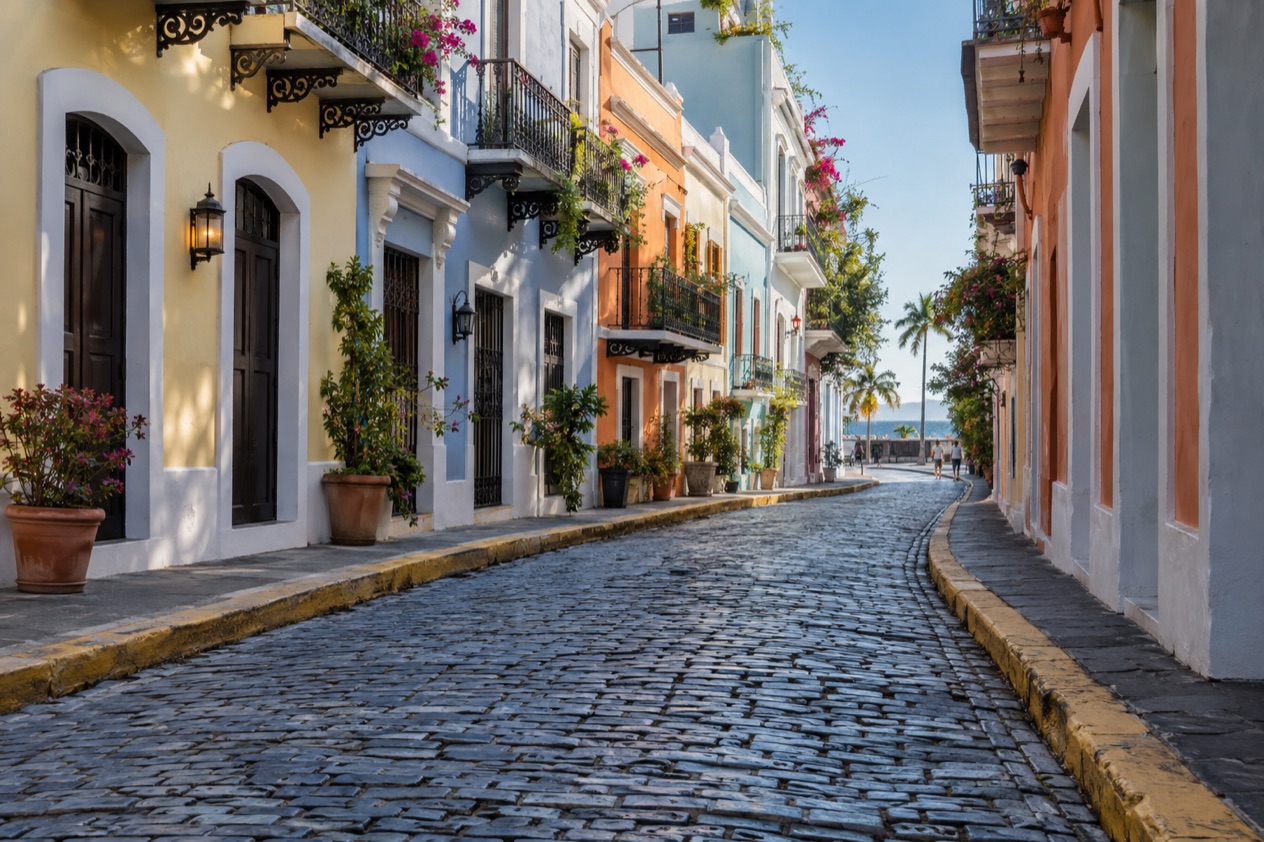
Early on a Condado morning, joggers pass the high-rise hotels along Ashford Avenue while the Atlantic breaks on the sand across the road. A few minutes away, in Old San Juan, the light slides down blue cobblestones, church bells ring over pastel townhouses, and someone is already carrying a tray of coffee up a hill toward El Morro. Both are San Juan, but they offer two different vacations: a beachfront resort strip, or a walled colonial town you explore on foot.
Which is better, Condado or Old San Juan?
Condado suits travelers who want a beach outside the hotel door, a pool, a casino and restaurants along one lively avenue, while Old San Juan suits those who want to wake up among forts, plazas and balconies and are happy to leave the swimming for a short ride. Neither is a wrong choice, and they sit close enough that you can easily taste the other one from either base.
The real question is how you like to spend a day. If it starts with sunscreen and a towel, Condado fits. If it starts with a walk and a long look at the old city, the walled town fits. The table lays out the differences side by side.
| Category | Condado | Old San Juan |
|---|---|---|
| Beaches | Atlantic beachfront right at the hotels, with steady surf that changes from day to day | No real beach of its own, the Balneario de Escambron is just outside the walls |
| Vibe | Resort strip, polished, with high-rise hotels and a seaside promenade feel | Colonial, historic, narrow streets, plazas and pastel townhouses |
| Things to do | Beach time, pools, shops, dining along Ashford Avenue, strolling by the lagoon | El Morro and San Cristobal, the city walls, Paseo de la Princesa, museums, churches, La Perla |
| Nightlife | Hotel bars, casinos, cocktail lounges and restaurants | Bars and music spilling into the streets, lively on weekends |
| Weather | Same warm, humid climate, with sea breeze on the beachfront | Same climate, but stone streets hold the heat and shade is precious |
| Getting around | Walkable along the avenue, served by two bus routes (T21 and D53) | Best on foot, the old free trolley no longer runs, and cars struggle with the narrow streets |
| Best for | Beach lovers, families who want a pool, first-timers who like resort comforts | History fans, photographers, food explorers, couples who like atmosphere |
Beaches and the sea
Condado is the one with the beach in front of it. It is an upscale neighborhood on the Atlantic, and the sand runs along the north side of the district, backed by hotels and apartment towers. The beach is lively from morning to sunset, with sunbathers, paddlers and walkers sharing the shoreline, and the water is the deep blue-green of the open ocean rather than the glassy shallows of a sheltered cove.
That open exposure matters. Since the city beaches meet the Atlantic and receive constant waves, the water varies daily and differs from one sandy area to another. Some mornings the water looks gentle and others it arrives in strong sets. When a lifeguard, a sign, or a flag gives you guidance, follow it, and if you remain unsure, do not enter the water.
Old San Juan does not really have a beach in its own streets. It sits on a small, narrow islet on the north coast, ringed by walls, rocks and the bay, and the most you get is a view of the water from the ramparts and from Paseo de la Princesa. The sea here is something to look at, not something to lie beside.
What Old San Juan does have is a good beach just outside its doors. A public beach park called the Balneario de Escambron is located directly next to the old city, where a reef keeps the water gentler. A reef generally keeps the water gentler, though calm is a tendency, not a promise.
Sargassum seaweed sometimes washes up on Puerto Rico’s beaches, altering the look and smell of a stretch of sand. It is a chance rather than a certainty, so treat it as a reason to stay flexible about which beach you choose on a given morning.
On beaches alone, Condado wins without much contest, because you can walk from your room to the sand in a few minutes with a towel over your shoulder. Old San Juan stays in the running only if you are willing to make a short trip, with Escambron as the easiest answer. Many visitors do both: a morning swim in Condado and an afternoon on the cobblestones.
Things to do
Both neighborhoods fill a day easily, but they fill it differently. Condado is about being near the water, eating well and going out in the evening. Old San Juan is about walking, looking up and wandering into whatever door is open. Add the food of the island, from mofongo (mashed fried plantain) to alcapurrias, and you have more than enough to plan around either one.
In Old San Juan: forts, walls and cobblestones
The great draw is Castillo San Felipe del Morro, the Spanish fort that anchors the point of the islet and gives you wind, sea views and long stone corridors to wander. Nearby San Cristobal guards the landward side. The forts and walls together form the San Juan National Historic Site, part of a UNESCO World Heritage Site, and that is precisely why so many travelers come to the city.
Everyone over 16 needs an entrance pass, and the pass, which is valid for a full day and covers both forts, is paid for without cash, since the park does not accept it. Plan the forts for the early part of the day, when the stone is cooler and the light on the water is soft, then spend the afternoon in the shade of the side streets.
As you move from one fort to the other, the streets underfoot are blue cobblestone, bordered by flat-roofed buildings of brick and stone from the colonial centuries. The city’s only remaining gate is the Puerta de San Juan, San Jose Church has reopened following a long renovation, and from Paseo de la Princesa you can take in the bay along the southern wall. Plazas, cafes and craft shops make easy stops.
La Perla and the sound of bomba
Just outside the north wall, between the old city and the Atlantic, lies La Perla, a colorful neighborhood that draws curious visitors. It is a real community where people live, so go with respect, and consider a walk arranged by a local community group rather than wandering alone. The setting, with the sea on one side and the old wall on the other, is memorable.
Community leaders here organize a weekly gathering where residents and visitors sing, drum and dance bomba, an Afro-Puerto Rican musical tradition. If you can be there when it happens, it is one of the most moving things a short trip to San Juan can offer, and a very different note from the polished hotel scene across town.
In Condado: sand, shops and evenings out
Condado’s day might begin on the sand, beside a hotel pool, or kayaking and paddleboarding on Condado Lagoon, before a long lunch. Ashford Avenue, the main street, runs for nearly two miles of restaurants, boutiques, cafes and hotels, so a walk along it is itself an outing. The Condado Vanderbilt, built as a summer home by the Vanderbilts, is a landmark worth a look even if you are not staying there.
At night, the avenue turns to cocktails, casino floors and dinners with an ocean breeze. Old San Juan has its own after-dark energy, with bars and live music in the narrow streets, but Condado is the easier choice when you want a polished evening and a short walk back to your room.
Easy additions from either base
Around Calle Loiza, the arts and food neighborhood of Santurce sits beside Condado and pays off for an evening of street art, bars and local cooking. East of the airport, Pinones hugs the shoreline, where beachside kiosks dish out fritters such as alcapurrias and bacalaitos. Both fit comfortably into a day from either neighborhood and show a side of San Juan that neither strip alone can.
Weather and the best time to go
Condado and Old San Juan share the same climate, hot and humid all year, so the season decides more than the neighborhood does. The drier stretch runs from about December to April, when days are warm and sunshine is the rule.
From roughly May through November comes the wetter stretch, bringing rain that may fall briefly and hard. The north coast, where both neighborhoods sit, is one of the wetter parts of the island, so a shower is never a surprise.
Where the two differ is in how the heat feels. Condado is open to the sea, and the trade winds help on the beachfront, which makes a hot afternoon easier to bear. Old San Juan has narrow streets, stone walls and little shade, and a midday walk can feel much hotter. Start early, carry water, and plan the afternoon around a cool cafe or a museum.
For a first visit built around sightseeing, the drier months are the comfortable choice, since walking the forts and the walls is far more pleasant under a clear sky. For a beach vacation, the sea stays warm all year, but winter brings bigger swells on the Atlantic coast, so the water on Condado’s side may be livelier than in summer.
The Atlantic hurricane season runs from June 1 to November 30, with its peak around the middle of September and most activity between mid-August and mid-October. Plenty of people travel in those months and have a fine time, but the season is real. Watch the National Hurricane Center along with word from local officials, since predictions can change fast, and remain prepared to shift your plans.
Old San Juan also rewards a rainy day better than a beach strip does. Museums, churches, covered galleries and long lunches are all within a few steps, so a gray afternoon is an excuse to slow down. In Condado, a rainy day tends to mean the pool is out and the beach is quiet, so you may want a backup such as a shopping or dining plan, or a ride to the old city.
Getting there and getting around
Both neighborhoods are in San Juan, close to the main airport, SJU, so the choice has little effect on how you arrive. Flights from the mainland are domestic, and from the terminal you head into town by road. Condado is about two to six miles from the airport, the Isla Verde resort area and the old quarter, so you reach it quickly, with the exact time depending on traffic.
A trio of bridges links the mainland to Old San Juan, which occupies a small islet just off the north coast. That geography shapes the whole experience. Roads in are limited, the streets inside are narrow, and the old town is built for walking rather than driving. Many visitors who stay elsewhere simply arrive for the day and leave in the evening.
Once you are in Old San Juan, you get around on foot. The free trolley that once served the old city no longer runs, so plan on walking, which is also the best way to see the town. Wear comfortable shoes, since the blue cobblestones are uneven and some streets climb steeply toward the forts.
Condado is easier on the feet in a different way. Ashford Avenue is flat and runs east to west along the beach, so a hotel, a restaurant and the sand are usually a short walk apart. The district is also served by the Puerto Rico Metropolitan Bus Authority with two routes, T21 and D53, which gives you a public-transit option if you prefer to avoid driving.
Historically the two are linked. Condado grew up as a streetcar suburb of the old city, and the Puente Dos Hermanos, named for the Behn brothers who helped bring the electric tramway, still marks the link. Today Puente Dos Hermanos still links Condado and Old San Juan. Many travelers stay in Condado and spend a full day or an evening in the old town.
Who should choose which
Pick Condado when the trip revolves around the beach, when you have kids along who crave sand and a pool, or when you want a resort district’s ease, with restaurants and shops right outside your door. It also suits people who prefer a flat walk, a sea breeze and a comfortable base with Old San Juan nearby.
Choose Old San Juan if you care more about atmosphere than amenities. It rewards photographers, history lovers, couples and anyone who likes to walk without a plan, stopping for coffee, a plaza bench or a view from the wall. Expect more stairs, more stone and more character, and less of the polished resort feel. It is the better pick for a short stay built around sights.
You do not really have to choose, because the two combine well. A common plan is to sleep in Condado for the beach and the evening scene, then give one full day to the old city, starting at the forts in the morning and ending with dinner among the lit-up townhouses. Add Santurce for a night of local food and you will have seen most of what San Juan offers.
Good to know before you go
Puerto Rico belongs to the United States, so travelers with U.S. citizenship can leave their passport and visa at home, and they spend U.S. dollars there. Since the island recognizes Spanish and English as official languages, a tiny effort such as buenos dias or gracias, or just a few Spanish words, will almost certainly earn you a warm welcome. Follow the same common sense you would in any crowded city, leave your valuables hidden when you are at the beach and mind your footing on those old cobblestones.
Puerto Rico remains on Atlantic Standard Time all year long and does not change for daylight saving, so when you are making plans with people back on the mainland, check yours against theirs. If you travel between June and November, keep an eye on the forecast, since that is the Atlantic hurricane season.
Sources
- Wikipedia, Condado (https://en.wikipedia.org/wiki/Condado,_Puerto_Rico), checked October 8, 2026
- Wikipedia, Old San Juan (https://en.wikipedia.org/wiki/Old_San_Juan), checked October 8, 2026
- National Park Service, San Juan National Historic Site, Fees & Passes (https://www.nps.gov/saju/planyourvisit/fees.htm), checked October 8, 2026
- National Park Service, San Juan National Historic Site, Hours & Operating Seasons (https://www.nps.gov/saju/planyourvisit/hours.htm), checked October 8, 2026
- Wikipedia, La Perla, San Juan (https://en.wikipedia.org/wiki/La_Perla,_San_Juan,_Puerto_Rico), checked October 8, 2026
- NOAA National Hurricane Center, Climatology (https://www.nhc.noaa.gov/climo/), checked October 8, 2026
To plan your stay
- Best Time to Visit Puerto Rico: Dry Season, Hurricane Season, Beaches and Festivals
- Things to Do in Puerto Rico: Old San Juan, Beaches, Bioluminescent Bays and Island Food
- Where to Stay in Puerto Rico: San Juan, Rincon, Vieques and the Best Areas for Your Trip
- Getting Around Puerto Rico: Rental Cars, Tolls, Carros Publicos and Ferries to Culebra and Vieques