
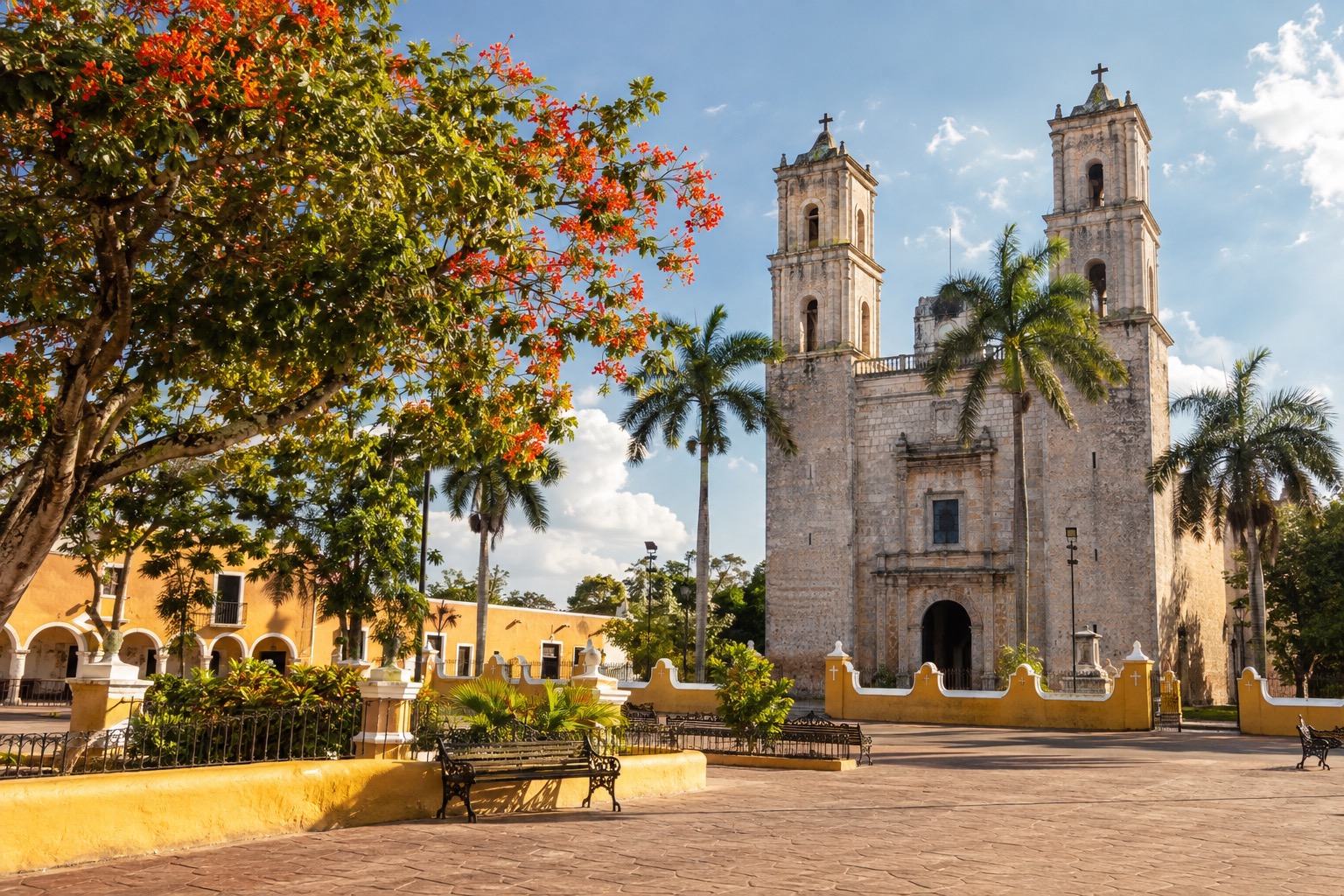
On a December evening, the main square of Valladolid fills with families eating marquesitas and strolling beneath the yellow walls of the cathedral, while the heat of the day finally lets go. In midsummer the same square empties at midday and the afternoon storms drum on the colonial rooftops. This inland Yucatán town has no sea of its own, but it has cenotes, shaded patios and a calendar that shifts with the rain.
When is the best time to visit Valladolid?
The best months are November through February for most travelers, with March as a close runner-up for those who like real heat. Days are warm without being punishing, nights turn pleasantly cool, and showers are short and infrequent.
For sightseeing, the cooler months make a long day easy. You can wander the Calzada de los Frailes to the Convento de San Bernardino de Siena, then drive out to Ek Balam without the sun flattening you by noon. From April into early June the heat builds fast, so plan ruins for the first hours after opening and spend the afternoons in the water.
For swimming and a slower pace, the hot months have their own appeal. Cenote Zaci, right by the center, feels best when the air is at its warmest. For a quieter trip with easier room-hunting, September and October bring rain on most days, but mornings are often clear and the town is calm.
Families should know that March is spring break season in Mexico and the U.S., and the plaza, the cenotes and the restaurants get loud and busy. Children do well here in winter, when the heat is gentle enough for a full day out and a cenote stop in the afternoon.
Valladolid weather by month
Heat is a constant in Valladolid, so the months differ mostly in how much rain falls and how cool the nights get.
| Month | Average high (°F) | Average low (°F) | Rain (in) | Rain days |
|---|---|---|---|---|
| January | 86.2 | 63.5 | 1.83 | 7.0 |
| February | 89.4 | 64.6 | 1.21 | 4.1 |
| March | 92.8 | 66.6 | 1.72 | 3.8 |
| April | 96.3 | 70.0 | 1.87 | 3.3 |
| May | 97.7 | 72.5 | 3.28 | 6.9 |
| June | 94.8 | 74.3 | 6.57 | 12.1 |
| July | 95.7 | 73.2 | 4.76 | 13.8 |
| August | 95.7 | 73.2 | 6.36 | 16.0 |
| September | 94.5 | 73.2 | 7.09 | 17.0 |
| October | 91.2 | 71.4 | 5.48 | 13.2 |
| November | 88.5 | 67.1 | 1.78 | 7.2 |
| December | 86.7 | 64.8 | 1.65 | 5.4 |
The year has two clear halves. From November to April it is the drier stretch, with a handful of rain days a month and cool nights in the winter. Winter rain is light and often comes with a passing cold front. From June through October, storms arrive in heavy afternoon bursts on most days, and the nights stay warm and sticky. May is the hottest month and a first taste of the rains.
When is Valladolid cheapest and least crowded?
The quietest stretch runs from September through October, along with the weeks of late spring just before the rains settle in. Streets are calm, tables are easy to get at the restaurants around the square, and rooms are simpler to find.
The busy weeks are the ones you would expect. Christmas and New Year fill the guesthouses, Easter week brings Mexican families from across the peninsula, and March draws spring breakers. Mexican school vacation, from about early July to late August, also brings domestic visitors, especially to the cenotes on weekends.
Because Valladolid is inland, crowds show up at the cenotes, the ruins and the plaza rather than on a beach. Arriving early at Ek Balam or Cenote Zaci is the surest way to have the place almost to yourself, in any month.
Which months should you avoid in Valladolid?
Avoid August through October if you dislike heavy rain, and May if intense heat wears you down. Hurricane season runs through the wet months, and September is the rainiest month of the year, so a storm can reshuffle plans on the coast and in town.
The heat peaks in April and May, when afternoons are fierce and the ruins offer almost no shade. Sightseeing is still doable, but only in the morning. In winter, nortes (cold fronts) bring gray skies, a breeze and cooler evenings for a day or two. They matter little here, and a light layer for the night is enough.
Sargassum is worth knowing about if you add a coast day to your trip. It is usually at its worst from spring into summer, and it is the first disappointment of many beach vacations. Valladolid itself is untouched, but the beaches nearby can be affected, and no stretch of coast is guaranteed to be spared. The U.S. State Department rates the state of Yucatán Level 1, exercise normal precautions.
Festivals and events in Valladolid through the year
Winter holidays and Carnival
Christmas and New Year bring lights to the plaza and the cathedral, with families out in the evening, street food stalls and music. The town feels festive but small, and the cool nights make it the best time for a long stroll after dinner.
Carnival arrives in February or early March, depending on the calendar, with parades, costumes and dancing in the streets. It is lively and local, more a family street party than a spectacle, and a good reason to be in town on a weekend.
Easter week and Día de Muertos
Easter week, Semana Santa, is a time of processions and quiet church services, and many Mexican families travel. Expect busy cenotes and full guesthouses, and book early if you plan to come.
Día de Muertos, October 31 to November 2, is marked in Yucatán as Hanal Pixán, the meal of the souls. Households build altars with food, candles and flowers, and bakeries sell the special mucbipollo, a large tamale baked in the ground. The season is close to the end of the rains, so the air starts to cool.
Local fiestas and the town’s anniversary
Valladolid celebrates its founding in late May with concerts, dances and traditional vaquería celebrations, bringing locals into the plaza. The date falls in the hottest part of the year, so evenings are the time to join in.
In the second half of summer, the neighborhood fiestas of Sisal and other parts of town fill the streets with music and food stalls. They are casual, free to wander and an easy way to see how the town lives beyond the visitor circuit.
Sources
- Servicio Meteorologico Nacional (CONAGUA), normales climatologicas 1991-2020, estacion 31046 (Valladolid (Obs), Valladolid), checked September 29, 2026
- sunrise-sunset.org, sunrise and sunset on the 15th of the month, checked September 8, 2026
- Wikipedia, "Valladolid, Yucatan", en.wikipedia.org, checked September 29, 2026 (source secondaire)
- INAH, official for the Ek Balam archaeological zone, inah.gob.mx/zonas/21-zona-arqueologica-ek-balam, checked September 29, 2026
- U.S. Department of State, Bureau of Consular Affairs, Mexico Travel Advisory, travel.state.gov, checked September 29, 2026