
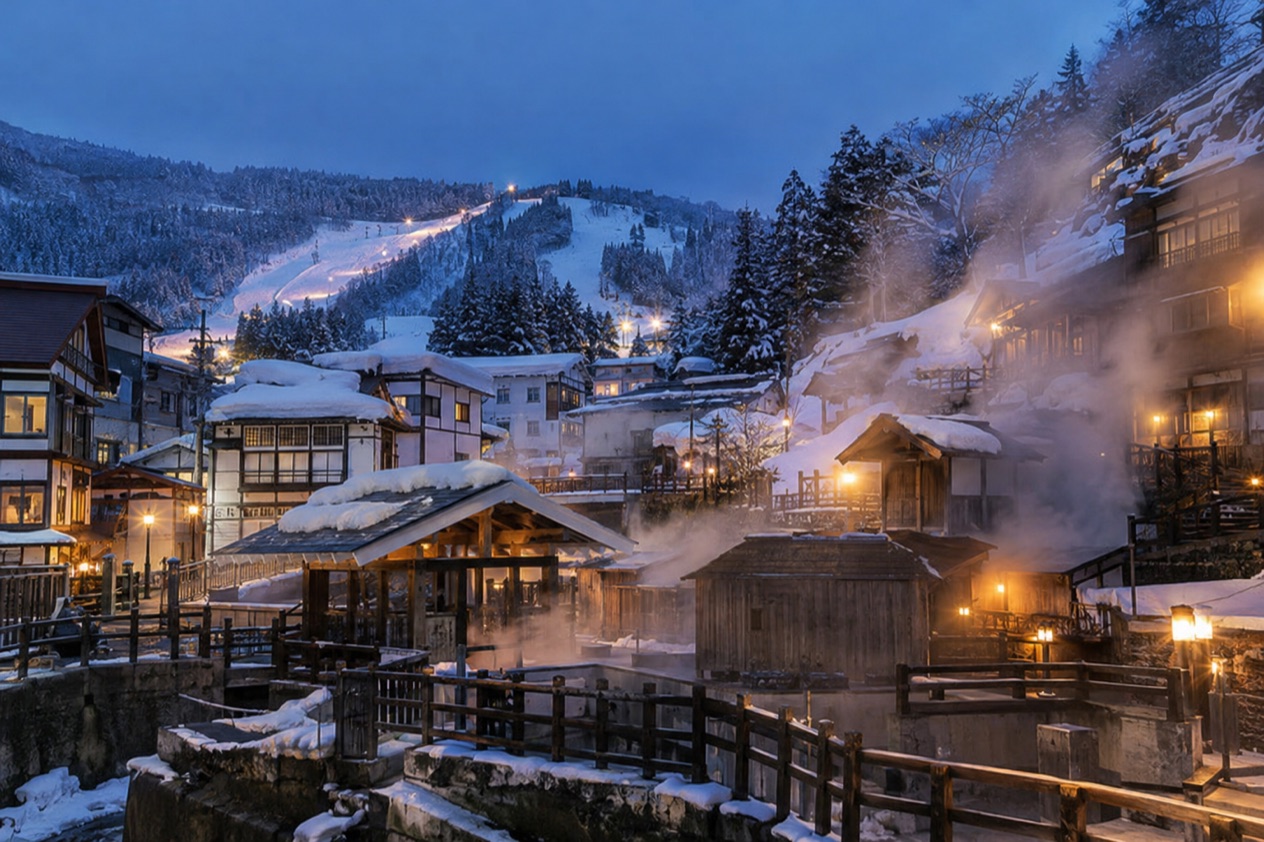
Steam rises from the stone basins at the side of the lanes in Nozawa Onsen, and the smell of sulfur drifts past shopkeepers steaming oyaki dumplings and bathers walking home in yukata with towels over their shoulders. This is a hot spring village in the mountains of Nagano that grew into a ski resort without giving up its old habits. It suits travelers who like their winter days on the slopes and their evenings in the bath.
Where is Nozawa Onsen and what is it like?
Nozawa Onsen is a village in the mountainous northeastern part of Nagano Prefecture, in central Japan, about an hour’s drive from Nagano City. It began as a hot spring resort and is now best known as a major ski destination, particularly popular among Australian visitors to Japan. The area is rural, with farms and forested slopes around the houses rather than the sprawl of a city.
The village covers about 22 square miles, and most of that is mountain. Houses and inns sit on a hillside at the foot of Mount Kenashi, whose peak reaches 1,650 meters above sea level. The land climbs from low farmland in the valley up to the village itself and on toward the summit, so a day here often means going up and down a slope, whether on skis or on foot along the village streets.
The character of the place comes from the mix of two worlds. By day, ski clothes and boots fill the lanes. By evening, people in yukata (light cotton robes) move between the baths, and the inns serve dinners built around mountain produce.
Because this is a real village, with residents who live here year round, the pace feels more domestic than at a purpose-built resort. Neighbors greet each other at the baths, and pickled vegetables and steamed buns are sold the way they have always been sold.
Nozawa Onsen suits people who want atmosphere as well as snow, couples and friends who enjoy wandering between baths, and skiers who like to finish a day in a village rather than a hotel complex. It may suit less well anyone who wants a big-city nightlife scene or a place with its own airport. Winters here are cold, and the summers are warm and humid, a humid continental climate that shapes every season of the year.
What is there to do in Nozawa Onsen?
The reasons to come are the skiing, the hot springs, the village streets and the food. Together they make Nozawa Onsen different from resorts that offer only slopes: here the hot water and the village life are as much a part of the trip as the lifts.
Skiing on the slopes of Mount Kenashi
Skiing is what turned a quiet bathing village into an international name. The runs spread over the flanks of Mount Kenashi, and the village sits at their base, so you move from the snow to the streets without a long transfer into town. It is a destination particularly popular among Australian visitors, and you will hear English in the lanes and the inns.
There is also a maintained cross-country skiing track, which exists because the area hosted the biathlon races of the Nagano Olympics. That gives the village a different kind of winter outing for anyone who prefers gliding along a trail to riding lifts. It is a good addition for a rest day from downhill skiing, or for a traveler who wants to be on snow without the runs.
Bathing in an onsen village
Onsen means hot spring, and the name of the village says exactly what it was built around. Bathing is the old center of life here, long before skis arrived. People spend the end of the day moving from bath to bath, wearing a yukata and carrying a small towel, and pausing for a drink or a snack on the way back.
The experience works best taken slowly. Hot water after a cold day outdoors is the point of the whole village, and it is easy to see why guests plan their evenings around it.
Habits at an onsen follow familiar customs: you wash before you enter the water, and the towel stays out of the bath. Visitors who are new to bathing together in separate-sex baths will find the routine easier once they have watched the locals.
Wandering the village and eating local
The lanes are lined with wooden inns, small shops and snack counters, and steam rises from drains and basins along the way. Oyaki, filled dumplings steamed or baked, are a typical bite of the Nagano mountains, and nozawana, a leafy green pickled in the area, turns up beside rice at breakfast and dinner.
Dinner in a village like this tends toward hot pots, grilled fish, mountain vegetables and rice, the kind of food that suits a cold evening. Sake and local beer are poured in small bars and at the inns. After dark the village slows down, and the best entertainment is often a walk between baths in the cold air.
Winter festivals and village traditions
Nozawa Onsen is known for a fire festival held in mid-January, one of the great winter events of the Japanese mountains. Villagers build a large wooden shrine structure and defend it against a torch-bearing crowd in a ritual of purification and good fortune. If your dates overlap, it adds an entirely local layer to a ski trip.
Outside that festival, the village rhythm follows the seasons, with the quieter months giving visitors a different view of the same lanes. Whenever you come, the combination of bathing, snacking and strolling does not depend on snow.
How many days do you need in Nozawa Onsen?
A long weekend is a workable minimum, and a few extra days is better. The trip in from Tokyo by Shinkansen and onward to the village takes a good part of a day, so a stay shorter than that would spend more time in transit than in the village.
With a short stay, you fit in a day or two on the slopes, a couple of evenings at the baths, and an unhurried walk through the village for oyaki and pickles. Skiers who want several different days on the mountain, or who want one day off the snow for the cross-country track, will find that a longer stay lets the pace relax. Evenings go into dinner and a bath, and mornings start slowly, which is how the village seems meant to be enjoyed.
With more time, you can add a day trip toward Nagano City, about an hour’s drive from the village, where the city offers a change of scene from the rural mountains. Because Nagano hosted the Olympics, the region has a sporting history that you can see in places like the cross-country track close to the village. A week lets you combine skiing, bathing and a city stop without rushing any of them.
If you come outside ski season, a shorter visit is enough for the baths and the village lanes, since the slopes are not the draw. The scale of the place is small, and its pleasures are simple enough that you can see most of the village in a day and spend the rest of the time just soaking and eating.
Where to stay in Nozawa Onsen
Travelers stay in the village itself, where traditional inns, guesthouses and lodgings for skiers sit along the sloping lanes. Staying in the village puts the baths, the restaurants and the snack counters at your door, and it is the choice that captures what Nozawa Onsen is about. Inns in the Japanese style, called ryokan, often come with dinner and breakfast, and guests change into yukata for the evening.
The village is built on a hillside, so where you sleep decides how your day begins. Lodgings near the lower lanes put you among the shops and bathing houses, which suits travelers who want to wander after dinner. Lodgings higher up bring you closer to the slopes of Mount Kenashi, which suits skiers who want to start early and avoid carrying gear far.
A traditional inn suits couples and travelers who want to experience Japanese hospitality, with futon bedding on tatami floors and meals served in a set order. A simpler guesthouse or ski lodge suits groups of friends and independent travelers who mostly want a bed and a base between runs. Whichever you pick, many guests bathe in the village’s public baths as well as any bath in their lodging, so a place to sleep and the experience of the hot springs are not tied together.
If you are not sure which style fits you, think about how you want your evenings to look. A ryokan makes the dinner and the bath the center of the night, while a lodge lets you set your own schedule. Both put you in the same village and the same lanes, so the choice is about comfort and mood, not about location.
How do you get to Nozawa Onsen and get around?
You reach Nozawa Onsen by flying into Tokyo or Nagoya and continuing by train, since there are no major airports near the village. The nearest train station is Iiyama, on the Hokuriku Shinkansen, 1 hour 45 minutes from Tokyo.
From Iiyama you continue to the village itself, which lies in the mountains of northeastern Nagano Prefecture. Nagano City is about an hour’s drive from the village, so the region around the village is connected to the larger city in the valley. The journey from the airport therefore combines a flight, a long train ride and a final leg into the mountains.
Once you arrive, the village itself is the main place to explore, and the lodgings, baths, shops and snack counters sit within the same hillside community. The slopes of Mount Kenashi rise directly above it, so the ski area and the village belong to one place rather than two separate destinations. A traveler who stays in the village can build a trip around its lanes and the mountain above.
Because there is no airport in the area, arrival is part of the trip’s rhythm: you leave the big cities behind and move into the mountains. That slower approach suits the village, which is a rural community rather than a hub. Plan your arrival day as a travel day, and let the first evening begin with a bath and dinner.
When is the best time to visit Nozawa Onsen?
Winter is the season travelers choose, because the village is best known as a ski destination and the winters are cold. That is when the slopes of Mount Kenashi are the draw, the cross-country track is part of the offer, and the hot springs feel their best after a day in the cold. The fire festival in mid-January falls in the same season, so a winter trip can combine skiing, bathing and a local ritual.
Summer is warm and humid, a very different mood from winter, and the village returns to being a mountain onsen community rather than a ski resort. It suits travelers who want the baths, the lanes and the food without the ski crowds around them. The hillside setting and the forested slopes around the village give the season a green, rural feel.
The seasons in between bring their own character to the mountains, with the same lanes and the same baths in a calmer setting. Because the village is a place to wander and soak rather than a place built only for snow, it works outside winter too. Choose winter for the skiing and the festival, and choose another season for the quieter side of the village.
Good to know before you go
Nozawa Onsen is a small rural village, so plan around the rhythm of an onsen community: bathing is part of daily life, and the habits of the baths are worth observing before you enter the water. The winters are cold and the summers warm and humid, so pack for the season you choose. Because the village is in the mountains and far from any airport, give yourself time on arrival and departure days.
Sources
- Wikipedia, Nozawaonsen, Nagano (https://en.wikipedia.org/wiki/Nozawaonsen,_Nagano), checked October 11, 2026
- Wikivoyage, Nozawa Onsen (https://en.wikivoyage.org/wiki/Nozawa_Onsen), checked October 11, 2026
To plan your stay
- Best Time to Visit Japan: Cherry Blossoms, Autumn Colors, Weather and Festivals
- Where to Stay in Japan: Ryokan, Temple Stays, Capsule Hotels and the Best Cities to Base In
- Sending Luggage from the Airport in Japan: Hands-Free Travel, Hotel Delivery and Coin Lockers
- Know Before You Go to Japan: Entry, Money, Etiquette and Getting Around