
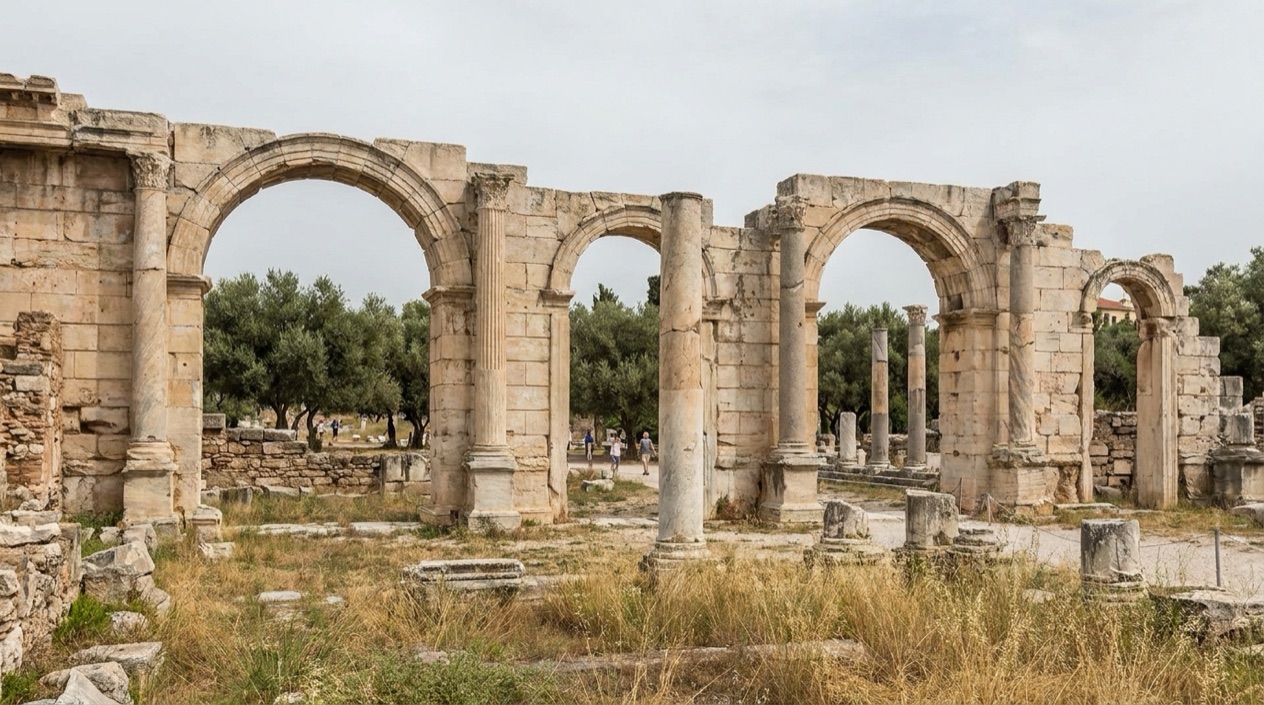
You come upon Hadrian’s Library near Monastiraki, where a long stretch of tall wall stands behind the café tables and the crowds heading toward the Plaka. Behind that wall lies an open field of broken columns, low foundations and the outlines of churches built one over another. It is a visit of ruins and layers, a place where Rome, Byzantium and modern Athens sit within a few steps of each other.
Is visiting Hadrian’s Library worth it?
The library was a gift of the Roman Emperor Hadrian to Athens, and what you see today is the shell of a place built for reading, study and talk.
What sets it apart from the other ancient sites around it is the mix. Here you do not find a single temple on a rock, but a Roman building later turned into part of the city walls and then home to three Byzantine churches. You can read the whole story of Athens in one open field, from papyrus rolls on shelves to a cathedral that was once the first of the city.
It also sits at the edge of the Plaka, a neighborhood of historic landmarks and lively shops that gets crowded, so the library works as a pause between busier stops. The Acropolis rises on the same side of town, and the Acropolis Museum in Koukaki is part of the same ring of ancient monuments linked by a pedestrian walkway. Many people fit the library into a wider walk through the old center rather than making a separate trip for it.
If you want a site with every wall restored and signs for each room, this may feel sparse. If you like standing in a courtyard and picturing scribes, lecturers and readers moving between halls, it gives you plenty to work with.
What to see at Hadrian’s Library
The Roman library and its halls
The building was created by Hadrian as a library, and its plan was built for study. The books were rolls of papyrus kept in cupboards and on shelves along the eastern side, while adjoining halls served as reading rooms and the corners as lecture halls.
Little of the decoration survives, but the descriptions are rich: ceilings of gilded wood, walls covered in marble and paintings. As you walk the field, try to place those details against the foundations and the standing wall, and the bare stone begins to take on color. Look for the line of the facade and the way the rooms were arranged around an open space.
Walls, damage and repairs
The library did not stay whole. It was seriously damaged by the Herulian invasion of 267, and the prefect Herculius repaired it between 407 and 412. Later it was incorporated into the Roman city walls, which explains why the long outer wall feels more like a fortification than a reading room.
That change of purpose is worth keeping in mind as you walk the edges of the site. A place made for scholars became a piece of the city’s defense, and the stones show the shift in how Athens used it.
The Byzantine churches
Within the old library, three churches were built over the centuries: a tetraconch in the 5th century, a three-aisled basilica in the 7th century, and a simple cathedral in the 12th century. Their outlines and fragments sit among the Roman remains, so you often see two eras in a single glance.
The 12th-century cathedral was the first cathedral of the city and was known as Megali Panagia. Another church, Agios Asomatos sta Skalia, was built against the north facade around the same time, but it is not preserved. Looking for these plans in the ground is one of the quiet pleasures of the visit.
The colossal Nike statue
A colossal statue of the goddess Nike, also called Victoria, is exhibited on the site. It was excavated in the Library in 1988, so it comes from the very ground you are standing on.
Take a moment with it, since it gives a sense of scale to a building that is mostly foundations today. The figure of victory, set among the stones of a library, is a good image to carry away from the site.
How to get to Hadrian’s Library
Hadrian’s Library is near Monastiraki station, which makes the Athens Metro the clearest way to reach it. The site is on the north side of the Acropolis, so you arrive at the edge of the old center rather than in a distant district.
The metro runs from 5:30 a.m. to 00:30 a.m., and on Friday and Saturday nights lines 2 and 3 stay open later. That gives you a wide window for getting to the site and for heading back to your hotel after dinner in the Plaka.
If you prefer the bus, passengers in Athens cannot use the front door to get on or off, so board and leave by the other doors. From the station, you step straight into the streets around Monastiraki, and the library’s long wall is the landmark to look for.
From the Koukaki side, the Acropolis Museum and its pedestrian walkway link the ancient monuments, which is a natural way to connect the library with the rest of the old center on foot. The Plaka lies right beside it, with its historic landmarks and shops.
When to visit Hadrian’s Library
The figures for Athens give you a sense of what each season feels like in an open site with little cover. In July the average high is 91.8°F and the average low 74.1°F, with very little rain, so the stones and the open field are hot and exposed. October brings an average high of 75.2°F and a low of 61.0°F, and April sits at 68.4°F and 53.2°F.
| Month | Average high (°F) | Average low (°F) | Precipitation (in) | Days with rain |
|---|---|---|---|---|
| January | 56.3 | 44.4 | 2.17 | 7.5 |
| April | 68.4 | 53.2 | 1.10 | 5.5 |
| July | 91.8 | 74.1 | 0.28 | 1.6 |
| October | 75.2 | 61.0 | 1.09 | 3.9 |
Spring and autumn suit a walk among ruins, since you are outdoors the whole time and the temperatures stay moderate. In January the highs are cooler and rain falls on about seven days, so a rain jacket is a sensible thing to carry.
In July, sun protection and water matter more than anything, and the heat makes a visit through a shadeless field a tiring one. The Plaka next door gets crowded, so the surrounding streets may be busier than the site itself.
Tips for your visit
Bring comfortable shoes, since you walk over uneven ground among foundations and fragments. In the warmer months, sun protection is the sensible addition, and in winter, a rain jacket fits the number of wet days in the table.
Take your time with the layers. The most rewarding way through the field is to match the Roman plan, the church outlines and the Nike statue, one after another, rather than looking for a single highlight. Knowing that the library held papyrus rolls in cupboards on the eastern side, and that the corners were lecture halls, gives each corner a purpose.
Nearby, you can combine the visit with the Plaka, which has picturesque streets, historic landmarks and lively shops, though it gets crowded. The Acropolis Museum in Koukaki and its pedestrian walkway link other ancient monuments, so a day of ancient Athens can be strung together without leaving the center. For families and travelers who want to understand what they see, a little reading about the Roman, Byzantine and later phases before you arrive helps a great deal, since the ruins reward what you bring to them.
Good to know before you go
The site stands in the middle of one of the busiest parts of Athens, so the streets around Monastiraki and the Plaka are the part to plan around. In July the heat of the open ruins is the main thing to prepare for. This is Athens, the official tourism guide for the city, is a good source for current visitor details.
Sources
- Wikipedia, Hadrian's Library (https://en.wikipedia.org/wiki/Hadrian%27s_Library), checked October 12, 2026
- OASA, Athens urban transport (https://www.oasa.gr/en/), checked October 12, 2026
- Athens Transport, public transport guide (https://www.athenstransport.com/english/), checked October 12, 2026
- This is Athens, the official Athens tourism site (https://www.thisisathens.org/), checked October 12, 2026
- Hellenic National Meteorological Service (HNMS), climatological normals 1991-2020 for Elliniko station (https://www.emy.gr/climatic-data), monthly mean daily maximum and minimum; rain from the ECMWF ERA5 reanalysis, 1991-2020, grid cell of Athens (Open-Meteo), checked October 12, 2026
- ECMWF ERA5 reanalysis 1991-2020, grid cell of Athens (Open-Meteo), checked October 12, 2026
To plan your stay
- Best Time to Visit Greece: September and Late May to Early June
- Arachova: Parnassus Mountain Town, Formaela Cheese, Ski Season and Saint George's Day
- American Airlines Flights to Greece: U.S. Cities, Athens Arrivals and Onward Island Flights
- Greece on a Budget: Cash Machines, Cards, Beaches and Ferries