
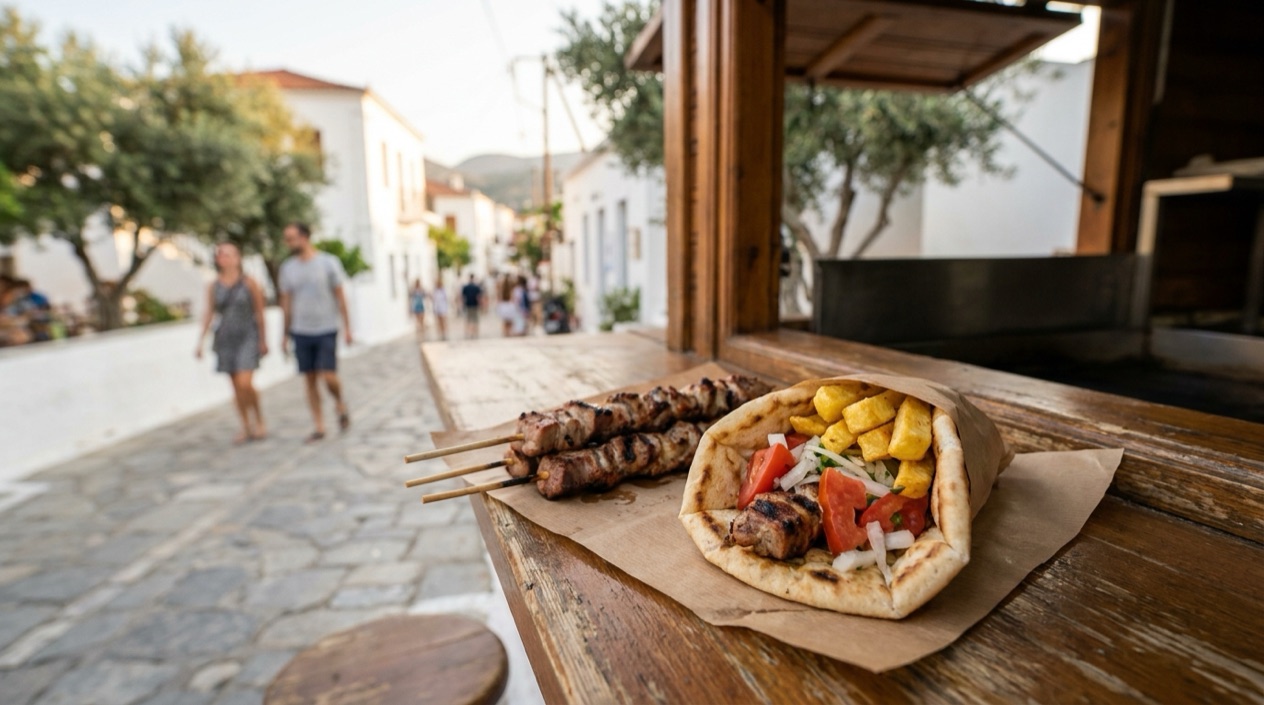
A spit of stacked meat turns slowly in front of the heat, a cook shaves off curls of it with a long knife, and the warm pita comes up the counter already rolled around tomato, onion and a few fried potatoes. That scene repeats itself in Athens, in Thessaloniki, on Corfu and on island waterfronts, in every kind of weather. Gyros and souvlaki are the everyday street food of Greece, and this is how to tell them apart and where to find them.
What are gyros and souvlaki?
Gyros and souvlaki are Greece’s two great meat-and-pita staples: gyros is meat cooked on a vertical rotisserie, sliced and wrapped in pita, while souvlaki is small pieces of meat, sometimes with vegetables, grilled on a skewer. Both are eaten hot, with your hands, often standing at a counter or on a bench outside the shop.
Gyros: the rotisserie
Look through the window of a gyros shop and you will see the spit: meat shaped into an inverted cone, set on a tall vertical rotisserie that turns slowly in front of a broiler or other source of heat. As the outer layer browns, the cook slices it away in thin strips. When it is made by hand, the meat is cut into thin, flat, roughly round slices, stacked on the spit and seasoned, with trimmings of fat usually tucked between them so the stack stays juicy as it turns.
In Greece the sliced meat usually goes into an oiled, lightly grilled piece of pita, rolled up with sliced tomatoes, chopped onions and fried potatoes. Tzatziki, the garlicky yogurt and cucumber sauce, often goes on top. In parts of northern Greece you may also be offered ketchup or mustard instead. The potatoes tucked inside surprise many first-time visitors, and they are a big part of why the wrap is so filling.
If you have only eaten gyros in the United States, expect a difference. The typical American mass-produced version is made with finely ground beef mixed with lamb, while the hand-built Greek spit is stacked from sliced meat. The idea is shared, the texture is not.
Souvlaki: the skewer
Souvlaki is cooked over the grill, small cubes of meat threaded on a skewer and turned until they char at the edges. In Greece and Cyprus the meat is usually pork. It is commonly eaten straight off the skewer while still hot, or served with or inside a rolled pita, and vegetables sometimes share the stick.
Souvlaki as a fast food started to be sold widely in the 1960s, introduced by vendors from Boeotia. The idea of meat on a stick is far older. French traveler Gustave Flaubert watched Greeks grilling pieces of meat on a bamboo stick in the Boeotian countryside in 1850, and excavations have turned up souvlaki trays at Gla, Mycenae and Pylos, so the skewer has a long pedigree in this part of the world.
A long history of street food
On Santorini, excavations unearthed stone cooking supports used before the Thera eruption of the 17th century BC, which suggests that grilled skewered meat was already a popular delicacy there around 2000 BC. The gyros wrap came later but caught on fast: by 1970 it was already a popular fast food in Athens, as well as in Chicago and New York City.
Gyros belongs to a wider family of spit-roasted meats. It is similar to the Arab shawarma, the Canadian donair and al pastor from Latin America, all of which derive from the Turkish doner kebab. Eating a gyros in Greece is a way of tasting one branch of that family at home.
How do they differ?
They differ first in how they are cooked: gyros comes off a vertical spit in thin slices, souvlaki comes off a grill on a skewer in cubes. The second difference is trickier, because the words themselves change meaning from one Greek city to the next.
Spit versus grill
Gyros is shaved, so every bite is thin, soft strips with browned edges, usually wrapped with tomato, onion, fried potatoes and tzatziki. Souvlaki is chunkier, with the smoky taste of the grill, and it can be eaten with no bread at all, pulled off the stick with your teeth. The skewer is also the form that most often involves pork in Greece, while the gyros spit is the one that has an American cousin built from ground beef and lamb.
Both can end up in the same pita, which is where the confusion begins. A pita rolled around grilled pieces of meat, tomato, onion and sauce looks a lot like a gyros wrap, and that is why many Greeks lump them under one name.
Athens: souvlaki and kalamaki
In Athens and other parts of southern Greece, the skewered meat that is called souvlaki elsewhere is known as kalamaki. Souvlaki, in conversation there, is used generally for gyros and similar dishes, in practice for almost any kind of pita wrap. So in Athens you can ask for a souvlaki and receive a gyros wrap, and if you want the plain skewer, kalamaki is the word.
Around the capital, then, the two terms behave like a reversed pair compared with the English menu you may know. It helps to look at what is on the counter and point, then listen for which word the person serving you uses.
Thessaloniki and the north
In Thessaloniki and in Macedonia and other regions of northern Greece, the common term for the skewered dish is souvlaki, the same as in English. Kalamaki is not connected to it there. The word gyros in Thessaloniki refers only to the meat on the spit, and what English speakers call a gyros wrap is called a sandwich.
The north has its own habit with sauces too: ketchup or mustard sometimes turns up in the wrap where the south would reach for tzatziki alone. Treat the local word as part of the pleasure, and order the way the person at the counter does.
Corfu’s red sauce
On Corfu, a special tomato sauce called red sauce (kokkini saltsa) is added to souvlaki. It is a small local twist that you will not find described on the menus of every island, and it gives the grilled meat a sweet and savory edge worth tasting if you are on the island.
Where do you eat them?
You eat them at small counter shops, at casual grill restaurants and at fast food chains, in cities and on islands alike. The simplest places hand you the wrap in paper and you eat it on the spot, while sit-down tavernas bring skewers to the table with bread, salad and sauces.
Counter shops and chains
The classic stop is a small shop with a spit in the window or a grill behind the counter. You order, watch the wrap being built, and eat it standing or on a nearby step. Greeks eat lunch around 14:00 to 15:00 and dinner between 21:00 and 23:00, though tourist establishments may open as early as 12:00, so a gyros makes a handy snack between those hours.
For an even cheaper and faster meal there is Goody’s, a popular fast food chain in Greece, where a hamburger with a Coke costs €3-5. It is a burger place first, but it shows the price range of a quick meal on the go. A grilled wrap from a local counter is the more Greek choice.
Sit-down tavernas
At a taverna, souvlaki arrives on the skewer or on a plate, often alongside a Greek salad. A genuine Greek salad is traditionally dressed only with olive oil, and vinaigrette or lettuce turns up only in the most tourist-oriented restaurants. It is customary to be served water and bread soon after you sit down, and to receive a small free dessert when you ask for the bill.
A cover fee is commonly charged in restaurants, officially, from €0.30 to €2 per person. If it tends toward €2, consider eating elsewhere. Fresh fish is sold by the kilogram and can be very expensive, so if you stray from the grill to the fish list, ask what your portion will cost before you order.
Spotting a good place
A few signs point to a less authentic restaurant: desserts listed on the menu, large food posters outside, waiters calling out to passersby, or plates being taken away while diners are still seated. A spit that is busy and a counter with a steady flow of local customers tells you more than any sign.
Vegetarians should know that restaurants catering strictly to vegans and vegetarians are practically non-existent outside Athens and Thessaloniki. Elsewhere, a plate of salad, sides and bread will fill the gap while the rest of the table has the skewers. Frozen seafood, by law, must be marked as such on the menu, a useful thing to look for if you order fish beside your souvlaki.
Good to know before you go
Prices for a gyros or souvlaki wrap depend on the shop, so look at the board before you order, and remember that a cover fee may appear on a sit-down bill. Keep the local words in mind: kalamaki for the skewer in Athens, souvlaki for the skewer in the north, and gyros for the spit meat. Order with a smile and a finger pointed at what you want, and the counter will do the rest.
Sources
- Wikipedia, Gyros (https://en.wikipedia.org/wiki/Gyros), checked October 12, 2026
- Wikipedia, Souvlaki (https://en.wikipedia.org/wiki/Souvlaki), checked October 12, 2026
- Wikivoyage, Greece, section Eat (https://en.wikivoyage.org/wiki/Greece#Eat), checked October 12, 2026
To plan your stay
- Best Time to Visit Greece: September and Late May to Early June
- Arachova: Parnassus Mountain Town, Formaela Cheese, Ski Season and Saint George's Day
- American Airlines Flights to Greece: U.S. Cities, Athens Arrivals and Onward Island Flights
- Greece on a Budget: Cash Machines, Cards, Beaches and Ferries