
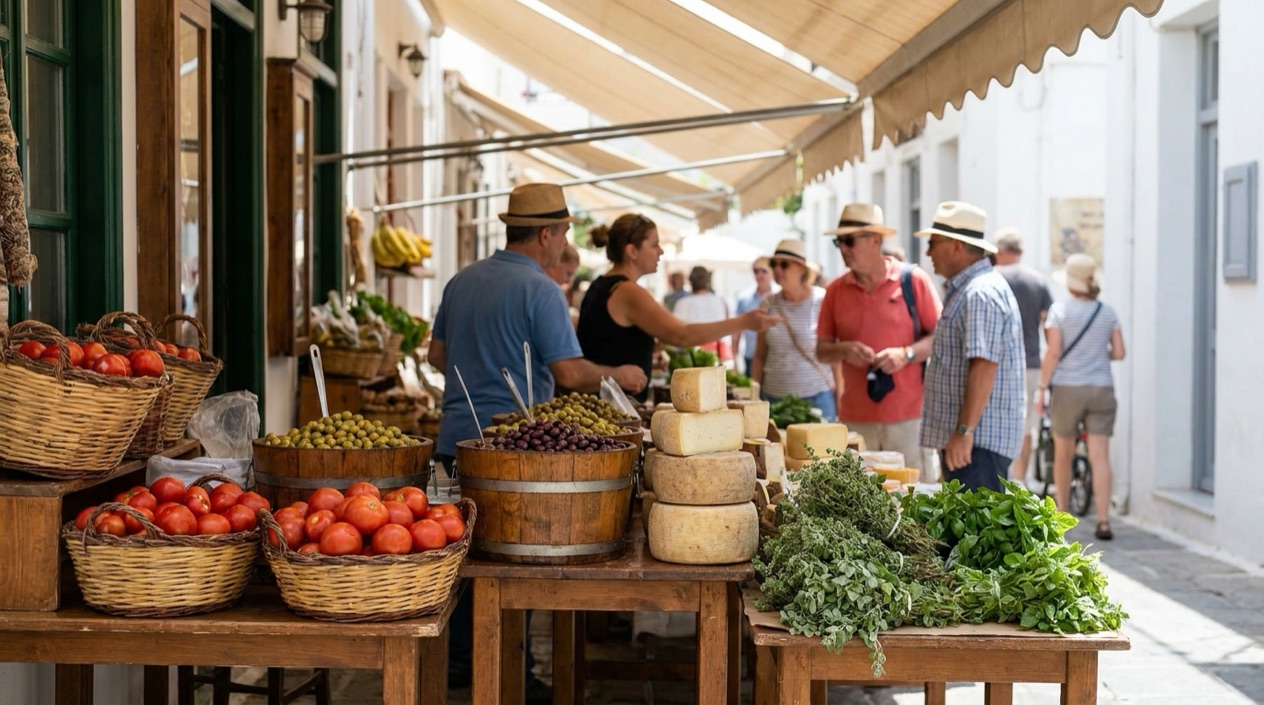
Bread arrives without being asked for, and the plates keep coming in the middle of the table for everyone to share. Vegetables and olive oil sit at the center of Greek cooking, and the Orthodox habit of fasting has left a whole repertoire of dishes made without meat.
Can you eat vegetarian in Greece?
Yes, and without much effort, because the cuisine rests on wheat, olive oil and wine, with vegetables, grains and cheese filling out the table. Olive oil is used in most dishes, and the herbs are the ones you smell in any Greek kitchen: oregano, mint, dill, garlic and onion. Since 2013 the Mediterranean diet has been on UNESCO’s Intangible Cultural Heritage Lists in Greece’s name.
What you will not find outside Athens and Thessaloniki are restaurants that cater strictly to vegetarians and vegans. Those places are practically non-existent elsewhere, so the way to eat well is to use the ordinary taverna and estiatorio, the home-cooking restaurants found across the country. You build a meal from the starters and the vegetable dishes, and you end up eating better than a single “vegetarian option” would give you.
The meze table
Think of a meal as a spread rather than a plate. Greek salad is the anchor: tomatoes, cucumber, onion, olives and a block of feta, dressed with olive oil alone. Lettuce and vinaigrette show up only in the most tourist-oriented restaurants, so a salad that arrives that way tells you something about the room.
Around it you can order fried zucchini, eggplant dishes, dolmades filled with rice and herbs, spinach pie, fava (a purée of yellow split peas), tzatziki and the baked beans called gigantes. Pull in a basket of bread and a few of these and you have a long, unhurried dinner. Fish dishes are common on the coast and the islands, so on a seaside menu the meat-free plates sit beside the grilled catch, not in place of it.
Breakfast and the pie shops
Bougatsa is a popular breakfast, sold mainly in bougatsadika, shops that also sell pies, pastries and drinks. The pastry is baked in flaky sheets and cut into squares to order, and the cheese and custard versions need no meat at all. You eat it standing at the counter or at a small table with a coffee.
The same shops are a good place to look for a cheese pie or a spinach pie when you want something light in the middle of the day. Because the pies are made in sheets and sold by the piece, you can try two or three kinds without committing to a sit-down meal.
Island dishes: Santorini and Crete
On Santorini, tomatokeftedes are the dish to look for. These tomato fritters are well known across the island, crisp at the edges and soft inside, and they turn up on taverna menus as a starter to share. They suit a plate of olives and a glass of something cold on a terrace.
On Crete the egg dish staka me ayga puts poached or fried eggs with staka, a buttery cream mixed with flour. It is rich and meat-free, a breakfast or brunch plate for anyone who wants something hearty. On Crete, tsikoudia is the most common aperitif, poured before the food arrives, and on Lesbos the local spirit is ouzo, for which the island is particularly famous.
Sweets, yogurt and ice cream
Genuine Greek yogurt carries 10% fat, which is why a bowl with honey and walnuts feels like dessert rather than a diet breakfast. It is quite different from the store yogurts you may know. Baklava layers tissue-thin pastry with honey, cinnamon and chopped walnuts, and many sugar bakeries sell it by the piece.
Those same bakeries sell locally made ice cream by the weight, which works out much cheaper than at the ice cream kiosks. Mastic, the aromatic resin grown on the island of Chios, flavors sweets, spoon preserves and ice cream, and gives them a resinous, faintly pine-like taste. Seasonal fruit rounds things off: strawberries and cherries appear in the markets from May, while kiwis and oranges are the fruits of winter.
What are fasting dishes?
Fasting dishes are the meals of the Orthodox fasting periods, cooked without meat and traditionally without dairy, and in Greek they are called nistisima. They grew out of the church calendar, which sets aside stretches of the year when people give up animal products, and the food that filled those weeks became part of everyday cooking. A great deal of what you will happily eat in a taverna belongs to this family, even when nobody is fasting.
The logic is simple: olive oil replaces butter, and beans, lentils, greens, grains and vegetables carry the meal. That is why the cuisine reads so well to a vegetarian, and why many of the plates need no adapting at all. Dates for the fasting periods move with the church calendar, so what you see on menus and in bakery windows shifts through the year.
Beans, greens and the olive oil pot
The core of the fasting table is slow-cooked pulses and vegetables. Fasolada is a bean soup with tomato, carrot and olive oil, often called a national dish. Lentil soup, gigantes baked in tomato sauce, and briam, a tray of potatoes, zucchini and eggplant roasted with olive oil, belong to the same family.
Horta, wild or cultivated greens boiled and dressed with olive oil and lemon, appear as a side on nearly every table. Spanakorizo, spinach cooked with rice, and rice-stuffed tomatoes and peppers called gemista are also made without meat when prepared in the fasting style. These dishes are often served at room temperature, which suits a long lunch with bread to mop up the oil.
Spreads, olives and the bakery counter
Meze for fasting days leans on spreads and pickles: taramosalata, made from fish roe, is the best known, along with fava, olives, capers and pickled vegetables. Bakeries bake lagana, a flat bread, and sesame-covered rings called koulouri, while tahini and halva give a sweet note without dairy.
Greek cuisine also leans on herbs and spices more than many of its neighbors, so even the plainest bean dish tastes lively. Cumin, dill, mint and bay laurel leaves flavor the pot, and oregano gets scattered over almost everything that comes off the grill or out of the oven.
Sweets without milk
Sweets of the fasting kind are made with olive oil, nuts, honey and fruit. Semolina halva, walnut cakes, spoon sweets (preserved fruit served on a small plate with a glass of water) and honey-soaked pastries fill the bakery windows. Fresh milk is sold only for a few days after production under Greek law, which makes it relatively expensive, so oil-based baking is a natural fit.
Baklava, with its honey, cinnamon and walnuts, sits comfortably alongside these. Order it with a small Greek coffee and you have an afternoon snack that works whether or not you are following any fast.
How do you order?
You order the way Greeks do: several plates for the middle of the table, brought out as they are ready, with bread and a drink to go with them. Do not expect starters and mains in separate courses.
At the table
Soon after you sit down, water and bread are brought to the table. When you ask for the bill, a small free dessert usually follows, often a slice of fruit, a spoon sweet or a little cake. Both are customary, not extras you need to request.
Timing matters. Greeks lunch in mid-afternoon and dine late in the evening, and in the hottest months dinner slides later still, as late as the small hours of the night in some places. Tourist establishments may open as early as noon, so a quiet early table is easier to find there, while a local place will fill only after the sun goes down.
Reading the menu
A few signs help you pick a place where the cooking is home-style. Desserts listed on the menu, large food posters outside, waiters calling to passersby, or plates cleared while diners are still seated are all bad signs for authenticity. A short menu where the vegetable dishes are written out plainly is a better one.
If a menu lists fish, remember that fresh fish is sold by the kilogram and can be very expensive, so ask the cost of your portion before ordering. Frozen seafood has to be marked as such by law. None of this affects a vegetable meal, but it is worth knowing when the table includes a friend who eats fish.
What to drink with it
A carafe of wine, a glass of ouzo clouded with water, or on Crete a small glass of tsikoudia all go well with a table of meze. Ouzo is poured with ice and water and sipped slowly beside the olives and cheese. The drink gives the meal its pace, and nobody is in a hurry to clear the plates.
Good to know before you go
Tavernas and estiatoria serve home cooking at affordable prices to locals and visitors alike, and many restaurants add an official cover fee per person to the bill. If the figure creeps toward the top of the range, consider eating somewhere else.
| Fee | Amount | Who pays |
|---|---|---|
| Restaurant cover fee | €0.30 to €2 per person | Each diner |
Sources
- Wikipedia, Greek cuisine (https://en.wikipedia.org/wiki/Greek_cuisine), checked October 12, 2026
- Wikivoyage, Greek cuisine (https://en.wikivoyage.org/wiki/Greek_cuisine), checked October 12, 2026
- Wikivoyage, Greece, section Eat (https://en.wikivoyage.org/wiki/Greece#Eat), checked October 12, 2026
To plan your stay
- Best Time to Visit Greece: September and Late May to Early June
- Arachova: Parnassus Mountain Town, Formaela Cheese, Ski Season and Saint George's Day
- American Airlines Flights to Greece: U.S. Cities, Athens Arrivals and Onward Island Flights
- Greece on a Budget: Cash Machines, Cards, Beaches and Ferries