
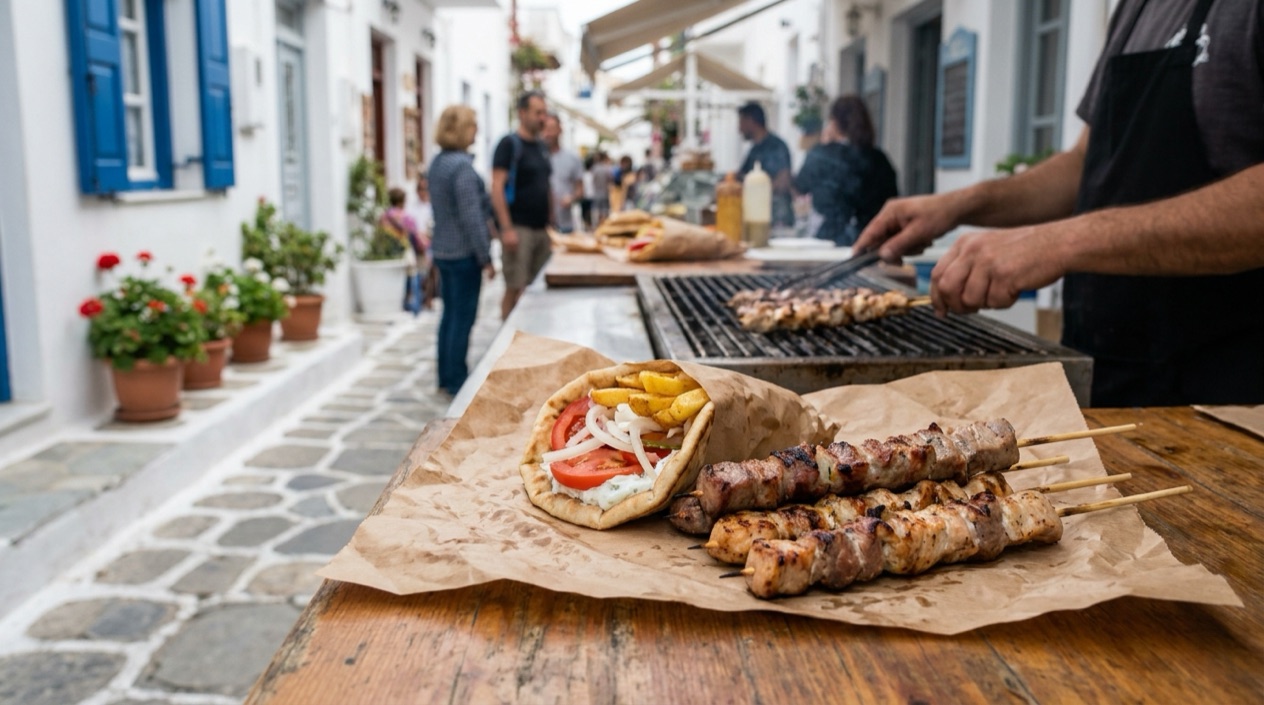
A cone of meat turns slowly in front of the heat, a cook shaves it into a pita that has just been oiled and warmed on the grill, and the smell of fat, oregano and fried potatoes reaches the pavement before you reach the counter. Across Greece the best quick meals are eaten standing up, from paper, with a napkin wrapped around the bottom of the wrap. From skewers and spits to flaky pies and spoonfuls of ice cream sold by weight, this is a country where lunch often fits in one hand.
What street food can you eat in Greece?
You can eat grilled meat in pita, flaky pies, custard pastries, fritters, sesame bread and ice cream, all of it built from the same pantry of olive oil, wheat, herbs and cheese. Greek cooking rests on the triad of wheat, olive oil and wine, and olive oil runs through most dishes, which is why even the humblest snack tastes of it. The classics are gyros and souvlaki, but the breakfast pies and the sweets are just as much a part of eating on the move.
Oregano, garlic, onion, mint and dill appear more often in Greek kitchens than in other Mediterranean ones, and you taste them even in a snack that costs very little. Lemon often arrives alongside, squeezed over the meat or the pie.
Gyros, the spit-roasted wrap
Gyros is meat cooked on a vertical rotisserie, sliced off in thin shavings and served wrapped in pita with tomato, onion, fried potatoes and tzatziki, the cool yogurt and cucumber sauce. In Greece the pita is oiled and lightly grilled, then rolled up around the filling. Some cooks in northern Greece add ketchup or mustard instead of tzatziki, so the wrap changes a little as you travel.
When the meat is cut by hand, thin round slices are stacked on the spit and seasoned, with trimmings of fat laid between them so the cone bastes itself as it turns. That is why a good spit looks glossy and dark at the edges.
By 1970 the gyros wrap was already a popular fast food in Athens, and it had crossed the Atlantic to Chicago and New York City. The gyros sold in the United States is typically a mass-produced mix of ground beef and lamb, so the Greek version, shaved from stacked slices, will taste different from what you know at home.
Souvlaki and kalamaki, the skewer
Souvlaki is small pieces of meat, sometimes with vegetables, grilled on a skewer. In Greece and Cyprus the meat is usually pork. You can eat it straight off the stick while it is still hot, or have it slid into a rolled pita with the same trimmings as a gyros, which makes it a close cousin of the wrap.
The modern fast-food version began to sell widely in the 1960s, after vendors from Boeotia introduced it. The idea itself is much older, and you can find pieces of grilled meat on sticks in the writing of French traveler Gustave Flaubert, who saw them in the Boeotian countryside. On Corfu, a tomato-based red sauce goes onto the souvlaki, a local touch you will not find everywhere.
Bougatsa and the pie counters
Bougatsa is a popular breakfast food, sold mainly in shops called bougatsadika. These places sell bougatsa alongside pies, pastries and hot or cold drinks, so a stop there is a full morning meal. A sweet bougatsa arrives cut into squares, usually dusted with sugar and cinnamon, and the savory kind is filled with cheese or minced meat.
Beyond the bougatsadika you will see trays of spinach and cheese pies, and rings of sesame-covered bread called koulouri, carried and sold from stands and bakeries.
Sweets, ice cream and a taste of mastic
Baklava is tissue-thin layers of pastry with honey, cinnamon and chopped walnuts, sold in sticky diamonds from bakery trays. Greek sugar bakeries also sell locally made ice cream by the weight, and it is much cheaper than at ice cream kiosks, so scoops there are worth the detour. Loukoumades, the honey-soaked fried dough balls, are another sweet you may meet in snack shops and cafés.
If you see anything flavored with mastic, the aromatic resin grown on the island of Chios, try it. It tastes faintly of pine and flowers and appears in sweets, spoon desserts and ice cream. Genuine Greek yogurt, with honey, is the other small pleasure of the sweet side, thick and rich where store-bought tubs at home are thinner.
Where do you find it?
You find it in small grill shops, bakeries, bougatsadika, sugar bakeries, tavernas and the fast food chains of the towns, with each city and island adding its own twist. The shops are often little more than a counter, a spit or a grill and a few stools, and the cook is also the cashier. Because Greece is a country of islands and mainland regions, what you eat standing up depends a lot on where you stand.
Athens and the south: souvlaki, kalamaki and the vocabulary
In Athens and the rest of southern Greece, the skewered meat is called kalamaki, while the word souvlaki is used for gyros and for almost any kind of pita wrap. So a request for a souvlaki in the capital can bring you a wrap of spit-roasted meat, while a kalamaki is the grilled skewer, often eaten with the stick in hand.
This is the part of the country where gyros and souvlaki counters are most familiar to visitors. Look for the spit turning in the window, the pile of warm pita beside it and the cook rolling each wrap in paper in a few seconds. Many places also sell the meat by the plate, with fries and salad, when you want to sit.
Thessaloniki and the north: the words change
In Thessaloniki the names swap around. There, souvlaki is the skewered dish that Athenians call kalamaki, and kalamaki has nothing to do with it. Gyros refers only to the meat on the spit, and the wrap itself is called a sandwich, so you can order a gyros sandwich and be perfectly understood.
In Macedonia and other regions of northern Greece the common word for the skewer is simply souvlaki. Ketchup or mustard sometimes turn up inside the wrap in the north, which surprises people who expected only tzatziki. The city is also a good place for the bakery-style snacks, since pies and sweet pastries fill its shop windows.
Bakeries and sugar shops everywhere
Bougatsadika are the places for a sweet or savory breakfast, and you can spot them by the trays of pie sheets and the large round pans on the counter. Many also serve tea, coffee and other drinks, so you can sit at a small table instead of eating on foot.
Sugar bakeries, the zacharoplastia, are the other stop. They sell sweets, baklava and ice cream scooped and weighed. If you want a sandwich-style lunch from a chain, Goody’s is a popular fast food chain in Greece, where a hamburger with a Coke costs €3-5.
The islands: tomato fritters, fish and aperitifs
Fish dishes are common in coastal regions and on the islands, and snack-sized versions turn up near the harbors. On Santorini, tomatokeftedes, or tomato fritters, are well known throughout the island, crisp outside and soft inside with herbs through the batter. They are usually served at tavernas, as a plate to share.
On Crete, you may meet staka me ayga, eggs poached or fried in a buttery cream called staka, and tsikoudia, the most common aperitif. Lesbos is particularly famous for its ouzo, the anise spirit that clouds when you add water. Both go with small plates in the evening, long after the souvlaki counters have done the daytime work.
How do you order?
You order by naming the dish and the filling, in the local word for it, and you point at what you want when the words fail. At a counter you say gyros or souvlaki, add pork or chicken if the shop offers both, and say what you want inside. The cook builds the wrap while you watch, so a wave of the hand or a small nod covers most of it.
Reading the menu: gyros, souvlaki, kalamaki
The one real trap is the vocabulary. In Athens, ask for a kalamaki if you want the skewer and a souvlaki if you want a pita wrap, since souvlaki is used loosely for any kind of wrap there. In Thessaloniki, ask for a souvlaki for the skewer and a sandwich for the wrap with the spit meat.
If you get the wrong thing, nobody minds, and it usually tastes good anyway. A plate of meat, a pita and a few sides can also be ordered separately, which suits two people who want to share.
Building the wrap
A gyros in Greece customarily comes with sliced tomatoes, chopped onions and fried potatoes, rolled inside an oiled, lightly grilled pita, and often topped with tzatziki. The potatoes go inside the wrap, not on the side, which is the detail that surprises visitors who know a different version of the dish.
If you do not want something, such as onion, say so while the cook is assembling it. Take the wrap in its paper and eat it from the bottom, folding the paper up as you go so the sauce stays in. Napkins are on the counter, so take a handful.
Sitting down at a taverna instead
A taverna or an estiatorio serves home cooking at affordable prices, to locals and to tourists, and it is the place for a longer meal with several shared plates. Water and bread arrive soon after you sit, and a small free dessert comes when you ask for the bill. Greeks lunch in the mid-afternoon and dine late in the evening, though places that cater to tourists may open earlier.
Greek salad is traditionally dressed only with olive oil, with a slab of feta on top, and lettuce or vinaigrette tend to appear only in the most tourist-oriented restaurants. Frozen seafood must be marked as such on the menu by law, and fresh fish is sold by the kilogram and can be very expensive, so ask the cost of your portion before ordering. Large food posters outside, waiters calling to passersby and plates taken away while you are still seated are bad signs.
Vegetarians will find plenty to eat in the pies, the fritters and the salads, but restaurants that cater strictly to vegans and vegetarians are practically non-existent outside Athens and Thessaloniki.
Good to know before you go
Dinner is the main meal in Greece, and in the hot summer months it is commonly eaten very late, so a street snack in the afternoon is a sensible way to get through the day. A cover fee is common in sit-down restaurants and shows up on the bill per person, while counters and bakeries have no such charge. If the cover fee runs toward the top of the range, you may prefer to eat elsewhere.
| Fee | Amount | Who pays |
|---|---|---|
| Restaurant cover fee | €0.30 to €2 | Each diner |
Sources
- Wikipedia, Greek cuisine (https://en.wikipedia.org/wiki/Greek_cuisine), checked October 12, 2026
- Wikipedia, Gyros (https://en.wikipedia.org/wiki/Gyros), checked October 12, 2026
- Wikipedia, Souvlaki (https://en.wikipedia.org/wiki/Souvlaki), checked October 12, 2026
- Wikivoyage, Greek cuisine (https://en.wikivoyage.org/wiki/Greek_cuisine), checked October 12, 2026
- Wikivoyage, Greece, section Eat (https://en.wikivoyage.org/wiki/Greece#Eat), checked October 12, 2026
To plan your stay
- Best Time to Visit Greece: September and Late May to Early June
- Arachova: Parnassus Mountain Town, Formaela Cheese, Ski Season and Saint George's Day
- American Airlines Flights to Greece: U.S. Cities, Athens Arrivals and Onward Island Flights
- Greece on a Budget: Cash Machines, Cards, Beaches and Ferries