
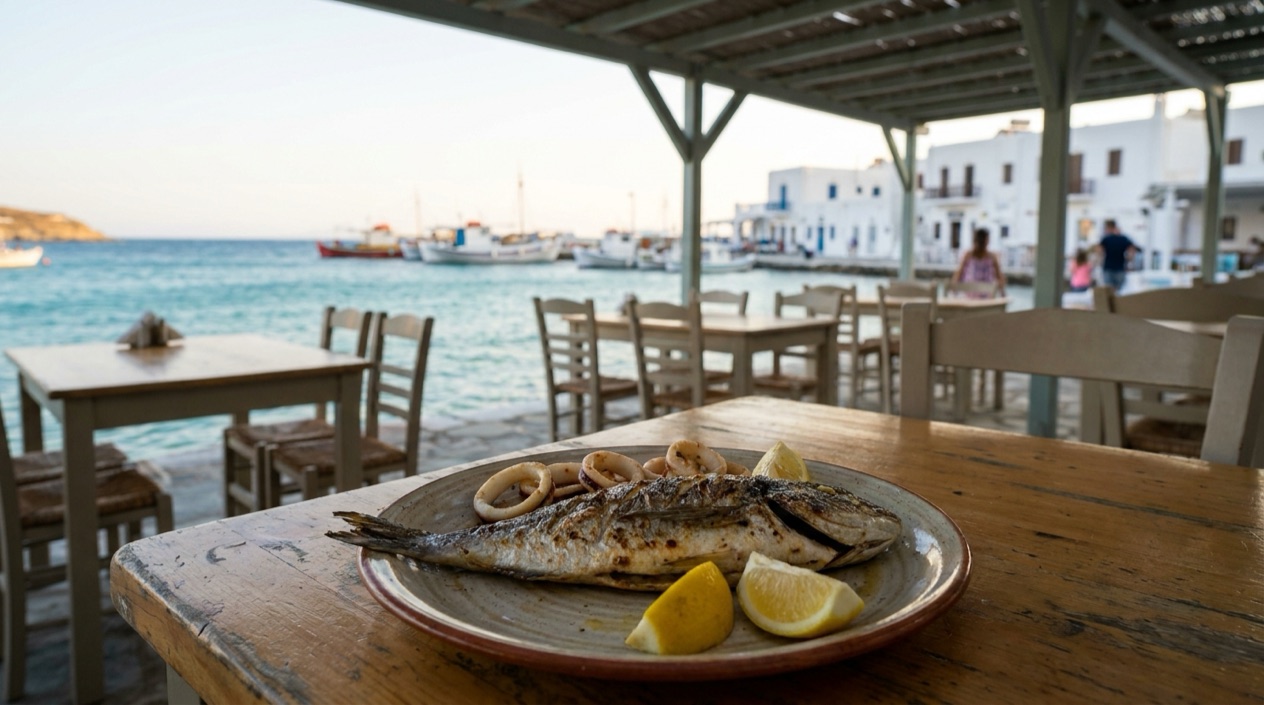
A plate of grilled octopus lands on a taverna table with a lemon half, a drizzle of olive oil and a scatter of oregano, and within a minute everyone is tearing at the bread. Small fried fish crackle in a basket, a bottle of ouzo sweats beside the water jug, and the evening stretches out without a clock. Seafood runs through Greek coastal life, on the islands and along the shore, and this is how to eat it well: what turns up on the table, how it is brought out and how the fish-by-weight system works.
What seafood do you find in Greece?
You find fish and shellfish in nearly every form on the coasts and islands, from grilled octopus and fried squid to whole fish cooked over charcoal, mussels in tomato sauce and the cured roe of the mullet. Fish dishes are common in coastal regions and on the islands, and the habit is old. Ancient Greek cooking rested on wheat, olive oil and wine, with meat rarely eaten and fish more common, and fish stayed central for coastal dwellers through Byzantine times.
Today that history shows up as a table of small dishes shared among friends. Olive oil is the most characteristic and ancient element of the cuisine and goes into most dishes, so even the simplest grilled catch arrives glossy with it. Lemon, which has been in Greek cooking for a very long time, sharpens almost everything, and oregano, garlic, dill and bay leaf do the seasoning.
Octopus, squid and the little fried fish
Octopus is the dish people picture first. It comes grilled until the tentacles turn smoky and slightly charred at the tips, or sliced and dressed with olive oil, vinegar and oregano as a cold plate. Squid arrives as kalamarakia, rings or whole little bodies lightly floured and fried, then squeezed with lemon and eaten hot.
Alongside them come the small fish that sit in a heap on a platter: sardines, anchovies and whitebait-style fry that you eat whole, bones and all, with your fingers. They are the kind of order that suits a long table, because one plate disappears quickly and the next one is already being discussed. A squeeze of lemon, a piece of bread and a cold drink are all they need.
Shrimp, mussels and fish soup
Shellfish tend to arrive cooked in a pan with something bright. Shrimp saganaki is baked in a small dish with tomato and feta, and mussels may come steamed with wine or in a spicy tomato sauce, with bread for mopping. These are the plates that turn into a conversation, since everyone reaches in with a fork or a piece of crust.
Fish soup is the quieter pleasure. Simmered with vegetables, olive oil and lemon, it is the kind of dish that tastes of the sea without a trace of heaviness. The fish and vegetables are often served on a separate platter from the broth, which makes it a meal in two parts.
Avgotaracho, the roe of Messolonghi
Avgotaracho Messolongiou is the most specific seafood product on the Greek table. It is a PDO product, made from flathead mullet caught in the Messolonghi-Etoliko Lagoons. The roe is cured and sold as a firm, amber-colored slab, and it is usually served in thin slices as a meze, with bread or something crisp.
Its flavor is salty, briny and deep, and a few slices go a long way next to a glass of something clear and cold. It makes a good small order when a table is deciding what to eat first, and it is a taste you will not find in this form outside Greece.
Seafood on the islands
On the islands, fish is simply what the kitchen cooks. Each island adds its own side plates, and some of them are not seafood at all. On Santorini, for instance, tomatokeftedes, tomato fritters well known across the island, often sit on the table beside the fish, crisp outside and soft within.
A Greek salad with feta, which can be bought packed or by the weight in shops, tends to arrive in the middle of a seafood meal too. Its only dressing, traditionally, is olive oil, and it cuts through the richness of anything fried.
How is it served?
Greek seafood is served plainly and in shared portions, grilled over charcoal, fried or simmered in olive oil and lemon, with bread and salad set in the middle of the table. The aim is to let the catch taste of itself. Dishes arrive as they are ready, not in courses, and a meal builds slowly as plates are added.
Grilled, fried and dressed with lemon
A whole fish is often grilled and then dressed at the table or in the kitchen with ladolemono, a simple mix of olive oil and lemon, sometimes with a little oregano. The skin turns crisp, the flesh stays moist, and the plate is carved or handed to you whole so that you can pick the best pieces off the bone.
Fried fish takes a lighter touch, a dusting of flour and hot oil, with lemon wedges on the side. Octopus and squid follow the same logic of fire or oil. Vegetables cooked in olive oil, such as boiled wild greens or roasted peppers, show up beside them as a counterweight.
Meze and a glass of something clear
Seafood and anise spirits belong together. Ouzo, for which the island of Lesbos is particularly famous, turns cloudy when water is added, and it is poured next to small plates of octopus, roe or fried fish. On Crete the most common aperitif is tsikoudia, a clear, strong spirit that arrives in small glasses, often with a small plate to go with it.
These drinks are sipped slowly, which suits the pace of a seafood meal. You do not rush a bottle of ouzo, and nobody rushes the table either. A cold glass, a shared plate and a pause between bites are part of the rhythm.
The rhythm of the table
Dinner is the main meal in Greece, and in the hot summer months it is commonly eaten as late as 21:00 or 22:00. Greeks tend to dine from about 21:00 to 23:00, though tourist establishments may open earlier.
Soon after you sit down, you are customarily brought water and bread. When you ask for the bill, a small free dessert often comes with it, which is simply how a meal is closed. Taverna and estiatorio, the two kinds of eating house you will meet everywhere, serve home cooking at affordable prices to locals and visitors alike.
What to eat beside the fish
A seafood table is rarely only seafood. Greek salad, with a block of feta on top, is nearly always there. Bread soaks up the olive oil and lemon from the plates, and a few vegetable dishes round things out. Dessert is often a small plate of fruit or something sweet, offered as the table clears.
Strawberries and cherries appear in Greek markets from May onwards, and oranges and kiwis are the fruits of winter, so what ends your meal changes with the season. If you want something richer, baklava is made from tissue-thin layers of pastry with honey, cinnamon and chopped walnuts, and Greek yogurt with honey is a lighter choice.
How do you order by weight?
You order fresh fish by weight because it is sold by the kilogram, which means the price on the menu is per unit of weight and the final bill depends on the size of the fish you choose. It is a different way of ordering from picking a dish off a list, and it is where a seafood meal can become expensive without anyone noticing.
Fresh fish in Greece can be very expensive, and budget diners should ask the cost of their portion before ordering. That one question solves most of the surprise. Ask what the fish weighs and what it will cost, and you can decide with a clear head.
How the process works
At a taverna that sells whole fish, you are often shown what is available. The server may bring a tray or point to a display, tell you the names of the fish and the price per kilogram, and then weigh your choice. Whole fish is usually priced this way, while octopus, squid, shrimp and the fried small fish tend to be ordered as plates from the menu.
Once you have chosen, the fish goes to the grill or the pan. It is cooked whole, brought to the table with oil and lemon, and often filleted for you or left for you to pick through. Treat the order as a shared dish, because a large fish is built to feed a table rather than a single person.
Reading the menu: fresh and frozen
By law, frozen seafood must be marked as such on the menu in Greece. A small note beside a dish tells you the item was frozen, and it is worth looking for. Anything not marked is presented as fresh, and fresh fish is the one sold by weight at the higher prices.
Plates such as fried squid or shrimp may carry that note, which is a reason prices on the menu vary from one dish to the next. Knowing the difference helps you judge what you are paying for, and it lets you choose a frozen plate for a lighter bill or a fresh whole fish for a bigger occasion.
Choosing a place that serves well
A few signs suggest a restaurant is not serving food as locals eat it. Desserts listed on the menu, large food posters outside, waiters calling out to passersby, or plates being taken away while diners are still seated are all bad signs. A better one is a kitchen that brings water and bread and a small free dessert at the end without being asked.
Menus that are short and focused on the catch tend to inspire more confidence than long ones that try to cover everything. Restaurants that cater strictly to vegans and vegetarians are practically non-existent outside Athens and Thessaloniki, so travelers who avoid fish will find vegetable dishes and salads at seafood tables instead, such as tomato fritters on Santorini or horta, boiled wild greens, with olive oil.
Good to know before you go
Seafood meals are long and unhurried, and dinner starts late, so plan an evening around the table rather than around the next stop. Ask about the price of a fish portion before you order, and read the menu for the frozen marking. Some restaurants charge a cover fee officially for bread and the table, and if it leans toward the top of the range, you may prefer to eat elsewhere.
| Fee | Amount | Who pays |
|---|---|---|
| Restaurant cover fee | €0.30 to €2 per person | Each diner |
Sources
- Wikipedia, Greek cuisine (https://en.wikipedia.org/wiki/Greek_cuisine), checked October 12, 2026
- Wikivoyage, Greek cuisine (https://en.wikivoyage.org/wiki/Greek_cuisine), checked October 12, 2026
- Wikivoyage, Greece, section Eat (https://en.wikivoyage.org/wiki/Greece#Eat), checked October 12, 2026
To plan your stay
- Best Time to Visit Greece: September and Late May to Early June
- Arachova: Parnassus Mountain Town, Formaela Cheese, Ski Season and Saint George's Day
- American Airlines Flights to Greece: U.S. Cities, Athens Arrivals and Onward Island Flights
- Greece on a Budget: Cash Machines, Cards, Beaches and Ferries