
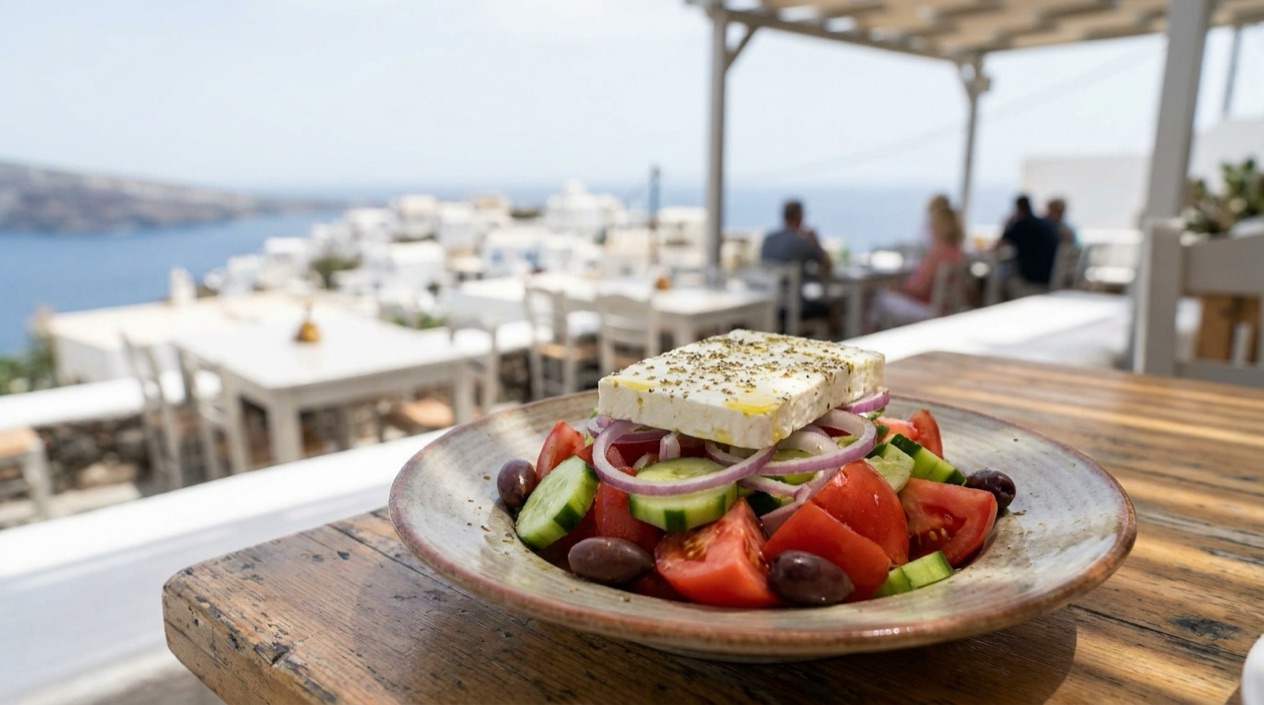
A plate lands in the middle of the table: thick wedges of tomato, cucumber half-moons, red onion rings, a slab of feta laid on top like a lid, a scatter of dark olives, and a pool of green-gold oil that has already started to mix with the tomato juice. Someone tears bread, someone reaches for the oregano. In a Greek taverna this is how a long lunch or a late dinner begins, and the salad deserves to be understood before you order it.
What is a Greek salad?
A Greek salad is a plate of tomatoes, cucumbers, onion, feta and olives, dressed with salt, Greek oregano and olive oil, and in Greece it usually goes by the name horiatiki, or choriatiki, which means village salad or rustic salad. The name tells you the idea: it is a farm-table dish, built from what grows around a village and put on a plate in big, unfussy pieces.
It is not a dish of careful arrangement. Vegetables are cut in chunks rather than slivers, the feta arrives as a piece rather than crumbles, and the dressing is simply what the plate collects at the bottom. That juice of tomato and oil is part of the dish, not a leftover.
Horiatiki on the Greek table
Horiatiki sits among the shared dishes of a taverna meal, next to grilled meat, fried fish or a pan of baked vegetables. Taverna and estiatorio, the sit-down restaurant serving home cooking, are widespread in Greece, and nearly every one has this salad on the menu. It is the plate people order first, before anyone has decided on anything else.
Olive oil is the most characteristic and ancient element of Greek cooking, and this salad is where it shows most plainly. There is nothing to hide behind. The oil is poured generously over the vegetables, and its taste, fruity or peppery or grassy, is part of what you are eating.
Greek cuisine rests on wheat, olive oil and wine, and the Mediterranean diet that grew from it has been on the UNESCO Intangible Cultural Heritage Lists since 2013. A plate of horiatiki with a piece of bread is that diet in miniature.
The salad outside Greece
Americans often know a different dish under the same name. Outside Greece, a Greek salad may be a lettuce salad with Greek-inspired ingredients, while the original has no lettuce at all. In the American version, lettuce, tomatoes, feta and olives are the standard elements, and local habits add more.
In Detroit, beets may turn up in the bowl. In the Tampa Bay area, a scoop of potato salad may sit alongside. Neither would be recognized on a taverna table in Greece, so if you are used to the bowl of greens at home, expect a plainer, juicier plate that you eat with bread.
A cousin from Cyprus
Cypriot salad, native to Cyprus, is a close relative. It is made with finely chopped tomatoes, capers, cucumbers, onions and flat-leaf parsley, with feta, and dressed with olive oil and lemon or red wine vinegar. The chopping is the main difference: where horiatiki is chunky, the Cypriot version is cut small, and the capers and parsley give it a sharper, greener taste. If you see it on a menu in Greece, it is a separate dish with its own name, not a variation of horiatiki.
What goes in it?
Tomatoes, cucumbers, onion, feta and olives, typically Kalamata olives, make up the salad, with salt, Greek oregano and olive oil as the only seasoning. Everything else on a plate is an addition, and a few of those additions are tied to particular places.
The core plate
The tomato gives juice and sweetness, the cucumber gives cool crunch, and the onion gives bite. Olives bring salt and a slight bitterness, and the feta gives creamy tang. Feta has a central place in the salad and in the Greek kitchen generally, and in markets it is sold both packed and by the weight.
Oregano is the herb that makes it Greek. Greek cooking uses oregano, mint, garlic, onion, dill, cumin and bay leaves more often than other Mediterranean cuisines do, and a pinch of dried oregano crushed over the feta is what you smell first when the plate arrives. Then comes the oil, poured over the top.
Additions from place to place
Small variations follow the map. Lemon juice sometimes goes in, and so does green bell pepper, cut into thin rings. On the Cyclades islands, caper berries are a common addition, the pickled fruit of the caper plant, with a salty, tart pop among the tomatoes. In Northern Greece, mint or parsley is often added as decoration.
On the island of Hydra, the cucumber in the salad is peeled, a small habit that makes the plate look and eat differently from one with striped green skin. These are the kinds of details worth noticing as you move from island to island, because the same name on the menu can come with a slightly different plate.
What stays out
Lettuce is the main absence. The original salad has none, and a version dressed with vinaigrette and heaped on greens is a sign of the most tourist-oriented restaurants. Greek salad is traditionally dressed only with olive oil, so vinegar and bottled dressing do not belong on it.
If you ask for the salad and receive a bowl of shredded lettuce with a sweet-sour dressing, you have found the kind of place that cooks for the idea of Greece rather than for Greeks. The plain plate of chunky vegetables, cheese and oil is what you are looking for.
Other tomato dishes worth knowing
If the tomatoes in a salad impress you, there are other ways to meet them. Tomatokeftedes, tomato fritters, are well known throughout the island of Santorini, where they come to the table crisp outside and soft within, flecked with herbs. They make a good companion to a salad when you want something fried alongside something raw.
Vegetables, olive oil and grains are the base of Greek cooking, and many dishes beyond the salad build on exactly these. Once you have eaten horiatiki, the logic of a taverna menu starts to make sense.
How is it served?
A Greek salad is served as a shared plate, left unmixed, with the feta sitting whole on top and bread alongside for the juices. It is conventionally brought to the table without being tossed, so you see each ingredient before you start, and you break up the cheese and mix the plate yourself, or just spear a bit of everything with your fork.
At the taverna table
Soon after you sit down, it is customary in Greece to be brought water and bread. The salad follows, and it is meant for sharing, in the middle of the table with other dishes. When the plate is nearly empty, what remains is a pool of tomato juice and oil, and in informal settings it is not unusual to dip bread into it. That last bit is often the best part.
Dinner is the main meal in Greece. Greeks dine around 21:00 to 23:00, and lunch is around 14:00 to 15:00, though tourist establishments may open as early as 12:00. If you arrive at an empty taverna at an early hour, the salad is still there, but the room fills later in the evening, when the meal becomes a long, slow affair.
When you ask for the bill, it is customary to receive a small free dessert, often something sweet and simple to finish the meal. This is a gesture of hospitality, not an extra course you ordered.
What to eat and drink around it
Fish dishes are common in coastal regions and on the islands, and a salad is the natural partner to grilled fish. Fresh fish is sold by the kilogram and can be very expensive, so budget diners should ask the cost of their portion before ordering. By law, frozen seafood must be marked as such on the menu.
For a drink, the island of Lesbos is particularly famous for its ouzo, the anise-flavored spirit that turns cloudy when water is added. On Crete, tsikoudia is the most common aperitif. Both fit the salty, oily, herb-scented plate, which is built for something sharp alongside.
In the morning, the Greek table is different. Bougatsa, a popular breakfast, comes mainly from bougatsadika, shops that sell bougatsa, pies, pastries and drinks. On Crete, staka me ayga, poached or fried eggs with a buttery cream called staka, is another breakfast dish. Neither includes a salad, but they show how much of Greek eating is built on simple, local things.
Spotting a good place
A few signs point to a restaurant cooking for tourists rather than for locals: desserts listed on the menu, large food posters outside, waiters calling to passersby, or plates being taken away while diners are still seated. The opposite signs are a handwritten menu, a crowd of Greek families, and a salad that arrives chunky and unmixed.
Taverna meals are generally affordable. Even a fast food chain like Goody’s, popular in Greece, sells a hamburger with Coke for €3-5, though the salad is the dish that shows you what a Greek kitchen does best. Restaurants strictly for vegans and vegetarians are practically non-existent outside Athens and Thessaloniki, but horiatiki is meat-free and cheese-based, and appears on nearly every menu.
Good to know before you go
Many restaurants officially charge a cover fee per person, which covers the bread and table setting. If it tends toward the top of the range, consider eating elsewhere. Bread and water arrive on their own, and a small dessert often comes with the bill. Ask the price of fresh fish before you order it, since it is sold by weight.
| Fee | Amount | Who pays |
|---|---|---|
| Restaurant cover fee | €0.30 to €2 | Each diner |
Sources
- Wikipedia, Greek cuisine (https://en.wikipedia.org/wiki/Greek_cuisine), checked October 12, 2026
- Wikipedia, Greek salad (https://en.wikipedia.org/wiki/Greek_salad), checked October 12, 2026
- Wikivoyage, Greek cuisine (https://en.wikivoyage.org/wiki/Greek_cuisine), checked October 12, 2026
- Wikivoyage, Greece, section Eat (https://en.wikivoyage.org/wiki/Greece#Eat), checked October 12, 2026
To plan your stay
- Best Time to Visit Greece: September and Late May to Early June
- Arachova: Parnassus Mountain Town, Formaela Cheese, Ski Season and Saint George's Day
- American Airlines Flights to Greece: U.S. Cities, Athens Arrivals and Onward Island Flights
- Greece on a Budget: Cash Machines, Cards, Beaches and Ferries