
A bell rings from a chapel above a harbor, a woman lights a thin candle at the door, and a visitor with bare shoulders wonders whether to step inside. Questions like this come up all over Greece, in island villages, city squares and monastery courtyards. The short answer: the Greek Orthodox Church is the Christian tradition behind most of the churches you will pass, and a visit goes best when you know what the name means, what to wear and how people behave inside.
What is the Greek Orthodox Church?
The Greek Orthodox Church is the Eastern Orthodox Christian tradition as it is lived in Greece, and the name is used in three different ways, which explains why guidebooks and locals do not always mean the same thing by it.
| Meaning of the term | What it refers to |
|---|---|
| Broad | The entire body of Orthodox (Chalcedonian) Christianity, also called Eastern Orthodox |
| Narrow | Independent churches in the Eastern Orthodox communion that keep Greek in formal church settings |
| Specific | The Church of Greece, operating within the modern borders of Greece |
The broad meaning is historical. Greek was once used to describe all Eastern Orthodox churches, because the word could point to the heritage of the Byzantine Empire.
Constantinople, the capital of that empire, was an early center of Christianity, and its liturgical practices, traditions and doctrines were gradually adopted throughout Eastern Orthodoxy. The Slavic and other Orthodox churches dropped the Greek label as their peoples’ national awakenings unfolded, beginning as early as the 10th century A.D.
The Church of Greece
When people in Athens speak of the Church, they usually mean the Church of Greece, a modern autocephalous church, which means it governs itself. Its headquarters are the Metropolitan Cathedral of Athens and Petraki Monastery, both in Athens. Its primate is Ieronymos II of Athens, who holds the title Archbishop of Athens and All Greece.
Its roots reach back to the early centuries. By the end of the 2nd century, metropolitan sees had developed in Thessaloniki, Corinth, Nicopolis, Philippi and Athens, which are names you will meet again as modern cities and ancient sites. The church declared its autocephaly in 1833, when the Bavarian Regents acted on behalf of King Otto, and the Ecumenical Patriarchate of Constantinople recognized it in 1850. Its services follow the Byzantine Rite.
Where the Church of Greece stops
The church’s canonical territory is confined to the borders of Greece before the Balkan Wars of 1912 and 1913, known as Old Greece. That is why its territory excludes Crete, the Dodecanese, Mount Athos and the Greek Orthodox churches of the diaspora. A church on Crete, then, belongs to a different structure from one in the Peloponnese, even though the icons, the chanting and the feast days look familiar from one to the other.
The Church of Crete remains under the direct jurisdiction of the Ecumenical Patriarchate of Constantinople, and the semi-autonomous Archdiocese of Crete is listed under that patriarchate. The autonomous Church of Sinai is also counted among Greek Orthodox churches. For a traveler this is background rather than a rule of the road: you enter a church in Heraklion or in Nafplio in the same way.
How it shows in the landscape
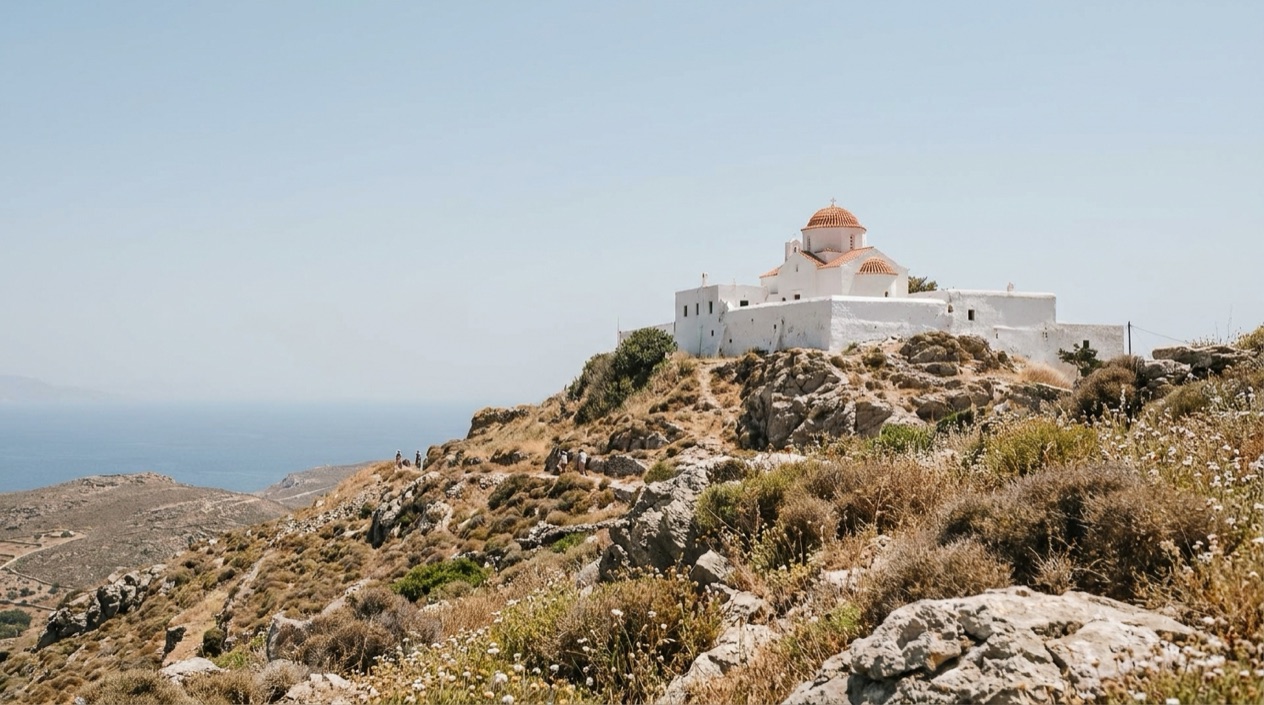
Church architecture changes with the region, so the building in front of you often says as much about the island as about the faith. Blue-domed churches and whitewashed homes characterize only the Cyclades, and Paros is one island where the whitewashed Cycladic houses stand. On Corfu you find pastel-colored baroque homes and churches. In Ermoupolis and Nafplion the Neoclassical style marks the town streets.
Seen this way, a walk through Greece becomes a walk past a living tradition, not only a set of monuments.
How do you visit a church?
You visit a Greek church by dressing for it, stepping in without fuss and treating it as a place where people are praying, not only as a sight. Dress codes for churches in Greece sometimes require women to cover their shoulders and both sexes to cover their knees. The word is sometimes: a tiny chapel on a hillside and a large monastery do not always ask the same thing, so it helps to carry a light layer in your bag.
Clothing at the door
At the entrance of churches and monasteries, especially those receiving most tourist traffic, appropriate clothing is usually available to borrow. You pick it up going in and drop it off on the way out. If you are in shorts or a sleeveless top after a morning on the beach, that is often enough to solve the problem without changing your plans.
Beach days and church visits often share the same day in the islands, and the contrast is part of Greece. A sarong or a long shirt in a day bag lets you step into a chapel on the way back from the shore, and the borrowed wrap is there when you did not plan ahead.
Inside the building
Inside, expect icons, candles and the scent of incense, and expect that someone may be lighting a candle or crossing themselves as you walk by. Visitors usually move slowly, speak softly and keep their phones away.
The Byzantine Rite uses chanting, so if you arrive during a service you may hear it before you see anything. Standing at the back for a few minutes costs nothing, and it tells you more about the Church than a plaque would.
Not every church is open to wander through, and a small village chapel may be a place where a family comes to pray rather than a sight. When a service is under way, the congregation comes first, so you take photographs with care or leave the camera down.
Monasteries and the seasons
Monasteries follow the same logic as churches, with clothing to borrow at the gate when the site receives visitors. Mount Athos lies outside the territory of the Church of Greece, so its own rules are separate and are not set by the habits described here.
The peak tourist season runs from May through September, when approximately 75% of all tourists arrive, and the vast majority of visitors come from April through October. From November through February the off season can be rewarding for visitors from more northerly climates, with mild temperatures, few tourists and reduced prices. In that quieter stretch a church visit often feels less like a stop in a schedule and more like part of a village’s ordinary day.
What are the customs?
The customs you notice most are small gestures, a candle at the door, a quick sign of the cross, and a handful of everyday habits that visitors are expected to respect, in church and out of it. Greece is a place where faith, food and festivals overlap, and a name day or a village feast can fill a square in the evening, so a bell or a chant is rarely far from daily life.
Gestures and manners
One gesture to avoid is holding up your palm with your fingers extended outwards. It is rude, it is known as the Mountza, and it is akin to giving someone the middle finger. A wave to a driver or a waiter should keep the hand loose and the palm turned in, and a nod or a smile does the work just as well.
Smoking is prohibited by law in all public places in Greece, such as restaurants and cafeterias. A hotline (1142) can be used to report people and establishments breaking the smoking ban. That rule matters at a church gate, in a courtyard café or on a taverna terrace, where it is easy to light up out of habit.
Candles, fire and the countryside
Candles are part of Orthodox worship, and lighting one at the entrance of a church is a gesture of respect. Outside, the picture changes. During the fire ban in Greece, every outdoor activity that could cause a forest fire is prohibited, including campfires, bonfires, barbecues, cookouts and fireworks. A picnic stove near a hillside chapel is the kind of thing the ban is about.
If you see a fire, call 112. Many chapels stand on slopes and headlands surrounded by dry scrub, and the ban is a reminder that a place of prayer and a stretch of countryside share the same hillside.
Beach manners and church manners
On all shores of the mainland and on most of the islands, Greece has nudist beaches where nudism is tolerated. Nudist hotels are located on Crete, Rhodes, Kefalonia and Zakynthos. Topless sunbathing, however, is not accepted outside the tourist areas, so what looks relaxed on one beach may draw glances on another.
The same idea of reading the setting applies when you leave the sand. A beach towel stays on the beach, a village square asks for a shirt, and a church asks for covered knees and, sometimes, covered shoulders. Locals do not make much of it, and a visitor who adjusts without being asked is generally noticed and appreciated.
Good to know before you go
The warmest time of the year starts in mid-July and generally lasts until mid-August, when the meltemi winds from the north cool Greece. Most Greeks avoid heavy physical activity outdoors between 13:00 and 17:00 in that stretch because of the strong midday sun, so a hilltop monastery or a chapel walk is something to plan around it.
The fine for causing a forest fire can be €200,000, a good reason to leave the lighter and the stove at the hotel.
Sources
- Wikipedia, Church of Greece (https://en.wikipedia.org/wiki/Church_of_Greece), checked October 12, 2026
- Wikipedia, Greek Orthodox Church (https://en.wikipedia.org/wiki/Greek_Orthodox_Church), checked October 12, 2026
- Wikivoyage, Greece, section Respect (https://en.wikivoyage.org/wiki/Greece#Respect), checked October 12, 2026
- Wikivoyage, Greece, section Understand (https://en.wikivoyage.org/wiki/Greece#Understand), checked October 12, 2026
To plan your stay
- Best Time to Visit Greece: September and Late May to Early June
- Arachova: Parnassus Mountain Town, Formaela Cheese, Ski Season and Saint George's Day
- American Airlines Flights to Greece: U.S. Cities, Athens Arrivals and Onward Island Flights
- Greece on a Budget: Cash Machines, Cards, Beaches and Ferries