
Somewhere between a ticket booth and a row of broken stones, almost every traveler in Greece starts asking who the figures on a painted pot are and why a name on a signpost sounds familiar. The short answer is that the myths were told long before they were written down, and they stayed attached to real ground: to Crete, to the mainland, to a harbor where a fleet once waited. Knowing a handful of stories turns a field of ruins into a place where something happened.
Which myths are tied to Greek places?
The myths most tied to places are the ones about the Trojan War and its aftermath, the adventures of Heracles, and the early stories of how the world began and who ruled it. Greek mythology is the body of stories the ancient Greeks told about the origin and nature of the world, the lives of gods and heroes, and their own cult and ritual practices.
It was never a single book. It was a spoken inheritance that singers carried from place to place, and the tellers were Minoan and Mycenaean singers as early as the 18th century BC.
That origin explains why the stories feel so local. A song sung in one valley and another sung on an island could share a hero but disagree about the details, and travelers still meet that patchwork today. A guidebook plaque gives one version, a village storyteller gives another, and both belong to the same tradition.
The stories of gods and the beginning of the world
Hesiod gathered the oldest layer in two poems, the Theogony and Works and Days. They tell how the world came into being, how one divine ruler followed another, how the human ages succeeded one another, where human troubles came from and why sacrifice became a practice. Modern readers sometimes divide the whole mythological history into three or four periods: the age of origins, when gods ruled, then a time when gods and mortals mingled freely, and finally the age of heroes.
For a traveler this sequence is a useful map in the head. A sanctuary tied to a god belongs to the first two stories, while a fortress tied to a hero belongs to the last. Once you sort a place into one of these layers, the carvings and the names around it start to fall into order.
The Trojan War and what came after
The war between Greece and Troy is told in Homer’s Iliad, and its aftermath lives in the Odyssey. The cycle begins well before the fighting, with Eris and the golden apple of Kallisti, then the Judgement of Paris, the abduction of Helen and the sacrifice of Iphigenia at Aulis. Each of these is a scene with a setting, and Aulis is a name you can look for on a map of Greece.
These stories are the ones you will hear most often on a trip, because they tie together so many places in one long chain. A fleet gathers, a daughter is offered, a city is besieged, a king struggles to get home. Anyone who has read a summary of the Iliad and the Odyssey before landing will recognize a surprising number of the names that surface in conversation.
Heracles and his labors
Heracles appears constantly in Greek art, and his twelve labors are among the best-loved sequences in the whole tradition. A curious detail from the research is that many of these myths show up on vases earlier than they do in literary sources. Of the twelve labors, only the Cerberus adventure appears in a literary text from the same period.
In practice this means that the image came first for many stories. When you stand in front of a painted vessel and see a hero wrestling a creature, you may be looking at one of the earliest records of the tale, older than any written version.
Where can you see them?
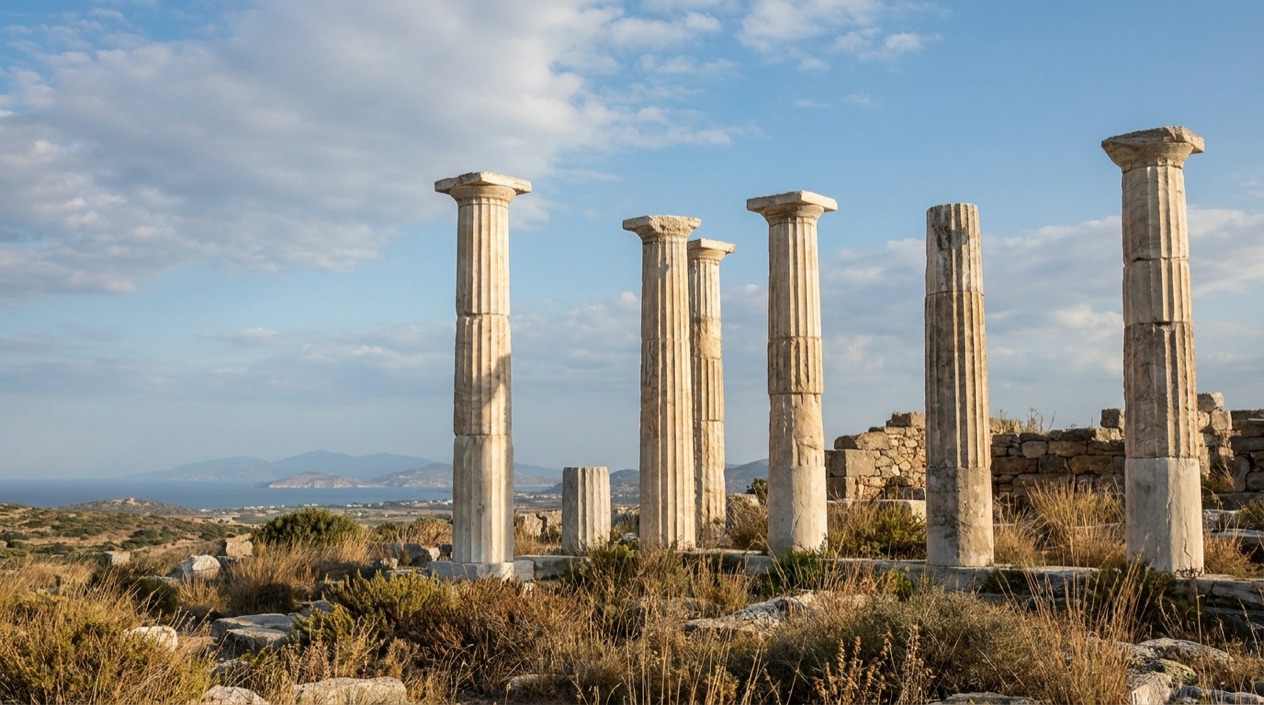
You can see the myths in the places where archaeology met the stories: the Minoan remains of Crete, the Mycenaean remains of the mainland, and the painted pottery that carries the scenes themselves. Two discoveries shaped how we read all of it.
In the nineteenth century Heinrich Schliemann uncovered the Mycenaean civilization, and in the twentieth century Arthur Evans uncovered the Minoan civilization in Crete. Both finds helped explain old questions about Homer’s epics and gave archaeological backing to details about gods and heroes.
Crete and the Minoan world
Crete is where Arthur Evans worked, and it is the island to think of first when you want to connect the stories to a Bronze Age civilization that the Greeks themselves remembered only in legend.
What you look for here is the link between story and object. Minoan remains show a world that Homer’s poems seem to remember in fragments, and that is why Crete appears so often in any tour of mythological Greece. Bring the stories with you and the island answers back.
The mainland and the Mycenaean world
The Mycenaean civilization that Schliemann found belongs to the mainland, and it ties directly to the heroes of the Trojan cycle. Its discovery gave scholars something solid to set beside Homer’s descriptions. For a traveler, the Peloponnese is the part of the mainland that shares in the tourism industry alongside the islands, though to a lesser extent than Crete, the Dodecanese, the Cyclades and the Western Greek Islands.
Two towns on the Peloponnese-side map also show another layer of Greece: Nafplion has Neoclassical architecture, a reminder that the country built in many styles after the ancient world. You can pair a day among Mycenaean stories with an evening among nineteenth-century facades and see how long the stories have kept their pull.
Pottery, vases and early writing
Geometric designs on pottery of the eighth century BC already depict scenes from the Trojan cycle and the adventures of Heracles. These objects are the most portable form of the myths, and you meet them in museum cases rather than in open fields. Look at the figures, then ask which story is being told.
Writing offers a quieter clue. The Linear B script, an ancient form of Greek found both in Crete and on the mainland, was used mainly to record inventories. Even so, certain names of gods and heroes have been tentatively identified in it. A clay tablet about stock and storage may therefore carry a name that later became a legend.
How do you read the sites?
You read a site by asking which layer of the story it belongs to, what object or name connects it to a tale, and how much of the tale comes from poems and how much from the ground. Start with the three-part sequence of the myths: origins and gods, the mingling of gods and mortals, the age of heroes. A place usually fits one of them, and the Trojan War is sometimes treated as a fourth period of its own.
Match the place to a poem
Before a visit, remember which poem your destination leans on. Sites linked to the war and its heroes echo the Iliad and the Odyssey, while stories about the order of the divine world echo Hesiod. This habit takes only a minute and changes what you notice, because a lintel, a tomb or a hillside suddenly has a literary neighbor.
It also helps with the way guides speak. When a guide says a story is told in more than one way, that is not a mistake. It is how the myths were passed along, by singers who kept the outline and changed the details.
Treat the objects as evidence
A painted scene, a script fragment or a ruined hall is a piece of evidence, not an illustration. The fact that many myths appear on vases before they appear in literature should make you look harder at the images. A scene of a labor may be older than the poem that later describes it.
Archaeology can support details about gods and heroes without proving the stories, and that distinction is part of the pleasure. You hold two things at once: a tale of heroes and a real civilization that left real objects behind.
Read the architecture around the myths
Greece layers many periods on top of one another, and the buildings tell you which one you are in. Whitewashed Cycladic homes belong to the Cyclades, and Paros is one island where you find them, while blue-domed churches are also a mark of that region only. Corfu has pastel baroque homes and churches, Ermoupolis and Nafplion have Neoclassical streets, and Ottoman-influenced buildings stand in Grevena and Kozani.
None of these styles is mythological, yet they help you separate the ancient story from the later town built around it. A traveler who can say which centuries are speaking is much better placed to hear the oldest voice underneath.
Good to know before you go
The peak season runs from May through September, when roughly three quarters of all tourists arrive, and the vast majority of visitors come between April and October. The warmest stretch begins in mid-July and lasts until mid-August, when the northern meltemi winds cool the country, and most Greeks avoid heavy physical activity outdoors between 13:00 and 17:00 because of the strong midday sun. For visitors from more northerly climates, November through February can be rewarding, with mild temperatures, few tourists and reduced prices, which suits anyone who wants to read the sites without the summer rush.
Sources
- Wikipedia, Greek mythology (https://en.wikipedia.org/wiki/Greek_mythology), checked October 12, 2026
- Wikivoyage, Greece, section Understand (https://en.wikivoyage.org/wiki/Greece#Understand), checked October 12, 2026
To plan your stay
- Best Time to Visit Greece: September and Late May to Early June
- Arachova: Parnassus Mountain Town, Formaela Cheese, Ski Season and Saint George's Day
- American Airlines Flights to Greece: U.S. Cities, Athens Arrivals and Onward Island Flights
- Greece on a Budget: Cash Machines, Cards, Beaches and Ferries