
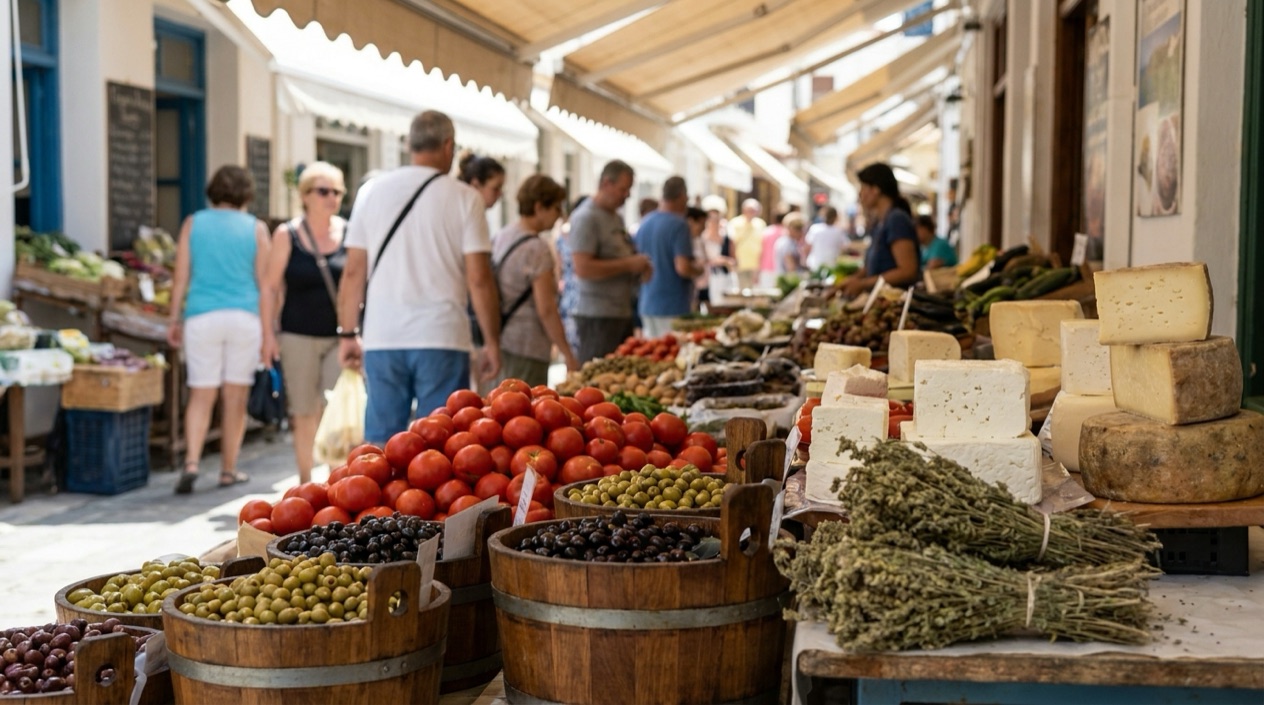
Cherries are heaped in shallow crates, a stallholder lifts a slab of feta out of its brine and sets it on the scale, and somebody a few stalls down is calling out the price of tomatoes. This is the everyday theater of a Greek food market, and it plays out in city halls, neighborhood street stalls and small island squares. It is a way into Greek eating for any traveler who likes to see the ingredients before they reach the plate.
Which food markets can you visit in Greece?
You can visit markets of several kinds: covered central halls in the big cities, street stalls of fruit and vegetables, and the counters of bakeries, cheese shops and sweet shops that work like small markets of their own. Each one shows a different side of the Greek table, and together they cover most of what you will later meet in a taverna.
What you find depends on the calendar. Greek markets follow the seasons closely, so the same stall looks very different from one month to the next, and the fruit on display tells you quickly what time of year it is.
Produce stalls and the fruit calendar
Strawberries and cherries appear in Greek markets from May onwards, and the first crates of them draw people in by color alone. Stalls then fill with the tomatoes, cucumbers, peppers and olives that end up in a Greek salad, along with herbs, lemons and bundles of greens sold loose and weighed on the spot.
In winter the picture changes. Kiwis and oranges are the fruits of the cold months, stacked in pyramids, and the stalls lean toward leafy greens, citrus and root vegetables. If you arrive in autumn or winter, expect citrus where a summer visitor would see stone fruit.
Prices are chalked or handwritten, and sellers often hand you a piece to taste before you decide. Buying a couple of pieces of fruit to eat as you walk is the simplest way to make a market visit part of a day of sightseeing.
Cheese, yogurt and the dairy counter
Feta is at the center of the Greek dairy counter, since it plays the central part in a Greek salad. It can be bought packed or by the weight, and buying it by the weight lets you see the block cut and wrapped in front of you. Next to it sit other cheeses, olives and jars of preserved vegetables.
Genuine Greek yogurt is thick and rich, with 10% fat, and tastes quite different from the supermarket cups you may know from home. Spooned with honey and walnuts, it makes a good breakfast to carry from a market stall. Fresh milk is another matter: Greek law allows it to be sold only for a few days after production, which is why it costs relatively more and why you see less of it on shelves than you might expect.
Bakeries and sugar shops
Bakeries are a market in miniature, with trays of bread, pies and syrup-soaked pastries. Baklava is the one travelers know, tissue-thin layers of pastry with honey, cinnamon and chopped walnuts, cut into diamonds and sold from big trays.
Greek sugar bakeries (zacharoplasteia) also sell locally made ice cream by the weight, which works out much cheaper than at ice cream kiosks. It is an easy way to turn a stroll between stalls into a dessert stop.
Local spirits to look for
Bottles of local spirits appear at market shops and delicatessens, and they follow geography. The island of Lesbos is particularly famous for its ouzo, the anise-flavored spirit that turns cloudy when water is added. On Crete, tsikoudia is the most common aperitif, a clear spirit poured in small glasses before a meal. A bottle of either makes a souvenir tied to the place you bought it, and a small taste at a delicatessen tells you what the locals will be pouring at the table that night.
Which are best known?
The markets that travelers most often put on a food itinerary are the central market halls of the two big cities, Athens and Thessaloniki, though the street stalls and bakeries of any town are just as rewarding for a taste of daily life.
Athens: the central market
Athens has a covered central market, usually called Varvakios, where meat, fish and produce are sold in separate halls. The fish section is a lesson in what the Greek table is built on, with the day’s catch laid out on ice. Fresh fish in Greece is sold by the kilogram and can be very expensive, so the price tag deserves a glance before you order a portion in a restaurant, where budget diners are advised to ask the cost first.
Around the hall, small shops sell spices, nuts, olives and cheeses, and the neighborhood has plenty of simple places to sit and eat. Athens is also one of the two cities where restaurants catering strictly to vegans and vegetarians can be found, which makes its markets a useful source of fruit, vegetables and nuts for those who eat that way.
Thessaloniki: the covered markets
Thessaloniki has its own market quarter, with covered passages such as Modiano and streets of food shops where cheese, cured meats, spices and sweets share the same blocks. It is a good place to see how regional Greek flavors are packaged and sold, and to try pastries and savory pies while you wander. As in Athens, restaurants strictly for vegans and vegetarians exist here and are practically non-existent outside these two cities, so the market stalls can also serve as a base for a picnic of produce, bread and olives.
Neighborhood and island markets
Beyond the two cities, Greek towns and islands have street markets of fruit and vegetables, along with butchers, bakeries and small grocers that serve as everyday markets. On Crete, a local shop may offer a taste of tsikoudia alongside honey and cheese. On Lesbos, a delicatessen is the natural place to look for ouzo.
These smaller markets give the clearest picture of what is in season where you are. They are also where the newsstand, the períptero, comes in: it sells chilled drinks, snacks and ice cream, handy for a cold drink between stalls.
How do you visit?
You visit a Greek food market the way locals shop in it: walk the length of the stalls first, taste what is offered, then buy small amounts of what looks best, paid for by the weight.
Buying by weight and tasting as you go
Almost everything at a market is sold by weight, from feta to ice cream from a sugar bakery. Point, ask for a small amount, and watch the scale. Fruit, cheese and olives are all easy to buy in portions that make a picnic rather than a pantry.
Haggling is possible in Greece on many things, especially on clothing and souvenirs, so at a market stall selling crafts or textiles a friendly offer is part of the exchange. At the food counters, prices are mostly the price of the day, and you simply pay it.
Paying at the stall
Greece uses the euro, divided into 100 cents, which Greeks call lepta. Small stalls are happiest with coins and small notes. Many businesses are reluctant to accept notes larger than €50, partly because change is scarce and partly because larger notes have a history of being counterfeited, so keep smaller bills for market shopping.
Cards are widely accepted in retail stores, hotels and travel agencies, but a produce stall or a corner bakery is a place for cash. Local souvenir shops usually require a minimum purchase before allowing a card, and they may not take it for special sales or deeply discounted items.
Turning a market visit into a meal
A market is a good way to understand what you will order later. Greeks usually lunch around 14:00 to 15:00 and dine between 21:00 and 23:00, though tourist establishments may open earlier, and shopping habits follow the same rhythm. Outside tourist resorts and apart from large supermarkets, shops usually take a long lunch break in the middle of the afternoon, then open again into the evening.
In a restaurant, a Greek salad is traditionally dressed with olive oil alone, topped with a slab of feta. Water and bread usually arrive soon after you sit down, and a small free dessert often comes with the bill.
A cover fee is common, and if it creeps toward the top of its usual range, you may want to eat elsewhere. Large food posters outside, waiters calling out to passersby or desserts listed on the menu are bad signs for authenticity, according to travelers who know the country well.
Good to know before you go
ATMs are easy to find in cities, but many Greek machines may not accept 5-digit PINs, so card users with a 5-digit PIN are advised to change it to 4 digits before leaving home.
Cards work widely in stores and hotels but not in some restaurants. In summer heat, dinner is commonly eaten as late as 21:00 or 22:00, and a late market snack can bridge the gap.
| Fee | Amount | Who pays |
|---|---|---|
| Greek ATM withdrawal fee, on top of your own bank’s charge | €2.50–3 | Cardholder, added to the withdrawn amount and invoiced to your bank |
Sources
- Wikivoyage, Greek cuisine (https://en.wikivoyage.org/wiki/Greek_cuisine), checked October 12, 2026
- Wikivoyage, Greece, section Buy (https://en.wikivoyage.org/wiki/Greece#Buy), checked October 12, 2026
- Wikivoyage, Greece, section Eat (https://en.wikivoyage.org/wiki/Greece#Eat), checked October 12, 2026
To plan your stay
- Best Time to Visit Greece: September and Late May to Early June
- Arachova: Parnassus Mountain Town, Formaela Cheese, Ski Season and Saint George's Day
- American Airlines Flights to Greece: U.S. Cities, Athens Arrivals and Onward Island Flights
- Greece on a Budget: Cash Machines, Cards, Beaches and Ferries