
A footpath climbs out of a harbor town between stone walls and dry herbs, and the only sound for a while is a bell on a goat somewhere up the slope. Below, a ferry is tying up at the quay and the cafés along the waterfront are putting out their chairs.
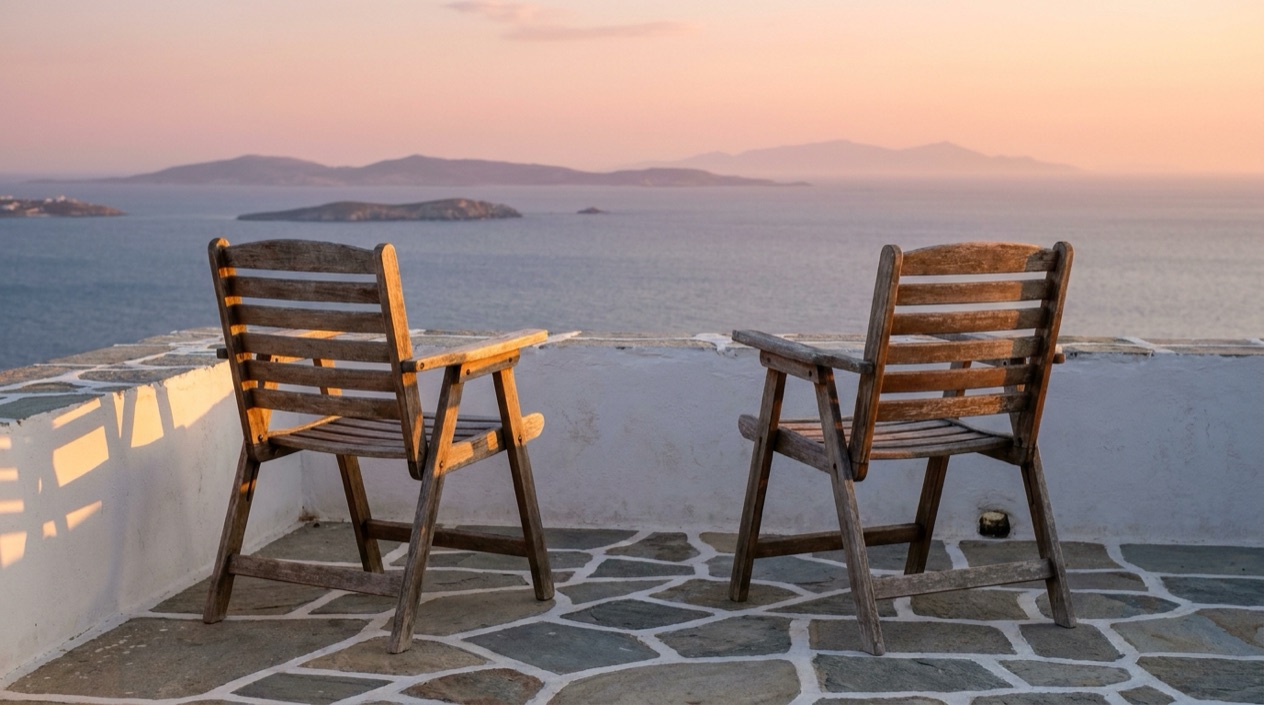
Which Greek islands are quiet?
The islands that fit a slower trip are the ones where the day is built around a trail, a harbor, a chapel or a beach rather than a nightclub, and the Greek islands list several of them. The big party names are easy to set aside: Ios, Mykonos and Santorini are the islands with lots of night life, along with Skiathos, Rhodes, Corfu, Paros and Zakynthos. What follows is the other side of the map.
Greece groups its islands into the Saronic Islands, the Cyclades, the North Aegean islands, the Dodecanese, the Sporades and the Ionian Islands, with Crete and Euboea standing apart. The Cyclades alone gather around 220 islands and islets, so there is plenty of room to choose something other than the names on every poster.
Islands for walking: Samos, Sifnos, Kefallonia, Koufonisi and Tilos
These five are the ones singled out as good for walking, and they are spread across several groups: Samos in the North Aegean, Sifnos and Koufonisi in the Cyclades, Tilos in the Dodecanese and Kefallonia in the Ionian. A trip to any of them can be organized around the path itself, with a village at one end and a beach or a chapel at the other.
Samos adds archaeological sites and a museum to the walking. Sifnos has a medieval town. Kefallonia and Koufonisi both appear among the islands with great beaches, so a morning on foot can end in the water. Tilos is the one on the list that carries no other label, which makes it a pure walking choice.
Andros, Iraklia and Skopelos
Andros, Iraklia and Skopelos are also good for walking, and each brings a different mood. Andros is the larger name of the three for hikers who like to wander from village to village.
Skopelos, in the Sporades, joins walking to a list of islands with great beaches. Pine, olive groves and a harbor town fill the picture, and a path from the waterfront up into the hills is a natural way to spend a day there.
Small islands near Athens: Hydra and Salamis
Hydra covers about 24.882 square miles, and it is counted among the great island harbor towns. The harbor is the island: a curve of waterfront with cafés, boats and stone houses climbing the slope behind it. It is a place to stroll, to sit over a coffee and to watch the boats come and go.
Salamis is larger at 37.13 square miles. Both belong to the Saronic group, the cluster of islands that lies in the Saronic Gulf. Aegina, in the same group, has significant archaeological sites and a museum, which adds a day of ruins to a stay on that side of the Aegean.
Patmos and Tinos
Patmos and Tinos have a significant connection with early or Orthodox Christianity, and that shapes the way a visit feels. Patmos belongs to the Dodecanese and Tinos to the Cyclades. Churches, monasteries and the rhythm of religious life are part of what you meet there, alongside the harbor and the village streets.
A traveler who likes to follow a thread through a trip, from chapel to chapel and from village to village, will find these two islands give the thread a clear shape. Dress habits and visiting rules at religious sites are best learned on the spot.
What do they offer?
They offer paths, harbors, beaches, ruins and old fortified towns, in different mixes on each island. A day on one of them usually begins with a Greek breakfast of yogurt, honey and fruit or a cheese pie from a bakery, then moves outdoors, and ends with a table at the water’s edge.
Walking days
Walking is the clearest thing these islands offer. On Samos, Sifnos, Kefallonia, Koufonisi, Tilos, Andros, Iraklia and Skopelos, the paths link villages, chapels and shorelines, and the landscape changes from one island to the next: dry hillsides in the Cyclades, greener ground on Skopelos and Kefallonia.
Along the way you pass low stone walls, wild oregano and thyme, and small white chapels. A path usually ends at a village taverna, where grilled fish or octopus, a Greek salad with a slab of feta, and a carafe of local wine make an easy reward.
Harbor towns and the Hora
The main town on a Greek island is often called Hora, which means the place, so Hora on Naxos is Naxos town. The great island harbor towns include Chios, Hydra, Symi, Naxos, Rhodes and Mykonos, and Syros, Corfu and Lefkada have fine ones too.
A harbor town is where the day is organized: a coffee at a kafenio, a walk along the quay, a look at the boats, then lunch. Rather than ticking off sights, you settle into the pace of the waterfront and let the lanes behind it lead you uphill.
Beaches
Beaches are on the list for Mykonos, Naxos, Thasos, Rhodes, Skiathos, Skopelos and Koufonisi, and also for Kos, Lefkada, Serifos, Milos, Corfu and Kefallonia. From that list, Koufonisi, Skopelos, Kefallonia and Serifos are the ones that pair beaches with a walking or village-town character.
Milos, Lefkada and Serifos give you a reason to plan a beach-hopping stay, going from cove to cove across the island. Pack sun protection and a hat, since the sun follows you on every one of them.
Fortresses, ruins and monasteries
Corfu, Rhodes, Sifnos and Serifos have great medieval towns and fortresses, with old walls and lanes that reward wandering. Delos, one of the Cyclades, has a significant archaeological site and museum, as do Rhodes and Aegina, and Kos, Samos, Thasos and Lesvos.
How do you get there?
You reach them by ferry or by plane, and ferries take travelers to every Greek island, though routes and frequencies vary depending on the time of year. Between islands, the best way to get around is by boat, so a trip that links two or three of them can be built around the sea.
By air
Thirteen islands have international airports: Corfu, Karpathos, Kefalonia, Kythira, Kos, Lemnos, Lesbos, Mykonos, Paros, Rhodes, Samos, Skiathos and Santorini.
Another group of islands has airports with domestic flights only: Astypalaia, Chios, Ikaria, Kalymnos, Kasos, Kastelorizo, Leros, Milos, Skyros and Syros. That covers Milos and Syros, both on the beach and harbor lists above.
| Island | Airport |
|---|---|
| Kefalonia | International |
| Samos | International |
| Skiathos | International |
| Milos | Domestic flights only |
| Syros | Domestic flights only |
| Chios | Domestic flights only |
By sea
Ferries serve every island, so Hydra, Tilos, Iraklia, Koufonisi and Andros are all reachable by sea. Routes and frequencies change with the time of year, which is worth keeping in mind when you plan a trip that links several islands in a row.
Openseas offers an X to ALL search that lists every ferry leaving a given island on a certain day, a handy way to see what connects from the island you are on. The search does not work for Piraeus.
Good to know before you go
Plan around ferry schedules, since routes and frequencies vary with the time of year, and keep in mind that islands with airports for domestic flights only are reached through another Greek airport. On arrival, head for the Hora, the main town, where you will find the harbor, the cafés and the start of most paths.
Before you set out on a walk, learn which trails the island offers from the people at your lodging, and take sun protection along on any day outdoors. Greece uses the euro, and the harbor towns are where you will find a place to eat, a bakery and a market stall for the road.
Sources
- Wikipedia, Greek islands (https://en.wikipedia.org/wiki/Greek_islands), checked October 12, 2026
- Wikivoyage, Greek islands (https://en.wikivoyage.org/wiki/Greek_islands), checked October 12, 2026
To plan your stay
- Best Time to Visit Greece: September and Late May to Early June
- Arachova: Parnassus Mountain Town, Formaela Cheese, Ski Season and Saint George's Day
- American Airlines Flights to Greece: U.S. Cities, Athens Arrivals and Onward Island Flights
- Greece on a Budget: Cash Machines, Cards, Beaches and Ferries