
A plate of tomato fritters lands on the table still crackling, a bowl of olives sits beside a loaf of bread, and the olive oil in the little dish has a green, peppery smell that tells you what the next hour will taste like. Greek food is eaten slowly and shared, and every region has its own answer to the same few ingredients. Food tours here mean following those answers from the bakery counters of the mainland cities to the island kitchens of the Aegean.
The pages that follow explain what the experience looks like in Athens, Thessaloniki and the islands, and how to arrange your own tasting days in a country where the table is the main attraction.
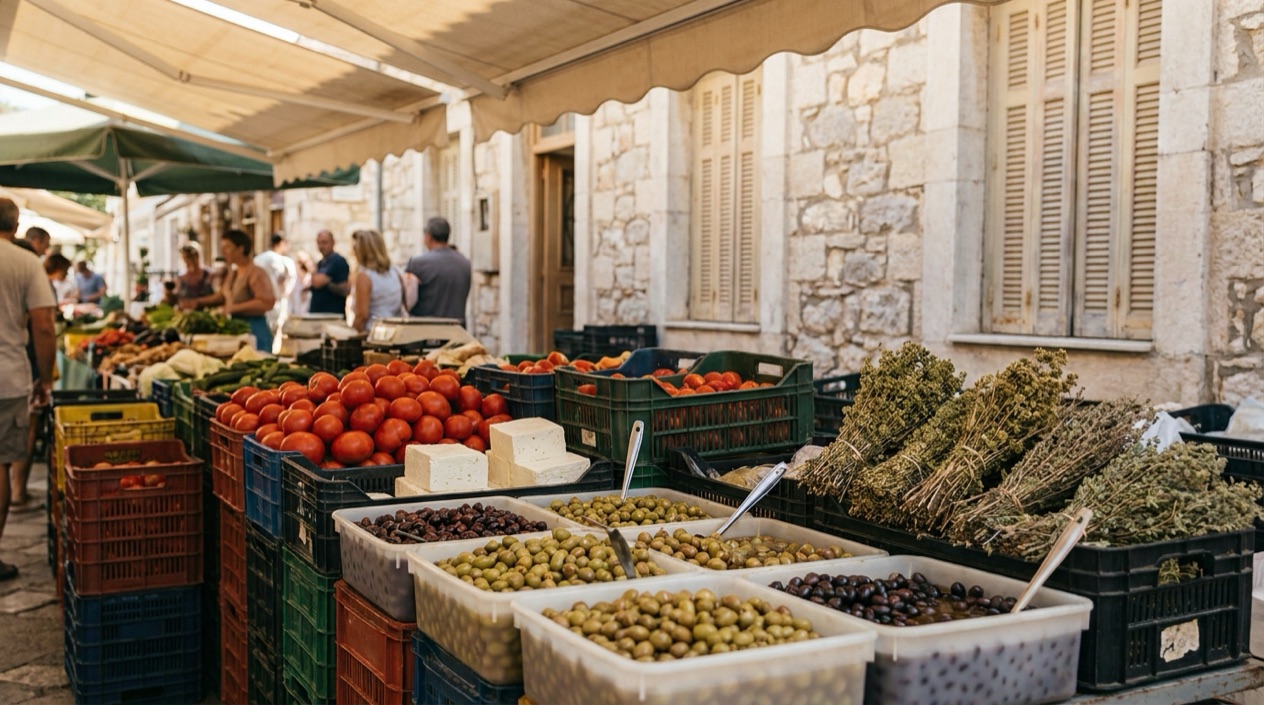
Which food tours exist in Greece?
The food tours you can build in Greece come in three shapes: a walk through a city that moves from bakery to taverna to sweet shop, a regional trail that follows one product across an island, and a long table meal where a single kitchen sends out dish after dish. Whichever shape you choose, the same foundation sits under everything: wheat, olive oil and wine.
Olive oil is the most characteristic and ancient element of Greek cooking, and it appears in most dishes, from greens and beans to grilled fish. Around it you find vegetables, grains, fish and meats such as pork, poultry, veal, beef, lamb, rabbit and goat.
The seasoning leans on oregano, mint, garlic, onion, dill, cumin and bay leaves, used more often than in other Mediterranean kitchens. A good tasting day lets you notice these things one by one.
The city walk: from breakfast pastry to sweet finish
A city food walk begins where Greeks begin their day, at a bougatsadiko, a shop that sells bougatsa along with pies, pastries and drinks. Bougatsa is a popular breakfast, a warm pastry that you eat at the counter or at a small table while the street wakes up. From there the route moves to savory pies, grilled meats wrapped in pita, and the small plates called meze that arrive at a taverna in the middle of the day.
The finish is usually sweet. Baklava is the classic ending, tissue-thin layers of pastry soaked with honey, spiced with cinnamon and filled with chopped walnuts.
The product trail: one ingredient, one island
Some of the most memorable tastings are built around a single ingredient. On the Aegean island of Chios, the star is mastic, an aromatic plant resin that is grown there and that flavors sweets, liqueurs and spoon desserts. Following it means seeing where it comes from and then tasting how local cooks use it.
On the mainland, the same idea works with Avgotaracho Messolongiou, a PDO product made from flathead mullet caught in the Messolonghi-Etoliko Lagoons. Olive oil offers the widest trail of all, since it is poured over nearly everything you eat. Tasting it plain on bread, before it disappears into a stew, shows how much it changes from one kitchen to the next.
The long table: tavernas and estiatoria
The taverna and the estiatorio, a more formal restaurant serving cooked dishes, are widespread across Greece. They serve home cooking at affordable prices to locals and tourists alike, which is why a table meal can be a food tour all by itself. Order several dishes for the middle of the table, a Greek salad, something fried, something baked in the oven, and pass the plates around.
Water and bread arrive soon after you sit down, and a small free dessert often comes with the bill. These gestures are part of the welcome, and they tell you that the meal is meant to unfold at its own speed.
Which cities have them?
The places that suit a food-focused trip in Greece are the big cities of the mainland and the islands that have a dish of their own, and each one rewards a different appetite. Athens and Thessaloniki carry the widest range, while Santorini, Crete, Chios and Messolonghi each hold one specialty you can build a day around.
Athens
Athens is where the everyday Greek table is easiest to follow, from the bougatsa counter in the morning to the taverna dinner late in the evening. Greeks lunch around 14:00 to 15:00 and dine between 21:00 and 23:00, so a day of eating here starts later than visitors expect. Tourist establishments may open as early as 12:00, which helps if you arrive hungry.
The city is also one of only two places in the country where restaurants catering strictly to vegans and vegetarians are easy to find. Elsewhere they are practically non-existent, though vegetable dishes, beans and salads cooked in olive oil turn up on almost every menu.
Thessaloniki
Thessaloniki shares with Athens the distinction of having restaurants that cater strictly to vegans and vegetarians. For everyone else, it is a city to eat in with a bakery in mind, since the bougatsa tradition suits a morning stop at a bougatsadiko, where pastries, pies and drinks are all on the counter.
Build the day around small stops rather than one big meal: a pastry first, meze at midday, a sweet in the afternoon, then a long dinner at the hour the locals sit down. Spreading the tasting this way lets you try more dishes without feeling overfed.
Santorini
On Santorini the dish to look for is tomatokeftedes, tomato fritters that are well known throughout the island. They are crisp outside and soft inside, scented with herbs, and they arrive as a starter that you share. A table with a plate of them, a Greek salad and a carafe of local wine is a food tour in miniature.
Fish dishes are common on the islands, and Santorini is no exception. Fresh fish is sold by the kilogram and can be very expensive, so ask the cost of your portion before you order.
Crete
Crete offers a breakfast that is hard to find elsewhere: staka me ayga, poached or fried eggs served with local staka, a buttery cream mixed with flour. It is rich and savory, and it makes a good first stop on a day of tasting. Follow it with greens, grilled meat and whatever the kitchen has baked in the oven.
Because Greek cooking leans on lamb, goat, rabbit and wild herbs, an island with farms and hills like Crete gives you a chance to see how the ingredients reach the plate. Olive oil, again, runs through all of it.
Chios and Messolonghi
Chios is the home of mastic, and a visit means tasting it in sweets and drinks. Messolonghi is known for its PDO avgotaracho, made from flathead mullet caught in the lagoons. Each is a single-product destination, which makes it easy to plan a trip around one flavor.
These two places suit someone who has already tried the classics and wants to understand what sits behind them. Pair the specialty with a simple meal of bread, salad and olive oil so that it stays the center of the plate.
How do you book?
Arranging a food experience in Greece starts with choosing what you want to taste and where, because the dishes change so much from one island to the next. A tasting day can be put together from tavernas, bakeries and sweet shops, with the order of the stops set by the Greek eating day.
Plan around the Greek eating day
Lunch is eaten around 14:00 to 15:00 and dinner between 21:00 and 23:00, so a tasting day built on local timing begins with a pastry, pauses in the middle of the day, and runs late. Some tourist establishments open as early as 12:00, which gives an earlier option if you prefer it.
Start at a bougatsadiko for breakfast, move to a taverna for meze, finish with baklava and coffee, and leave dinner for the evening. That sequence covers the pastry, the savory dishes and the sweets in one day.
Read the room before you sit down
A few signs help you tell a table worth sitting at from one that is not. Bad signs include desserts listed on the menu, large food posters outside, waiters yelling for clients, or plates taken away while diners are still seated. A place that serves water and bread soon after you sit, and brings a small free dessert with the bill, is following the usual habits.
Greek salad is traditionally dressed only with olive oil. If one arrives with vinaigrette or lettuce, you are probably in one of the most tourist-oriented restaurants. By law, frozen seafood must be marked as such on the menu, so look for that note when you read the fish list.
Ordering fish, yogurt and sweets
Fresh fish is sold by the kilogram and can be very expensive, which is why budget diners ask the cost of their portion before ordering. It is a normal question and saves any surprise at the end of the meal.
For breakfast or dessert, ask for Greek yogurt, and notice the difference: genuine Greek yogurt has 10% fat, unlike typical store-bought brands. Drizzle it with honey and walnuts and it echoes the flavors of baklava in a lighter form. The Mediterranean diet that these dishes belong to has been on the UNESCO Intangible Cultural Heritage Lists since 2013.
Good to know before you go
Fast food is the cheap end of the Greek table: at Goody’s, a popular chain, a hamburger with Coke costs €3-5. Restaurants officially charge a cover fee, and if it tends toward the top of the range, consider eating elsewhere.
| Fee | Amount | Who pays |
|---|---|---|
| Restaurant cover fee | €0.30 to €2 per person | Each diner |
Sources
- Wikipedia, Greek cuisine (https://en.wikipedia.org/wiki/Greek_cuisine), checked October 12, 2026
- Wikivoyage, Greece, section Eat (https://en.wikivoyage.org/wiki/Greece#Eat), checked October 12, 2026
To plan your stay
- Best Time to Visit Greece: September and Late May to Early June
- Arachova: Parnassus Mountain Town, Formaela Cheese, Ski Season and Saint George's Day
- American Airlines Flights to Greece: U.S. Cities, Athens Arrivals and Onward Island Flights
- Greece on a Budget: Cash Machines, Cards, Beaches and Ferries