
A tray comes out of the kitchen with a crackle of filo, and the smell of warm honey and cinnamon reaches the next table before the plate does. In Greece the sweet end of a meal is a small ritual of syrup, nuts, custard and fried dough, and it turns up in pastry shops, at street stands and, quite often, on the house. This is a look at the desserts you will meet across the country, what baklava really is here, and where to eat them.
What desserts do Greeks eat?
Greeks eat syrup-soaked pastries, fried dough with honey, custard wrapped in filo and spoonfuls of thick yogurt, and most of them lean on the same few flavors: honey, cinnamon, lemon, orange and nuts. The cooking behind them has deep roots.
Ancient Greek cuisine was built on wheat, olive oil and wine, and the Byzantine kitchen added spices through Constantinople’s place in the spice trade. A good deal of what ends up on a dessert plate today is wheat, oil and sweetness, put together in many ways.
Lemons and oranges matter more than you might expect. Lemon in particular has a long history in Greek cooking, and its sharpness is what keeps a syrup-heavy dessert from becoming cloying. Rose water and cinnamon do the same job in other recipes. Once you start noticing these flavors, you can tell one dessert from another before you taste it.
Loukoumades, the honey puffs
Loukoumades are small balls of dough fried until golden, then drenched in honey and dusted with cinnamon. In Greece they are a popular street food, served with any combination of honey, cinnamon, walnuts and chocolate sauce. They arrive hot, glossy and a little crisp on the outside, soft and airy within, and they are best eaten while the syrup is still running down the sides of the paper cup or plate.
The dish has a long past. There is evidence that it grew out of enkrides, a dough fried in oil and eaten with honey in Ancient Greece, and during the Byzantine period these fried puffs were popular in Lent because they met the requirements of Orthodox fasting.
Similar sweets were described as early as the 13th century under the name judge’s morsels. Loukoumades are a mainstay of Greek cooking, in particular in the south, and in Cyprus they go by lokmades as well, spiced with cinnamon in honey syrup and sometimes touched with powdered sugar.
Galaktoboureko, custard in filo
Galaktoboureko is a custard pie: sheets of crisp filo around a semolina custard, soaked in a clear sweet syrup. The custard can be flavored with lemon, orange or rose, so two slices from two bakeries may taste quite different.
The top shatters under the fork, the middle is soft and cool, and the syrup ties it together. Some bakers roll it into individual pieces about 4 inches long, which are easy to carry out of a shop on a paper plate.
The dessert is popular across Greece, with regional and local variations in ingredients and preparation, and the versions of Athens and Thessaloniki are the ones people tend to mention. Its roots go back to the Byzantine Empire. In Cyprus it is known as galatopourekko, and in Albania it is sometimes made for the Orthodox Easter. Order it with a coffee and let the pastry soften slightly in the syrup.
The small sweet that arrives with the bill
One of the nicest habits in Greek restaurants is the small free dessert that arrives when you ask for the bill. It might be a square of cake, a slice of fruit, a few spoonfuls of something sweet or a shot of liqueur beside it. It is a gesture of hospitality, and it often turns out to be one of the best bites of the evening.
Yogurt with honey and walnuts is another common ending, and the yogurt matters here. Genuine Greek yogurt has 10% fat, which is why it feels so rich and spoonable next to the thin store-bought kind. Add a drizzle of thyme honey and a handful of nuts and you have a dessert that needs no oven at all.
What is baklava?
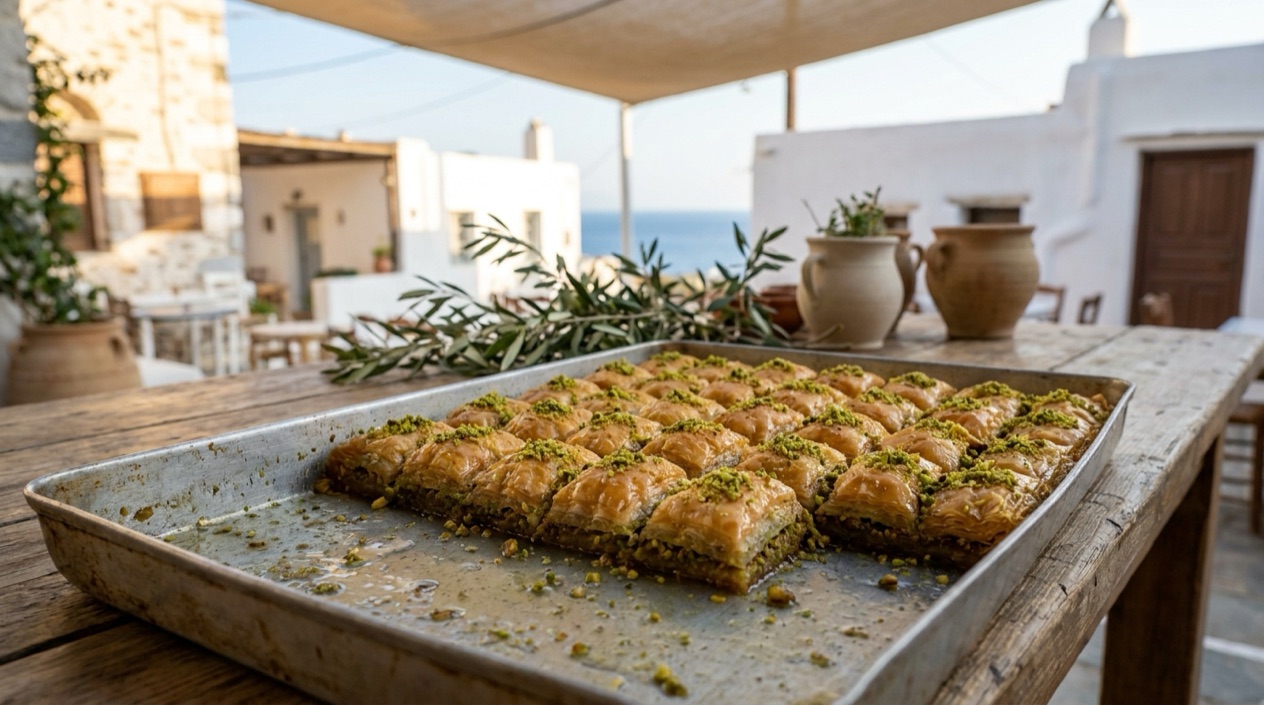
Baklava is a dessert of tissue-thin layers of pastry with honey, cinnamon and chopped walnuts, baked until crisp and drenched in syrup. Cut into diamonds or squares, it shines on a pastry-shop counter, and the first bite gives a dry shatter followed by sticky sweetness and the warm note of cinnamon. It is rich, so one piece alongside a small strong coffee is usually plenty.
Greek baklava has its own character. Walnuts are more common than pistachios here, and cinnamon is part of the flavor, which gives it a more homey, spiced taste than the pistachio-green versions known elsewhere. The syrup is sweet but clear, and the pastry on top should still make a little noise when you press it.
Layers, nuts and the symbolism in each tray
Greek baklava is traditionally made with 33 layers of filo dough, a number that refers to the years of Jesus’ life. Whether a given baker counts them out or not, the idea explains why the pastry is so fine and the stack so tall. Each sheet is brushed with butter, the nuts go in between, and the tray is cut before it goes into the oven so the syrup can seep into every slice afterward.
The nuts change with the map. In southern Greece baklava is mostly made with chopped almonds, while in the north it is made with walnuts. If you travel from one part of the country to another, a slice in each place is a small lesson in regional taste. Almond baklava tends to feel lighter and sweeter, and walnut baklava darker and more earthy.
Plakous on Lesbos
On the island of Lesbos, a type of baklava is still known as plakous, the name of an Ancient Greek pastry considered a predecessor of baklava. It is a good reminder that Greek baklava is part of a very long line of layered, honeyed pastries rather than a recent import in a shop window.
The Lesbos version is baked with very thin pastry layers and chopped nuts, then soaked in simple syrup and sprinkled with cinnamon. Anyone who likes to compare will find it a quieter, more delicate cousin of the thick, glistening trays seen elsewhere. If the island is on your route, ask for plakous by name at a local pastry shop.
Baklava and its cousins
Baklava sits in a family of filo and syrup sweets. Galaktoboureko swaps the nuts for custard, while Laz boregi, a cousin from the Black Sea region of Turkey, uses a muhallebi (milk pudding) made with cornmeal and ground black pepper in place of semolina custard, with thin filo, butter and simple syrup around it. Seeing these side by side makes it easier to understand how a Greek pastry counter is organized: nuts here, custard there, everything finished in syrup.
Where do you try them?
You try them in three kinds of places: pastry shops, street stands and the tavernas where dessert arrives after the meal. Each gives a different version of the same sweet idea, and a day of eating can easily include all three.
The Greek table also has its own rhythm. Lunch comes mid-afternoon and dinner late in the evening, between 21:00 and 23:00, so the sweet end of the day often falls well after dark.
Pastry shops and sweet counters
A Greek pastry shop, a zacharoplasteio, is the place to see the whole range at once: trays of baklava cut into diamonds, galaktoboureko in generous squares, and rows of cakes and cookies behind glass. Pointing is the usual method, and you can ask for a single piece to eat there or take away. This is also where you can compare the nuts, with walnuts in the north and almonds in the south.
Galaktoboureko is where the cities come in. Athens and Thessaloniki are both associated with notable versions, so a slice in either is a good excuse to step inside a bakery. Look at the top, which should be golden and crisp, and at how the syrup has settled. Pair it with a Greek coffee or a cold glass of water, and sit as long as you like.
Street stands and loukoumades
Loukoumades are the dessert for walking. Served at stands and casual counters, they come in paper cups or on small plates with honey, cinnamon, walnuts or chocolate sauce in whatever combination you choose. Because they are fried to order, the smell of hot dough is often what draws you in. Eat them right away, with a fork or with your fingers, since they soften as the syrup sinks in.
They are a mainstay of cooking in the south of the country, so the south is a natural place to look for them. On Cyprus you will see the same sweet written as loukoumades or lokmades, usually served in a honey syrup with cinnamon. A plate of them makes a good shared dessert for a table of friends.
At the taverna, and how to read the signs
At a taverna, you are served water and bread soon after sitting down, and a small free dessert follows when you ask for the bill. That is the sweet to wait for, rather than ordering one at the start.
If a place pushes a long dessert list at you, treat it as a hint. Desserts listed on the menu are among the bad signs for a restaurant that wants to feel local, along with large food posters outside, waiters calling to passersby, and plates cleared while diners are still seated.
Seafood and salad get their own habits too. Frozen seafood must be marked as such on the menu by law, and fresh fish is sold by the kilogram and can be very expensive, so ask the cost of your portion before ordering. A Greek salad is traditionally dressed only with olive oil. These small details help you decide where to sit down before the dessert even arrives.
Good to know before you go
Most sweets are easy to find without much planning, and a meal ends with a free dessert more often than you would think. Restaurants catering strictly to vegans and vegetarians are practically non-existent outside of Athens and Thessaloniki, and Greek pastries lean on butter, honey, milk and eggs, so keep that in mind. A cover fee is common in restaurants, and one at the high end of the range is a reason to eat elsewhere.
| Fee | Amount | Who pays |
|---|---|---|
| Restaurant cover fee | €0.30 to €2 per person | Each diner |
Sources
- Wikipedia, Baklava (https://en.wikipedia.org/wiki/Baklava), checked October 12, 2026
- Wikipedia, Galaktoboureko (https://en.wikipedia.org/wiki/Galaktoboureko), checked October 12, 2026
- Wikipedia, Loukoumades (https://en.wikipedia.org/wiki/Loukoumades), checked October 12, 2026
- Wikipedia, Greek cuisine, section History (https://en.wikipedia.org/wiki/Greek_cuisine#History), checked October 12, 2026
- Wikivoyage, Greece, section Eat (https://en.wikivoyage.org/wiki/Greece#Eat), checked October 12, 2026
To plan your stay
- Best Time to Visit Greece: September and Late May to Early June
- Arachova: Parnassus Mountain Town, Formaela Cheese, Ski Season and Saint George's Day
- American Airlines Flights to Greece: U.S. Cities, Athens Arrivals and Onward Island Flights
- Greece on a Budget: Cash Machines, Cards, Beaches and Ferries