
A glass of cold white Assyrtiko arrives at the table, and beside it, without anyone asking, a small glass of water. That is how a tasting often begins in Greece, in a courtyard or a taverna, with the grape named and the place it grew close at hand. Vineyards are scattered across the mainland and the islands, from Santorini to Crete, from the Peloponnese to Macedonia, and a wine trip here follows the grapes from region to region.
Where can you tour wineries in Greece?
You can taste Greek wine on islands and on the mainland, because almost every part of the country has its own grape and its own appellation. Santorini, Crete, Attica and the area around Naoussa make a good set of starting points, each with a variety that tastes nothing like the next.
What ties the trip together is the idea of a native grape. Many of the varieties you meet are rooted in one island or one district, and a winery visit is often a lesson in why that grape stayed where it did. Come curious about the name on the label and the conversation fills itself.
Santorini and the Assyrtiko vines
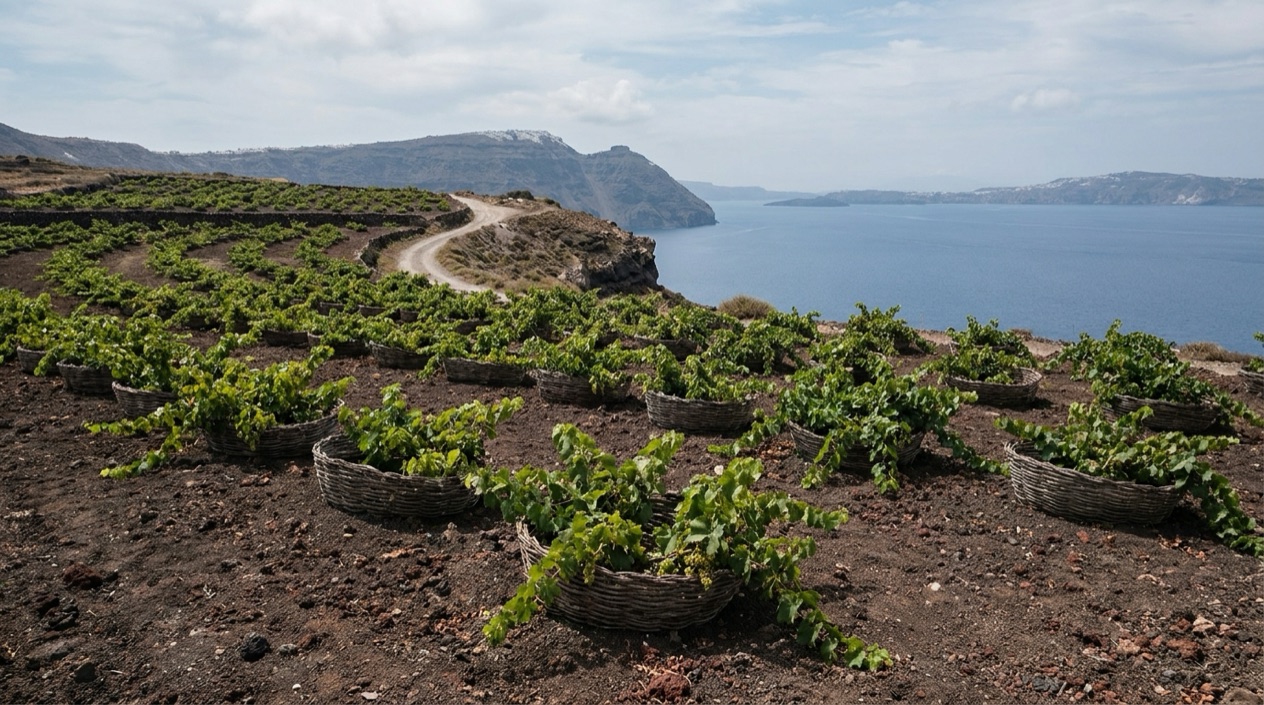
Assyrtiko is a white grape native to Santorini, and its old vines have resisted phylloxera, the vine pest that devastated vineyards elsewhere. That makes a tasting here a look at very old plants as much as at a glass of wine. Ask to see how the vines are trained and you will understand why the island’s wine is treated as a story of survival.
Santorini is one of the Aegean Islands wine regions, alongside Lemnos, Paros, Rhodes and Samos. A visit pairs well with seafood, and a chilled white poured next to grilled fish is the classic island table. Order the Assyrtiko first and let the staff suggest the rest.
Crete: Vidiano, Liatiko and four wine districts
Crete’s wine regions include Archanes, Dafnes, Peza and Sitia, which gives a visitor several districts to explore. Vidiano is a white grape indigenous to the island, chiefly grown around Rethymno and Heraklion. It is difficult to cultivate and grown on a small scale, so a bottle of it feels like a find rather than a supermarket purchase.
Liatiko is a red variety native to Crete, deemed to be at its best when made as a sweet wine. A tasting that moves from a white Vidiano to a sweet Liatiko shows the island’s range in a single sitting. Cretan tables then finish with raki and fruit, so the wine visit slides naturally into dinner.
Attica: Savatiano close to Athens
Savatiano is the predominant white grape in Attica, the region around Athens. It shows excellent heat resistance, which is why it thrives in a dry, hot landscape, and with cold fermentation it gives a distinct floral and fruity aroma. Central Greece also has wine regions in Atalanti.
Savatiano is also the grape behind many bottles of retsina, so a visit is a chance to compare the resinated and the unresinated styles side by side.
Naoussa and the Xinomavro country
Xinomavro is the predominant grape variety in Macedonia, centered on the town of Naoussa. It has great aging potential, with a palate reminiscent of tomatoes and olives.
Macedonia’s wine regions also include Amyntaio (Amyndeon), Epanomi, Goumenissa, Pieria and Chalkidiki, so a trip can link several appellations. Ask for an older bottle if the winery has one, since aging is the point of this grape.
Which regions are best known?
Greece’s wine map divides into the Aegean Islands, Crete, the Ionian Islands, the Peloponnese, Macedonia, Thessaly, Epirus and Central Greece, each with named appellations. The modern map took shape in the twentieth century. A Wine Institute was established by the Ministry of Agriculture in 1937, Greece’s first Cabernet Sauvignon vineyard was planted in 1963, and legislation set up appellation laws in 1971 and 1972.
That history explains why labels today carry the names of districts rather than just brands. When you read a bottle, the district tells you which grape to expect and what the wine will probably taste like.
The Peloponnese: Mantineia, Nemea, Monemvassia-Malvasia and Patras
The Peloponnese wine regions include Mantineia, Nemea, Monemvassia-Malvasia and Patras, a long list for a single peninsula. Moschofilero comes from the AOC region of Mantineia in Arcadia and produces crisp, floral wines in still and sparkling styles. The sparkling version suits an aperitif before dinner.
Because four named districts sit in one part of the country, the Peloponnese rewards a trip built around several tastings. Compare a floral white from Mantineia with whatever red the Nemea producers pour, and you get two very different pictures of the same region.
The Ionian Islands: Kefalonia, Corfu, Zakynthos and Lefkada
The Ionian Islands wine regions include Kefalonia, Corfu, Zakynthos and Lefkada. Robola is most grown in the mountainous vineyards of Kefalonia and has a smokey mineral and lemony character that complements seafood. It is a white to order with a plate of grilled fish.
Island hopping among these four gives a tasting trip a natural rhythm, with a vineyard visit by day and a seaside table at night. The Ionian islands are also where Greece’s western coast meets its wine, so they make a different trip from the Aegean ones.
Macedonia, Thessaly, Epirus and the Aegean
Thessaly’s wine regions include Nea Anchialos, Rapsani and Messenikola, and Epirus has wine regions in Zitsa and Metsovo. These are less obvious names than Santorini, but they show how much ground Greek wine covers. A traveler who has already done the islands can use them to go deeper.
In the Aegean, Lemnos, Paros, Rhodes and Samos join Santorini on the list of wine islands. Each can anchor a short stay built around a tasting or two, with the winery visit as the reason to leave the beach.
How do you book?
A Greek wine tour begins with a choice of region and grape, because the vineyards are spread across the mainland and many islands and each district has its own style. Decide first whether you want a crisp white, a structured red or a sweet dessert wine, and the itinerary follows from that.
Choosing by grape
If you want a mineral white, aim for Santorini’s Assyrtiko or Kefalonia’s Robola. If you want a floral, crisp one, head for Mantineia’s Moschofilero. For red, Naoussa’s Xinomavro offers aging potential and a palate of tomatoes and olives, while Crete’s Liatiko is best as a sweet wine.
Matching the grape to the dish on your plate is half the pleasure. Seafood suits Robola, and a long lunch is the right place for a bottle of Savatiano from Attica.
Retsina and aged wines
Retsina is a traditional Greek wine flavored with pine resin. The resin was once used as a sealant for wine flasks and bottles, which is how the taste came to be part of the wine. It became the national beverage during the 1960s and, with rapidly growing tourism, came to be associated worldwide with Greece.
The taste is strong and distinctive, so try it once with a plate of meze rather than on its own. Greek cava, meanwhile, means aged reserve blends, with a minimum of one year for whites and two years for reds, and it is the label to look for if you prefer a wine with some time behind it.
Spirits, coffee and what to sip afterwards
A wine trip in Greece often ends with a spirit. Raki, also called tsikoudia, is a Greek spirit with 35-40% alcohol that is served cold in the summer months. In Crete it is traditionally an after-dinner drink and is often served with fruit as dessert.
Ouzo is the other name to know, and Mytilene on Lesbos is particularly famous for it. Mainlanders do not drink ouzo with ice, but tourists and islanders generally do. Greek coffee, a thick, strong black coffee served in a small cup, is usually served moderately sweet if you do not say otherwise, and it is the usual last note of a meal.
Good to know before you go
A glass of water is traditionally served with any drink you order, one glass for each, though in touristy areas you might have to ask. On some small islands tap water is imported and heavily chlorinated, so visitors prefer bottled water.
Imported alcohol is likely to be very expensive if genuine. If it is cheap, it may be a locally distilled spirit with flavorings called bomba, sometimes passed off as whisky or gin in island bars catering to young people. Stick to Greek wine, ouzo and raki, and iced tea in mass-sector tavernas and cafes typically means instant, so ask twice if you want it brewed.
Sources
- Wikipedia, Greek wine (https://en.wikipedia.org/wiki/Greek_wine), checked October 12, 2026
- Wikivoyage, Greece, section Drink (https://en.wikivoyage.org/wiki/Greece#Drink), checked October 12, 2026
To plan your stay
- Best Time to Visit Greece: September and Late May to Early June
- Arachova: Parnassus Mountain Town, Formaela Cheese, Ski Season and Saint George's Day
- American Airlines Flights to Greece: U.S. Cities, Athens Arrivals and Onward Island Flights
- Greece on a Budget: Cash Machines, Cards, Beaches and Ferries