
On a hot afternoon on an island dock, someone reaches for a lighter to start a small grill on the rocks, and a neighbor shakes a head. In a cool church doorway, someone else pauses in a sleeveless top and shorts.
Most of the slips travelers make in Greece are small ones like these, and they come down to timing, fire, clothing and manners.
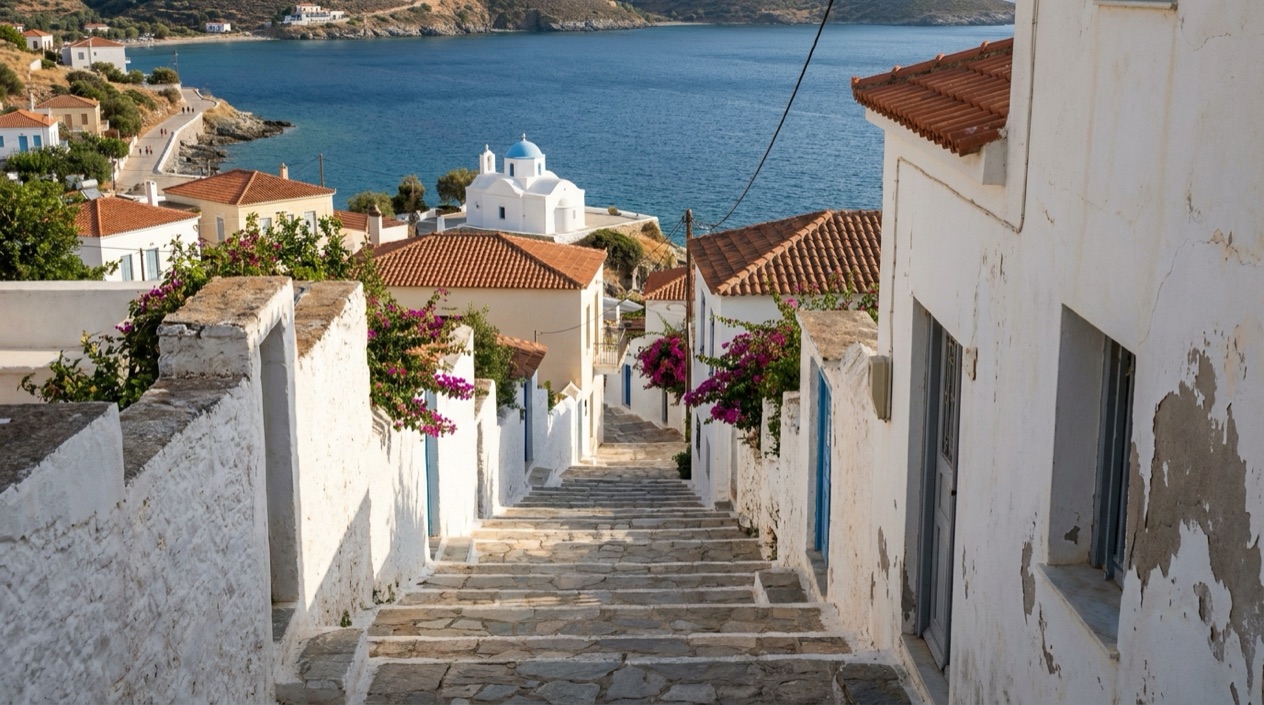
What mistakes do visitors make in Greece?
The common mistakes fall into four groups: planning sea travel without allowing for the calendar, treating fire casually in summer, dressing for a church as if for the beach, and missing the paperwork when arriving on your own boat.
Planning ferries without the calendar
Greek island trips run on boats, and boats follow the weather and the holidays. From January to March the Aegean can be extremely rough, and ferries are often kept in port for days at a time. A tight itinerary with a flight home the morning after a crossing is the classic trap of the cold months.
The other end of the year has its own problem. Ferries in August fill up around the National Holiday on August 15, and travelers who leave decisions to the last minute find the sailings they wanted already taken. The mistake in both cases is treating a ferry like a city bus and leaving no slack in the schedule.
Treating fire as a small thing
A beach cookout, a campfire on a headland or a few fireworks on a summer night can feel like harmless vacation fun. During the fire ban, every outdoor activity that could cause a forest fire is prohibited, including campfires, bonfires, barbecues and cookouts, and fireworks. The stakes are real: the fine for causing a forest fire can be €200,000.
The mistake is usually not malice but habit. A cigarette tossed from a car window, a portable grill carried to a pine-lined cove, or a flame lit for atmosphere at a picnic all fall into the same category. Hillsides full of pine and dry scrub are the setting where one spark matters most.
Arriving by boat without the paperwork
Sailors who charter or bring their own vessel make a different set of mistakes. Boats arriving in Greek waters must pay the TEPAI boating tax on the day of arrival, the fine for not paying is high, and the tax must be paid for each calendar month a boat stays in Greece. It is easy to assume a short stay or a stop at a quiet harbor changes nothing.
Flag matters too. Boats with an EU flag arriving directly from a Schengen country do not need to check in, but must have an updated crew list on board.
Boats with a flag from outside the EU must check in at a port of entry, visit customs, buy a transit log, and have it stamped by port police at every harbor visited. Every boat in Greece must also carry liability insurance that explicitly states coverage is in accordance with Greek laws.
Wearing the wrong thing in the wrong place
Churches and monasteries sit all over the Greek landscape, from village chapels to large monastery complexes, and a swimsuit-and-sandals look does not belong inside them. Dress codes sometimes require women to cover their shoulders and both sexes to cover their knees. Travelers who plan a day of beaches and sightseeing together often get caught between the two.
The beach brings the opposite error. Greece has nudist beaches on all shores of the mainland and on most of the islands, where nudism is tolerated, but that tolerance does not carry over to every stretch of sand. Topless sunbathing is not accepted outside the tourist areas, so a habit from one beach does not transfer to the next.
How do you avoid them?
You avoid them with a few small habits: build slack into your sea travel, keep flames out of the countryside, carry something to cover up, and sort boat paperwork on the day you arrive.
Build slack into island plans
Treat the first and last days of any island trip as buffer. If a flight home leaves the day after a crossing, a cancelled boat becomes a missed plane, so give the return leg a spare night. In the winter months, when boats can sit in port for days, the sensible itinerary is one with few moving parts and a base you are happy to be stuck in.
In peak summer the habit changes. Around the mid-August holiday, plan ahead and lock in the sailings that anchor your trip, then fill the days between them with things that can move: a beach day, a village walk, a long lunch. Flexibility belongs to the activities, not to the ferries.
Keep flames away from the landscape
The easy rule is that anything with a flame stays at a proper restaurant, a taverna kitchen or a hotel terrace. Grilled fish and souvlaki are best eaten where someone else does the cooking, and a good taverna will do it better than a camp stove on a rock ever could. Leave the portable grill, the bonfire and the fireworks at home.
If you see smoke or flames, call 112. Do not wait to see whether someone else has reported it, and do not try to judge whether it is serious. A short call from the first person to notice is the part that counts.
Pack a cover-up and use the loaner
A light scarf or shawl and a pair of lightweight long pants or a long skirt in a day bag solve most church problems. Put them on at the door and take them off afterward. The habit takes seconds and removes the question of whether a given chapel is strict.
If you arrive without them, there is another option. At the entrance of churches and monasteries, especially those receiving most tourist traffic, appropriate clothing is usually available to borrow. Pick it up going in and drop it off on the way out.
Settle the boat paperwork on day one
For skippers, the cleanest approach is to sort the TEPAI payment, the insurance document and, for non-EU flags, the transit log before sailing on from the first harbor. Keep the crew list current and aboard. Paperwork left for later tends to pile up at exactly the moment you want to be leaving a harbor.
Passengers on a chartered boat can ask the skipper or the charter company which of these items are in hand. It is a single, polite question, and it keeps everyone aboard clear on who has done what.
What do locals expect?
Locals expect ordinary courtesy: respect for churches, care with fire, attention to the smoking rules, and a little awareness of how you look and gesture in public places. Greeks are used to visitors, so no one expects perfection, but a few details stand out.
Gestures and the Mountza
One gesture is worth learning before you arrive. Holding up your palm with your fingers extended outward is rude in Greece. It is known as the Mountza and is akin to giving someone the middle finger.
The trap is how natural it feels. A flat palm raised to say stop, no thanks or wait a moment is a gesture most Americans use without thinking, at a waiter, a taxi driver or a shopkeeper. Say the words, nod, or use a hand held lower and turned sideways instead.
Smoking in public places
Smoking is prohibited by law in all public places in Greece, such as restaurants and cafeterias. Visitors picture a Mediterranean café with a haze of smoke over the tables, but that picture is out of date as the law is written. A smoker steps outside rather than lighting up at the table.
The rule is taken seriously enough that a hotline, 1142, can be used to report people and establishments breaking the ban. Travelers will never think about it, but it explains why a quiet word from a waiter or a neighbor is not just fussiness.
Beach manners and what to wear
On the sand, locals read the setting. Where nudism is tolerated, the people around you are there for that, and the manner is to keep your distance and leave cameras in the bag. Elsewhere, especially outside the tourist areas, topless sunbathing is not accepted, so you follow what the people on the beach are doing.
Nudist hotels exist in Greece too, on Crete, Rhodes, Kefalonia and Zakynthos. They are a specific choice, made on purpose, and nothing about an ordinary hotel stay on those islands suggests the same atmosphere.
Behavior in churches and monasteries
Inside a church or monastery, you are a guest in a place of worship that is still in use. Handing it back on the way out is part of the same politeness.
Beyond clothing, the habit is simple: lower your voice, keep your phone in your pocket, and watch what others in the doorway do before you step in. A candle lit by a local and a visitor looks the same from the pew.
Good to know before you go
Greece rewards a loose schedule and a little preparation. Keep a cover-up in your day bag, leave flames to the kitchens, step outside to smoke, and give your ferry days some breathing room, especially in the winter weeks when the Aegean turns rough and around the mid-August holiday when boats fill up. Everything else, from a long lunch to a swim at an unplanned beach, tends to sort itself out.
Sources
- Wikivoyage, Greece (https://en.wikivoyage.org/wiki/Greece), checked October 12, 2026
To plan your stay
- Best Time to Visit Greece: September and Late May to Early June
- Arachova: Parnassus Mountain Town, Formaela Cheese, Ski Season and Saint George's Day
- American Airlines Flights to Greece: U.S. Cities, Athens Arrivals and Onward Island Flights
- Greece on a Budget: Cash Machines, Cards, Beaches and Ferries