
On a platform at Athens central station, with a paper cup of coffee in hand, you can watch the departures board and wonder whether the train will take you where you want to go, or whether this is a job for a ferry or a bus. In Greece the train is one useful tool among several. A single company runs every passenger service, the busiest tracks link Athens and Thessaloniki, and a few short heritage lines are journeys in themselves.
How do trains work in Greece?
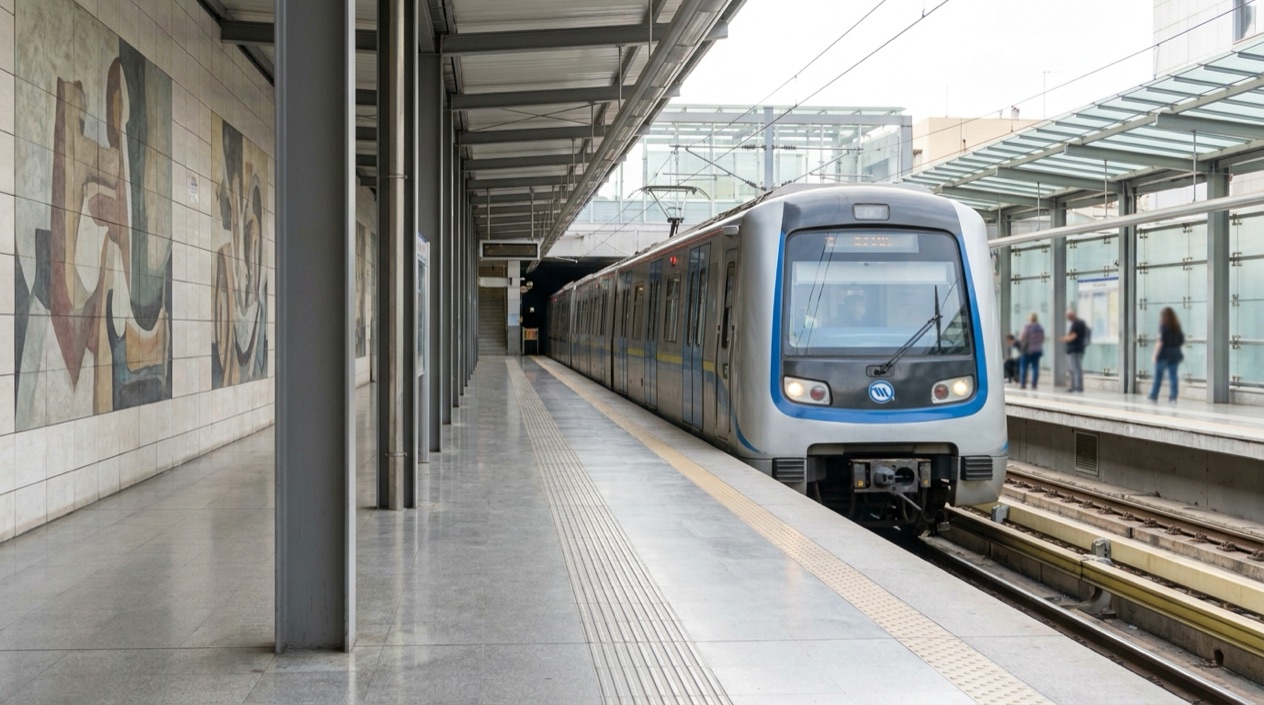
Trains in Greece are run by one company, Hellenic Train, which is the sole operator of passenger services on the whole railway network. There is no choice between rival railways, no competing timetables to compare, and no second brand to learn. Whatever line you ride, from a suburban commuter run to a mountain rack railway, the ticket, the app and the rules come from the same operator.
The network itself is modest in size, with a total length of 1,390 miles. Most rail traffic is in the Athens-Thessaloniki corridor and the suburban railways around the two cities. Other lines, such as Thessaloniki-Florina, Lamia-Trikala and Thessaloniki-Serres, usually have only one or two trains per day, so those are routes to plan around rather than to improvise.
The shape of the network
Most of the track is standard main line, but Greece also keeps several kinds of narrow gauge. There are 489.0 miles of metre gauge railway, and two much smaller systems, 13.9 miles of one narrow gauge and 9.3 miles of an even narrower one. The narrowest belongs to the Pelion line, and the other narrow track includes the rack railway to Kalavryta.
The mountainous country shows in the records. The Kallidromo Tunnel is the longest railway tunnel in Greece, at 5.97 miles. The highest point on the whole network is at Kalogeriko, at 2,671 feet. For a traveler, that means the lines that do run often cross real hills and not just flat plains, and the windows have something to look at.
What is changing on the rails
Hellenic Train is investing €308 million to introduce 23 new Coradia Stream electric trains, a sign that the fleet is being renewed and not simply maintained. Electrification is also spreading. On the Thessaloniki-Alexandroupolis route, the section between Thessaloniki and Drama is planned to be upgraded and electrified up to Serres, with a completion date of 2032.
Not every service has survived. The Thrace Suburban Railway from Alexandroupolis to Xanthi was suspended on 3 February 2010. If an older guidebook or a map shows a line that you cannot find on the operator’s list, it may belong to this past, so it is worth trusting the current schedule over any printed route.
Trains, metros and trams are different things
Inside Athens and Thessaloniki you will meet other rail systems that are not the intercity train. Athens Metro Line 1 opened in 1869 as a single-track steam railway and was electrified in 1904, which makes it the oldest metro line in the Athens urban area. The Athens Tram, opened in 2004 for the Summer Olympics, has two routes: Line 6 (Syntagma-Pikrodafni) and Line 7 (Akti Poseidonos-Asklepieio Voulas).
Thessaloniki’s metro is newer, having opened on 30 November 2024. It has two lines with 18 stations in total, and it is fully automated and driverless, the first system of its kind in Greece. It is operated by Thessaloniki Metro Automatic (THEMA), a Franco-Italian consortium, which is a separate matter from Hellenic Train.
Which routes matter for visitors?
For visitors the routes that matter are the Athens-Thessaloniki corridor, the suburban Proastiakos lines from both cities, and a handful of heritage and rack railways that are worth the trip for their own sake. Beyond them, Greek geography sends you to buses and ferries. Knowing where the train stops is half of planning a Greek journey.
Proastiakos around Athens and Thessaloniki
The Proastiakos is the suburban railway, and Athens central station is the main layover station for lines to Athens Airport, Kiato and Chalcis. The lines between Athens central station and Halkida have been electrified since January 8, 2017, which allows electric multiple unit service. For a traveler that means the airport and the nearby towns are tied into one rail network.
Thessaloniki has two Proastiakos commuter services of its own. One connects the Main Railway Station with Katerini and Larissa, and the other links the city with Edessa. These are the trains to know if you want to leave Thessaloniki for a different town without a car, and they sit alongside the long-distance trains of the main corridor.
Heritage and mountain railways
The Diakopto-Kalavryta Rack Railway is described as a landmark on rails, and it remains in operation as a local and tourist service. It runs on a narrow gauge and uses a rack to climb, which is why it feels closer to a mountain excursion than to ordinary transport. Riders come for the ride as much as for the destination at the top.
The Pelion Train is a seasonal heritage line running from Ano Lechonia to Milies, on a railway with a gauge of 60 centimeters. Because it is seasonal, it is a line to confirm before building a day around it. Together these two railways are the clearest cases where the train is the experience, not just the means.
A train that meets a ship
The train ride from Katakolo to Olympia takes 45 minutes. That is a useful link for anyone arriving at the port of Katakolo.
Where the train gives way to buses and boats
KTEL is the national government-subsidized system of independent bus businesses that together form a dense route network serving almost the entire country. Bus routes from major cities to islands near the mainland, such as Corfu and Cephalonia, include the ferry crossing in the price of the bus ticket. Where there is no track, KTEL is the system that fills the map.
The Greek ferry system is basically hub-and-spoke, with the spokes radiating from Piraeus out to the various island groups. Athens has three ports: Piraeus, Rafina and Lavrio, and for central Cyclades islands such as Tinos and Mykonos it is often better to leave from Rafina. Santorini is an 8-hour slow boat from Athens, and the entrance view from the boat is spectacular.
How do you book?
Tickets are Hellenic Train’s own, since it is the sole operator, and the Hellenic Train App is where you can change a ticket after the fact. With the app you can move your ticket to another date and time by paying or refunding the price difference. A change of plan does not have to mean starting again from zero.
One ticket for a whole journey
An integrated ticket covers the entire journey even when one or more connections are included. In practice, that means a trip that needs a change of train can sit under a single ticket instead of several separate purchases. It is a useful idea for a route that crosses from one line to another, such as a Proastiakos leg that joins a longer journey.
The same logic suits the corridor between Athens and Thessaloniki, where the main line meets the suburban railways at each end. When you are building a trip that mixes a suburban train and an intercity one, the integrated ticket is the idea to look for first.
Gift cards
Hellenic Train also sells gift cards, which make sense for someone who wants to give a rail trip rather than a thing. They come in four set values.
When rail is not the answer
If your route leaves the main corridor, the booking question may become a bus or a boat question. Ferries in August fill up because of the National Holiday on 15 August, so travelers should plan ahead. During the winter off-season, January to March, weather on the Aegean can be extremely rough and boats are often kept in port for days at a time.
A rental car is another way around the gaps in the rail map. About 90% of rental cars in Greece are manual, so for automatics it is advised to reserve one in advance. Rental car terms in Greece often restrict taking the vehicle on ferries, which matters if your plan includes an island.
Good to know before you go
Think of Greek rail as a handful of strong lines and a few special railways, with buses and boats taking over from there. The Cyclades are a good example, since the Western group (Serifos, Sifnos, Milos) and the Central group (Naxos, Paros, Mykonos) are on different spokes.
In summer you can usually get from one island to another in the same group on any day, but boats between the groups, for example Naxos to Sifnos, may be significantly less frequent. Keep that in mind when a rail day in Athens leads into an island week.
Sources
- Hellenic Train (https://www.hellenictrain.gr/en), checked October 12, 2026
- Wikipedia, Rail transport in Greece (https://en.wikipedia.org/wiki/Rail_transport_in_Greece), checked October 12, 2026
- Wikipedia, Transport in Greece (https://en.wikipedia.org/wiki/Transport_in_Greece), checked October 12, 2026
- Wikivoyage, Greece, section Get around (https://en.wikivoyage.org/wiki/Greece#Get_around), checked October 12, 2026