
A rental counter in Athens, a map spread over the hood, a finger tracing the long highway toward Thessaloniki: this is the moment travelers start wondering what the road will ask of them. In Greece, tolls belong to the motorways and almost nowhere else, so the answer depends on which numbered road you take. Around that sit a few rules about licenses and permits that matter just as much as any booth on the way.
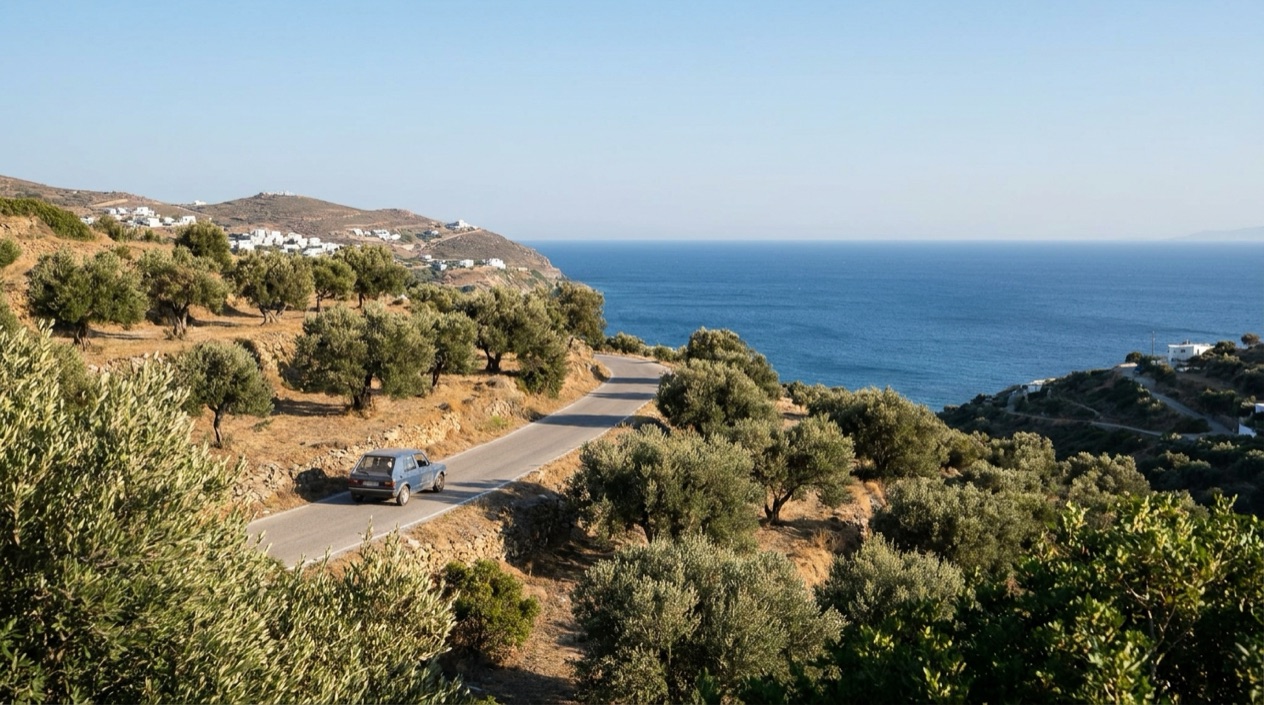
Which roads charge tolls in Greece?
Only motorways charge tolls in Greece, with a single exception: the Aktio–Preveza Undersea Tunnel, which is the one toll point that is not on a motorway. National roads, the ordinary two-lane highways that link towns and villages, are the part of the network you drive without a toll. Motorways carry the highest speed limit in the country, national roads a lower one, and expressways sit in between.
The big motorways are labeled A1, A2, A3, A5 and A7, and each has its own character and its own nickname on road signs and in conversation. A rental counter… this is the moment travelers start wondering.
| Motorway | Also known as | Length (miles) |
|---|---|---|
| A1 | Athens–Thessaloniki Motorway | 342 |
| A2 | Egnatia Odos | 416 |
| A3 | Central Greece Motorway (E65) | 112 |
| A7 | Morea Motorway | 96 |
The A1 and the A2: the long motorways
The A1 is the motorway that ties Athens to Thessaloniki, and it is the road visitors picture when they think of crossing the mainland by car.
The A2 is the longest motorway in Greece and goes by the name Egnatia Odos. The name is shared with a Roman road, the Via Egnatia, which is also called Egnatia Odos. Don’t confuse either one with Egnatia Street in Thessaloniki, a commercial street in the city that has nothing to do with motorway tolls. If a hotel host in Thessaloniki mentions Egnatia, ask which one they mean.
The A3, the A5 and the A7
The A3, called the Central Greece Motorway or E65, is the shortest of the main toll motorways listed here. The A7, the Morea Motorway, serves the Peloponnese, and the A71, the Lefktro–Sparta Motorway, opened on 18 April 2016 as a branch in the same region.
The A5, known as Ionia Odos, is the western motorway. Its Antirrio–Ioannina section was inaugurated on 5 September 2017, and the Patras–Pyrgos section opened on 4 December 2025. Unlike its neighbor the A52, the A5 does charge tolls, which is worth remembering when you plan a drive along the Ionian side of the mainland.
The tunnel at Aktio and Preveza
The Aktio–Preveza Undersea Tunnel is the single toll point outside the motorway system. It links the two sides of the entrance to the Ambracian Gulf, and travelers heading toward the Preveza area from the Aktio side will cross it. It is easy to forget because it sits on a road that otherwise behaves like any national road, free of tolls.
How do you pay?
Paying for the road in Greece starts well before a toll booth, with the paperwork that lets you drive legally at all. A U.S. visitor behind the wheel needs a valid U.S. driver’s license, and insurance companies may require an international driver’s permit. Drivers without an EU license are expected to carry that permit from their home country, and it is certainly required after an accident or a police stop.
Get the permit at home
The U.S. Embassy in Greece does not issue permits. You get yours in the United States from the American Automobile Association (AAA) or the American Automobile Touring Alliance (AATA). AAA has a mail-in option for applying from overseas, but it will likely take days or weeks, so the practical moment to deal with it is long before you fly.
The permit also touches your insurance. Most insurance companies require both your valid U.S. license and the permit for coverage in Greece, so a missing document can matter after a mishap far more than a missed toll. Driving without a U.S. license and permit may bring fines of 1,000 Euros or more, or leave you responsible for all expenses in an accident.
Rental cars, automatics and ferries
About 90% of rental cars in Greece are manual, so an automatic is the one to reserve in advance. Rental terms also often restrict taking the vehicle on ferries, which matters if your plan includes an island hop with the same car. Read that clause before you picture the car in the hold of a boat out of Piraeus.
Small motorbike and all-terrain vehicle rental firms frequently carry no insurance and ask customers to cover the cost of all damages to the vehicle. Your own insurance company may not cover two-wheel or ATV rentals either. Greek law requires every motorcyclist to wear a helmet.
Getting around without a car
If driving does not appeal, KTEL is the national government-subsidized network of independent businesses whose buses serve almost the entire country in a dense route system. On routes from major cities to islands near the mainland, such as Corfu and Cephalonia, the ferry crossing is included in the price of the bus ticket, so a single purchase covers both the road and the sea.
Trains are a narrower option. Most rail traffic runs in the Athens–Thessaloniki corridor and the suburban railways of the two cities. Lines such as Thessaloniki–Florina, Lamia–Trikala and Thessaloniki–Serres usually have only one or two trains per day.
What do tolls cost?
What a drive costs in tolls depends on how much of it you spend on a toll motorway, because every other kind of road in Greece is free to use. That makes route choice the main lever you have. A trip on national roads between villages adds nothing for the road itself, while long motorway legs between the big cities are where tolls appear.
Stretches with no toll at all
Some motorways are fully toll-free. The A52, known as Amvrakia Odos, is one of them, in contrast to the A5. The A64 and the A65, both sections of the Attiki Odos around Athens, are also fully toll-free. For a traveler circling the capital, that means these ring-road sections do not add to the bill.
The tunnel at Aktio and Preveza is the one toll outside the motorways. A route that avoids motorways and tunnels entirely carries no tolls, though it will not match a motorway’s top speed limit. National roads have a lower maximum, and the faster expressway class sits between the two.
The other costs of the road
A toll is rarely the biggest financial risk on a Greek drive. Fines for driving without the proper license and permit can run to 1,000 Euros or more, and rental firms for small motorbikes and ATVs may hand you the full bill for damage. Those are the numbers worth keeping in mind when you compare a rental with a bus ticket.
There is also the question of what a car does to your island plans. A KTEL ticket to Corfu or Cephalonia includes the ferry, while a rental car may be barred from the boat by its contract. Ferries fill up in August around the 15 August National Holiday, so plan ahead.
Staying longer
A Greek license is required if you stay more than 185 days in Greece, which is far beyond the length of an ordinary vacation. For anyone shorter, the combination to keep in the glove box is the U.S. license and the international permit, and nothing else changes how the toll motorways treat you.
Good to know before you go
Greece has one of the highest traffic fatality rates in the European Union, and on many two-lane highways slower traffic drives on the shoulder while cars pass straddling the center double-yellow line, so the lane markings are not a guide. Talking or texting on a mobile phone while driving is illegal, and police check phone records when investigating accidents. Driving under the influence of alcohol or drugs is illegal too, and police conduct random alcohol testing.
Sources
- U.S. Department of State, Greece travel information, travel and transportation (https://travel.state.gov/content/travel/en/international-travel/International-Travel-Country-Information-Pages/Greece.html), checked October 12, 2026
- Wikipedia, Egnatia Odos (https://en.wikipedia.org/wiki/Egnatia_Odos), checked October 12, 2026
- Wikipedia, Highways in Greece (https://en.wikipedia.org/wiki/Highways_in_Greece), checked October 12, 2026
- Wikivoyage, Greece, section Get around (https://en.wikivoyage.org/wiki/Greece#Get_around), checked October 12, 2026
To plan your stay
- Best Time to Visit Greece: September and Late May to Early June
- Arachova: Parnassus Mountain Town, Formaela Cheese, Ski Season and Saint George's Day
- American Airlines Flights to Greece: U.S. Cities, Athens Arrivals and Onward Island Flights
- Greece on a Budget: Cash Machines, Cards, Beaches and Ferries