
A row of loungers faces the water, umbrellas tilt against the sun, and somewhere behind you a beach bar is shaking a frappé. Out on the sand, a few people have simply spread a towel and gone straight to the sea. That is the Greek beach day on the coast of the mainland and on the islands, and it comes with a few habits and rules worth knowing before you pick your spot.
How do sunbeds work on Greek beaches?
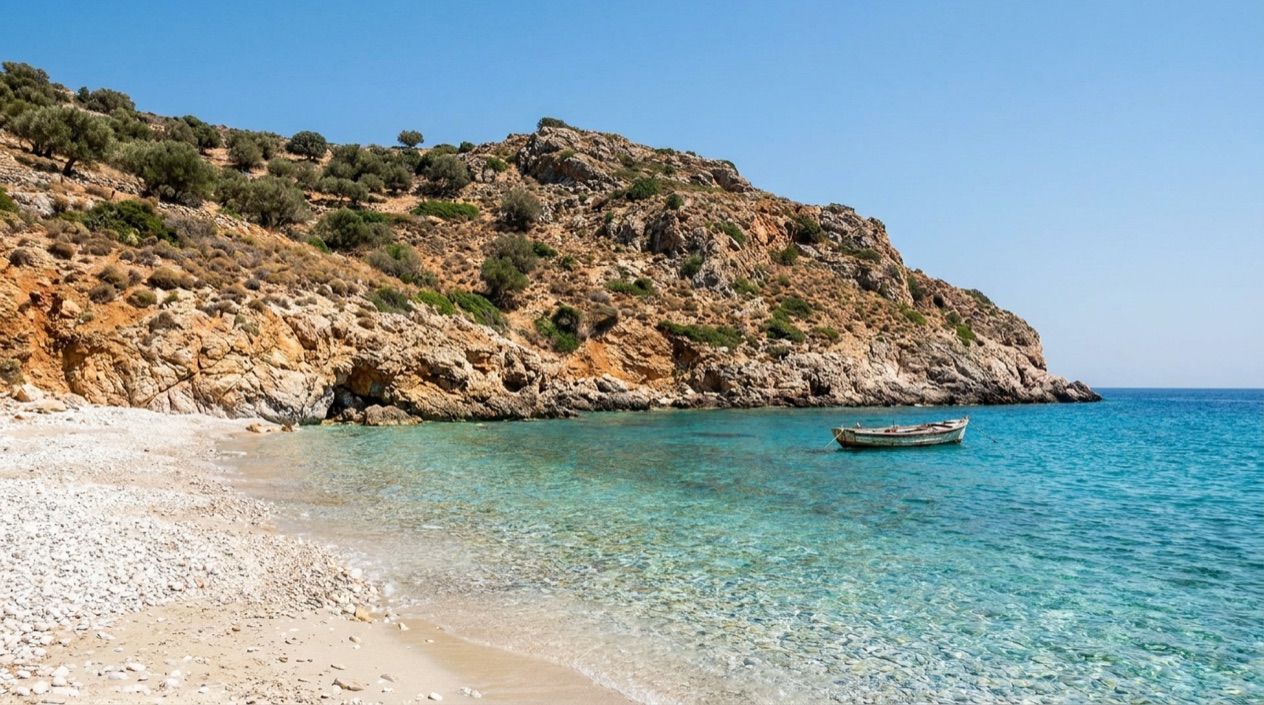
A sunbed is a lounger, often with an umbrella over it, set on the sand or the pebbles, and the beaches that carry the Blue Flag show best what a well-kept stretch of shore offers around it. Beyond that picture, the details of any single beach belong to that beach, so it helps to read what is in front of you: where the loungers stand, where the open sand begins, and what stands behind the shoreline.
The scene changes from one bay to the next. Some shores are lined edge to edge with loungers and a snack bar, while others are open sand with a single tavern at one end. Both kinds are part of the Greek coast, and many beaches mix them, with a lounger section on one side and free space on the other for your own towel.
What a Blue Flag beach gives you
The Blue Flag is a certification from the Foundation for Environmental Education that a beach meets its standards. To earn it, a beach must satisfy at least thirty criteria across four categories, and the awards for Europe are announced each year on 5 June. A flag on a beach therefore tells you something about the surroundings of your lounger, not only about the water.
On such a beach you can expect trash bins and recycling bins that are regularly attended to, and a reasonable number of restrooms that are maintained. Water quality has to meet set limits, and the water must be free of industrial or sewage waste. First aid instruments must be accessible, and protective safety measures must be in place. The beach also has to run environmental education events, at least five of them.
Reading the shore before you settle
Look at the whole beach before you unfold anything. On a Blue Flag beach, only emergency and maintenance vehicles are allowed on the sand, so what you see around your lounger is people, towels, umbrellas and bins. Measures also exist to keep different activities, such as swimming and jet skiing, respectful of each other, which shapes how the water is shared.
Dogs and other pets are not allowed on Blue Flag beaches, and neither are dumping and camping. If you travel with a dog, that is a good reason to look at the rules of the specific beach before you plan the day around it. Pairing a morning on the sand with lunch at a seaside taverna, grilled fish, a Greek salad with feta and a carafe of cold water, makes a day that needs little else.
Towel on the sand, no lounger at all
Not every beach day involves a lounger. Greek shores range from busy resort stretches to bays where the only furniture is a wooden bar under a tamarisk tree, and plenty of people simply bring a towel and a book. A nude or clothing-optional stretch, for example, usually has very basic facilities, and use is casual, with no pre-booking needed.
That also means access can be harder than at a regular beach, so a stretch with few services asks for a little more preparation. Bring water, shade and something to eat, then take your trash with you. It is the same spirit as the Blue Flag standard, applied by the visitor instead of by an operator.
What are the beach rules?
The rules that shape a Greek beach day are about the environment, fire, pets and how you dress or undress, and the clearest ones are those that apply on Blue Flag beaches and during the fire ban. The rest comes down to common courtesy toward the people sharing the sand with you.
On a Blue Flag beach
Dumping and camping are not allowed on Blue Flag beaches, dogs and other pets are prohibited, and only emergency and maintenance vehicles may drive on the sand. That makes the beach a place for walking, swimming and lying in the sun, with no engine noise behind you and no tent on the sand.
The beach must also be kept clean, with enough trash bins and recycling bins for the public, and its water must meet limits on escherichia coli and intestinal enterococci. In practice that means using the bins provided and leaving the shore as you found it, which is how a certified beach holds on to its flag from one season to the next.
Fire, smoke and the summer ban
During the fire ban in Greece, every outdoor activity that could cause a forest fire is prohibited. That includes campfires, bonfires, barbecues and cookouts, and fireworks. A beach picnic with a portable grill, or an evening fire on the sand with a bottle of wine, falls exactly into that category while the ban lasts.
The stakes are real: the fine for causing a forest fire can be €200,000. If you see a fire, call 112. Smoking is also prohibited by law in all public places in Greece, such as restaurants and cafeterias, and a hotline, 1142, exists to report people and establishments that break the smoking ban.
Nudity, topless sunbathing and etiquette
A nude beach is one where users are at liberty to be nude, usually with mixed bathing. On all shores of the mainland and on most of the islands, Greece has nudist beaches where nudism is tolerated. Beaches in Crete are clothing-optional, except some central urban beaches, and the last part of the eastern end of Plakias beach, in the south of the Prefecture of Rethymno, is used mainly by tourists for nudism.
Topless sunbathing, on the other hand, is not accepted outside the tourist areas, so what is fine at a resort beach may not be at a village cove. Naturist etiquette asks you to respect the privacy of others, and staring is frowned upon. Sexual activity and sexual harassment have no place, and neither do predatory behavior and unauthorized photography.
What should you know?
You should know that the Greek shoreline is a public place with its own habits, so the way you dress, smoke, cook and gesture matters as much on the sand as in town. A few small points make the difference between a smooth beach day and an awkward one.
Choosing a beach for the way you want to spend the day
If you want facilities, look for a Blue Flag beach, where restrooms, bins and first aid instruments are part of the standard. If you want a stretch where clothing is optional, know that facilities there tend to be very basic and access is at times harder than at a regular beach. The two kinds of day are different, and so is the packing that goes with each.
Pets are the clearest dividing line. Because dogs and other pets are prohibited on Blue Flag beaches, a traveler with an animal will want to know the rules of a given beach before heading there. Nude beaches are usually on public land, and any member of the public may use them, with no membership or subscription to any movement required.
Nudist hotels and naturist stretches
Nudist hotels in Greece are located on Crete, Rhodes, Kefalonia and Zakynthos, which gives naturists a base as well as a beach. For everyone else, the practical lesson is simply to expect that some bays on those islands, and along the mainland shore, host people who are undressed, and that nobody asks you to join in.
If you do choose a clothing-optional stretch, the manners are short and clear. Keep your camera in your bag, keep your eyes on the horizon or your book, and give people room. A towel placed too close to a stranger is more noticeable on an open beach than almost anything else you can do.
Leaving the beach: churches, tavernas and gestures
A beach day often ends with a walk up to a village, and a chapel or monastery may be on the way. Dress codes for churches in Greece sometimes require women to cover their shoulders and both sexes to cover their knees.
At the entrance of churches and monasteries, especially those that receive most tourist traffic, appropriate clothing is usually available to borrow. You pick it up going in and drop it off on the way out.
One small gesture is worth leaving at home. Holding up your palm with your fingers extended outward is rude in Greece, known as the Mountza, and it is akin to giving someone the middle finger. A wave to a waiter or a neighbor on the beach is better done with the palm turned sideways or a simple nod.
Good to know before you go
Carry a bit of shade and water to a beach with basic facilities, and leave the grill and the fireworks behind while the fire ban is on. Keep the emergency number 112 in your phone, and save the smoking hotline too if it matters to you. Euro amounts at beach bars and tavernas are not set by any rule you can look up, so the menu on the table is the guide.
Sources
- Wikipedia, Blue Flag beach (https://en.wikipedia.org/wiki/Blue_Flag_beach), checked October 12, 2026
- Wikipedia, Nude beach (https://en.wikipedia.org/wiki/Nude_beach), checked October 12, 2026
- Wikivoyage, Greece, section Respect (https://en.wikivoyage.org/wiki/Greece#Respect), checked October 12, 2026
To plan your stay
- Best Time to Visit Greece: September and Late May to Early June
- Arachova: Parnassus Mountain Town, Formaela Cheese, Ski Season and Saint George's Day
- American Airlines Flights to Greece: U.S. Cities, Athens Arrivals and Onward Island Flights
- Greece on a Budget: Cash Machines, Cards, Beaches and Ferries