
A shopkeeper twists a paper cone around a scoop of dried oregano still on its stem, and the whole doorway smells of herbs and sun. Behind her, strings of amber worry beads click on a hook and jars of thyme honey line the shelf. Greece sends you home with things you can taste, wear and set on a table, and this is a look at which ones are worth the room in your suitcase.
What souvenirs can you buy in Greece?
Food comes first for travelers, because each region has its own specialty and a jar or bottle carries the place with it. Crafts come second, and they tend to be tied to a single island or town.
Food and drink to carry home
Olive oil is the obvious start, and Greek tables use it on everything. Look for bottles and tins from the olive-growing regions, and for jars of olives themselves, with Kalamata the name people know. Honey comes in thyme and pine varieties, and it tastes different from one hillside to the next. Dried oregano, sold on the stem or in bags, is the herb that goes into a Greek salad.
Some products belong to one island. Chios is the home of mastic, a resin used in sweets, liqueurs and spoon sweets. Aegina is known for its pistachios. Naxos makes kitron, a citrus liqueur, and Santorini turns local tomatoes, capers and fava into jars.
Crete offers mountain herbs and raki, the clear spirit poured at the end of a meal. Ouzo, the anise spirit, is sold in bottles of every size, easy to pack.
Sweets travel well too. Loukoumi (Greek delight) comes in boxes, sesame-and-honey pasteli bars sit by the register in many shops, and glyka tou koutaliou, fruit preserved in syrup, come in jars meant to be eaten off a spoon. Feta is a Greek cheese you can taste at the counter, though it is better eaten on the spot than carried far.
Crafts, ceramics and things to wear
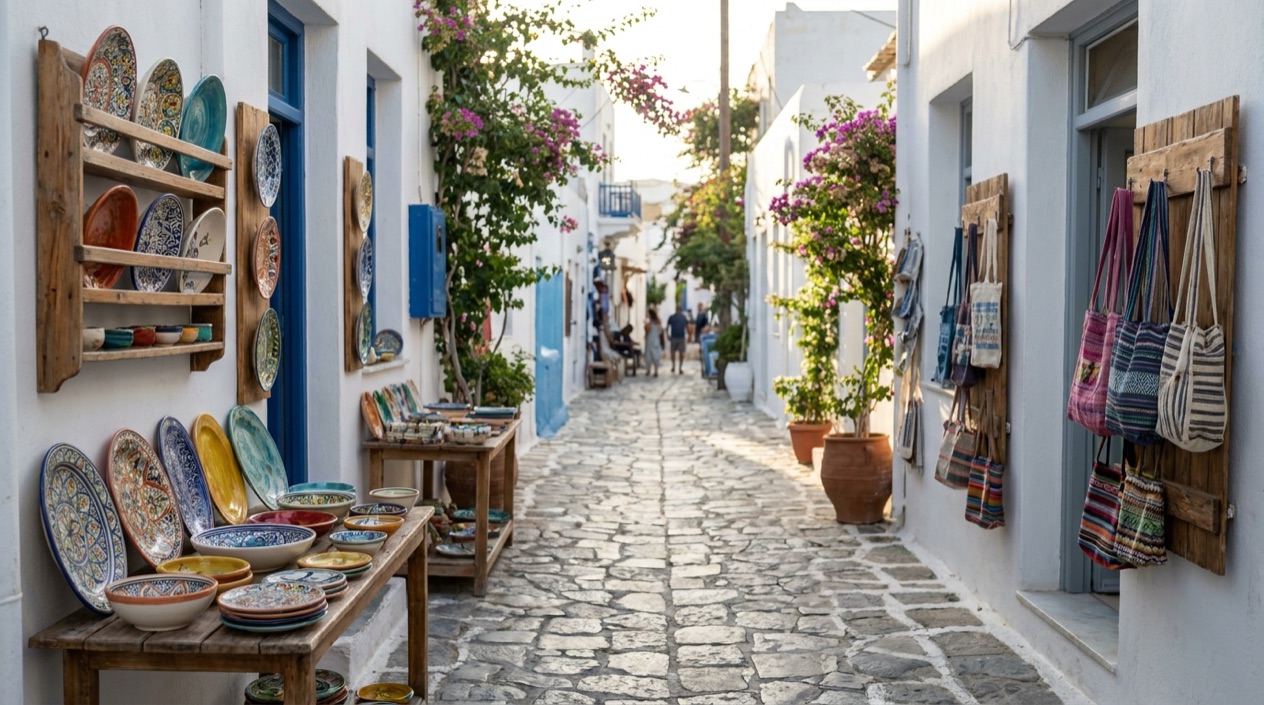
Pottery is the craft you see most often: bowls, plates, olive dishes and mugs painted in blues, whites and earth tones, often with patterns taken from the sea or from ancient vases. Islands such as Sifnos are known for their pottery, and in many villages you can see a workshop with its wheel by the door. Pieces from a workshop feel quite different from the printed copies sold at the harbor.
Leather sandals are sold in small shops and made to measure in some of them, and they are a gift that gets used all summer. Woven bags, embroidered linens and hand-knotted textiles appear in village stores. Jewelry ranges from silver pieces inspired by ancient motifs to simple bracelets with the blue eye, the evil eye charm Greeks hang in homes and on babies’ clothes to turn away envy.
Worry beads, sponges and soaps
The komboloi, a string of beads you run through your fingers, is the small object you will see men fidgeting with in kafenia (traditional coffee houses). It makes a light, inexpensive gift in amber-colored resin, wood, stone or glass. There is no right way to use one, and clicking it while you sit with a coffee is how most owners do it.
Kalymnos, in the Dodecanese, is the Greek island most closely associated with the sponge-diving tradition. Olive-oil soap and laurel soap, often wrapped in plain paper, are among the easiest things to bring back for a lot of people at once. Worry beads, a sponge and a bar of soap fit in a corner of a bag and cost little space.
Where do you buy them?
You buy Greek souvenirs in neighborhood shops, open-air markets, island village stores and workshops, and the places differ in what they sell and how you pay. A food shop sells jars and bottles, a craft studio sells its own work, and a harbor stall sells whatever sells fast. Walking one street away from the waterfront often changes the shelves in front of you.
Markets and neighborhood shops in the cities
City shopping streets mix tourist stores with small grocers who sell spices, nuts, dried fruit, olives and cheese by weight. In the Athens flea-market streets around Monastiraki, you pass stalls of sandals, bags, linens and trinkets, and in the shops lining the alleys you find worry beads, ceramics and reproductions of ancient statues. Thessaloniki and other cities have their own food markets, where spice and sweet shops are as much a visit as a purchase.
Bargaining comes up here. In Greece one can bargain on many things, especially on clothing and souvenirs, so a friendly question about a better price at a market stall is normal. Food in a grocer’s shop is usually priced as marked, and the same is true of a bottle on a supermarket shelf.
Island villages, workshops and harbor stalls
On the islands, the chora (the main town, usually on a hill) is where small studios sell pottery, jewelry and weaving. Many places make what they sell on the premises, so you can talk to the person who painted the bowl. Harbor stalls sell sponges, soaps, magnets and bags, and the quality differs from one table to the next, so pick things up and look at them.
Village stores in food-producing places sell the local specialty directly: mastic on Chios, pistachios on Aegina, kitron on Naxos. Buying at the source means you taste before you pay, and it is a good reason to step off the main street. On a day trip, ask what the place is known for and let that guide your choice.
Supermarkets and the períptero
Large supermarkets are a quiet place to buy gifts in bulk: olive oil, herbs, tea, honey, sweets and packaged spices sit on ordinary shelves. The períptero, the newsstand kiosk you see on city corners, sells newspapers, magazines, chilled drinks, confectionery, snacks, tobacco and ice cream. It is the place for a last-minute sweet, not for a gift with any weight.
Paying and opening hours
Cards are widely accepted in retail stores, but local souvenir shops usually require a minimum purchase before allowing you to use your card, and may not accept it for special sales or deeply discounted items. Many businesses are also reluctant to accept notes larger than €50, partly because of a scarcity of change. Small notes and coins are worth keeping in your pocket for market stalls.
| Shop type | Open |
|---|---|
| Shops outside tourist resorts (large supermarkets excepted) | Usually a long lunch break from about 14:00 to 17:00, then open again until 20:00 and sometimes longer |
What should you not buy?
Skip anything that could have come from any seaside town in the world, and be careful with pieces sold as antique. Greece has plenty of objects tied to a place, so a plastic trinket or a generic printed T-shirt is a missed chance. A good rule is to buy what you can see being made or grown nearby.
Generic trinkets and printed copies
Fridge magnets, plastic worry beads and printed pottery patterns fill harbor stalls everywhere, and they look alike from island to island. If the label does not say where something was made, treat it as a mass-market item. A hand-painted bowl from a workshop or a jar from a village producer says more about your trip and will be used more often.
Reproductions of ancient statues and vases are sold in museum shops and city stores. They are fine as decoration when they are sold as reproductions, with the maker named. A small bowl or figure you picked because you like it will outlast one bought only because it looked like something from a museum.
Pieces sold as ancient or very old
A stall owner may tell you a coin, a lamp or a fragment is old. You have no easy way to check, and a copy is the likely answer, so buy such pieces only as a keepsake and at a price you would pay for a copy. A museum shop or a workshop that signs its work is a safer place for anything that claims a past.
Impulse buys and sale items
What should you not buy?
Bargaining works on clothing and souvenirs, but it does not suit every counter. A food producer who sells honey or oil from their own hives or trees will rarely drop the price on a jar. Save the haggling for market stalls and leave the producers alone.
Good to know before you go
Greece uses the euro, divided into 100 cents, which Greeks call lepta, so a lepto is a single cent. Visa, MasterCard, Maestro and Eurocard are widely accepted in retail stores, hotels and travel agencies, but not in some restaurants.
Many ATMs may not accept 5-digit PINs, so a card with one is worth changing to 4 digits before you leave home. Alphabank branches exchange euro and US dollar American Express Travellers Cheques into euros at their usual bank rates without fee or commission.
| Fee | Amount | Who pays |
|---|---|---|
| ATM withdrawal, on top of your own bank’s charge | €2.50–3 | The cardholder, added to the amount withdrawn and invoiced to the home bank |
Sources
- Wikivoyage, Greece, section Buy (https://en.wikivoyage.org/wiki/Greece#Buy), checked October 12, 2026
To plan your stay
- Best Time to Visit Greece: September and Late May to Early June
- Arachova: Parnassus Mountain Town, Formaela Cheese, Ski Season and Saint George's Day
- American Airlines Flights to Greece: U.S. Cities, Athens Arrivals and Onward Island Flights
- Greece on a Budget: Cash Machines, Cards, Beaches and Ferries