
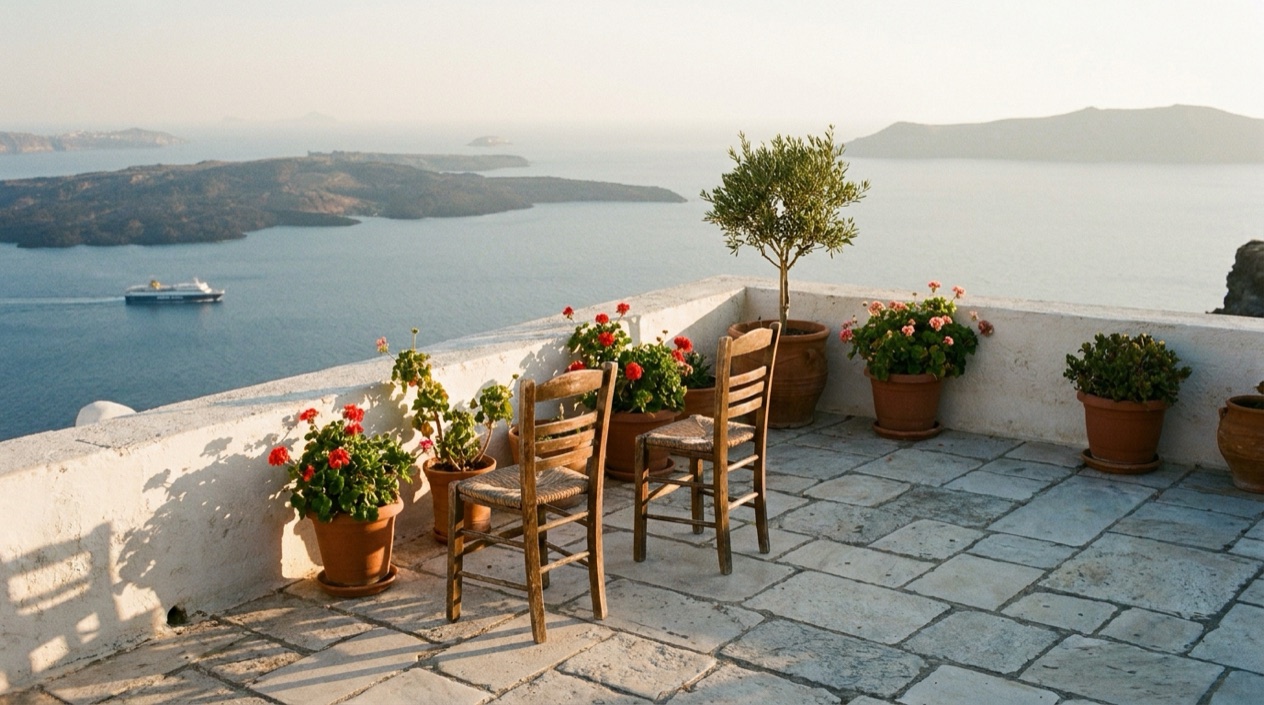
A plate of fried zucchini balls, a glass of ouzo clouding with water and a chair at a small table where nobody asks why there is only one of you. That is a Greek evening for a traveler on their own, and it comes after a day on a mountain path, a ferry deck or a stretch of sand. Greece rewards the person who sets the pace alone, with mountains, gorges, mainland coasts, island beaches and old pilgrim roads to choose from.
Is Greece good for solo travelers?
Greece gives a solo traveler plenty to fill the days with, because so much of what it offers is built around walking, swimming, sailing and sitting at a table, none of which needs a companion. You can hike a mountain on your own schedule, spend the afternoon on a beach and settle into a taverna in the evening, then do it again somewhere new the next day.
What changes from place to place is the mood. A mountain trail asks for attention to the path, a harbor town asks you to linger, and a football night in a big city asks you to join a crowd. Traveling alone lets you pick whichever of these suits the day, without negotiating.
Trails and mountains for your own pace
Hiking is where Greece suits a solitary traveler best, since a trail asks nothing of you but your own steps. The most popular hiking areas are Mount Olympus, the gorges of Crete, the national parks of Epirus and the less-known Rhodope Mountains.
Walking alone means you stop when a view or a village asks you to. You can linger over a stone bridge, follow a bird across a ridge or simply sit and eat the bread and cheese you carried. In the evening, a village table with a plate of beans, greens and grilled meat feels like a reward you have earned yourself.
Beaches, with and without a swimsuit
A beach day is a solo pleasure in its own right: a book, a towel, a swim and a cold coffee frappé, the foamy iced drink Greeks make with instant coffee. The most famous mainland beaches are found in Chalkidiki, Epirus and the Peloponnese, so you do not need a ferry ticket to have a seaside holiday.
Naturist beaches are part of the picture too. The most popular Greek islands for them include Crete, Zakynthos, Rhodes, Gavdos and Antiparos. If clothing-optional sand appeals to you, it is a way to meet the sea on very plain terms, and the habit on such beaches is simply to respect the people around you and keep cameras away.
A football night and a table for one
If you want company without having to make conversation, a football match is the answer. Olympiakos plays at Karaiskakis Stadium in Piraeus, and AEK Athens and Panathinaikos play in Athens, while PAOK plays in Thessaloniki. The stands are loud, the songs are long and a stranger beside you will often explain the offside rule whether you asked or not.
Afterward, a souvlaki wrapped in paper or a plate of grilled sardines fits a night out alone perfectly. Meze, the small shared plates of Greek eating, are easy to order one or two at a time, so a single diner can taste a lot without the table groaning. Tzatziki, grilled octopus, saganaki cheese and a dish of olives make a full meal.
Where do solo travelers go?
Solo travelers in Greece tend to follow their interests, heading to the mountains, the gorges, the mainland coast or the island beaches, rather than a single route. The places below each reward someone traveling on their own in a different way, from a summit approach to a pilgrim road to a harbor with a boat waiting.
Mount Olympus and the parks of Epirus
Mount Olympus is one of the most popular hiking areas in the country, and the national parks of Epirus sit on the same list. Both are places where you walk through changing landscapes, with forest, rock and open slopes, and where the day’s reward is the view and a meal at the end of it.
Olympus carries the weight of myth, since the ancient Greeks placed their gods on its heights, and that story follows you up the path. Epirus has a different feel, with its parks and mountain villages, and it suits someone who wants to walk without a plan and finish the day over a pie of wild greens and cheese, a regional favorite.
The gorges of Crete and the Rhodope Mountains
Crete is on the hiking list for its gorges, deep cuts through the mountains that you walk through rather than look down on. It is also one of the islands with naturist beaches, so a solo traveler can combine a gorge walk with a swim in the same stay. After a hike, a Cretan table of dakos (barley rusk with tomato and soft cheese) and a small glass of raki is a good way to end the day.
The Rhodope Mountains are the less-known name among the hiking areas. That makes them a choice for someone who would rather follow an unfamiliar path than a famous one, and who likes the feeling of having found a corner others skip.
Mainland coasts and island beaches
Chalkidiki, Epirus and the Peloponnese hold the most famous mainland beaches, which makes them natural targets for a solo swimmer who prefers to stay on solid ground. Pick one region and stay put, and you can swim, read, walk the shoreline and eat grilled fish at a seaside taverna without ever opening a ferry timetable.
For islands, Crete, Zakynthos, Rhodes, Gavdos and Antiparos are the names that come up for naturist beaches. Each island has its own character, from the large and varied to the small and remote, so the choice depends on whether you want a long stay or a single focused swim.
Athens, Piraeus and Thessaloniki for city days
The big clubs of the Super League tie the cities together: Olympiakos in Piraeus, AEK Athens and Panathinaikos in Athens, PAOK in Thessaloniki. Fourteen clubs play in the Super League, and sixteen in Super League 2, so a match is rarely far from wherever you happen to be.
A city stay gives a solo traveler something different from the mountains: cafés where you can sit with a newspaper, bakeries selling spinach pie and bougatsa, the custard pastry eaten warm with powdered sugar, and the pleasure of walking without a destination. Add a match and the evening is planned.
What should you know before you go?
Before you go, know that Greece’s solo experiences depend heavily on the season, the sea and the kind of trip you want, so it pays to match your plans to the right months. Sailing, pilgrimage and hiking each have their own rhythm, and the sea in the Aegean can change the plan.
Sailing areas and the Aegean wind
The most popular sailing areas are the Ionian Islands, the Cyclades, the Saronic Gulf Islands, the Dodecanese and the Sporades. The Ionian Islands are described as ideal for novice sailors, thanks to mild winds and short distances between them. The North Aegean Islands are less known for sailing, but the greater distances mean fewer boats and anchorages that are easier to find.
In the Aegean, spring and autumn are the best times for sailing. July and August can bring strong Meltemi winds, reaching up to 8 Beauforts, which suit experienced skippers better. A solo traveler who is new to the water will want to keep that in mind when choosing both the months and the waters.
Pilgrim roads and holy places
Religious tourism has its own centers in Greece: Mount Athos, and the sites the Apostle Paul visited on his travels, especially Philippi. For a traveler on their own, these are places that invite a quiet, reflective pace, whether or not faith is the reason you came.
In northern Greece, the Via Egnatia is part of the pilgrimage route to Jerusalem. Following it, even in part, gives a trip a thread to hold onto, linking ruins, churches and towns along an old road. It suits a traveler who likes history with a purpose and who is happy to read the landscape as they go.
Choosing your kind of trip
Greece offers several distinct trips in one country: a hiking trip in the mountains and gorges, a beach trip on the mainland or an island, a sailing trip in the right season, a pilgrimage along old routes or a city trip built around a football match. Few visitors try all of them at once, and a solo traveler is free to commit to one.
Pick the theme first and the places follow. If you want mountains, look to Olympus, Crete, Epirus or the Rhodope range. If you want the sea, look to the mainland coast or an island chain. If you want history with a purpose, look to Athos, Philippi and the Via Egnatia.
Good to know before you go
Greece uses the euro, and a solo traveler will spend most of it on meze, grilled fish and the coffee that stretches an hour. Sailing waters in the Aegean are best in spring and autumn, since the Meltemi can blow hard in July and August. A good map and a flexible plan serve you better than a fixed schedule in the mountains and on the water.
Sources
- Wikivoyage, Greece, section Do (https://en.wikivoyage.org/wiki/Greece#Do), checked October 12, 2026
To plan your stay
- Best Time to Visit Greece: September and Late May to Early June
- Arachova: Parnassus Mountain Town, Formaela Cheese, Ski Season and Saint George's Day
- American Airlines Flights to Greece: U.S. Cities, Athens Arrivals and Onward Island Flights
- Greece on a Budget: Cash Machines, Cards, Beaches and Ferries