
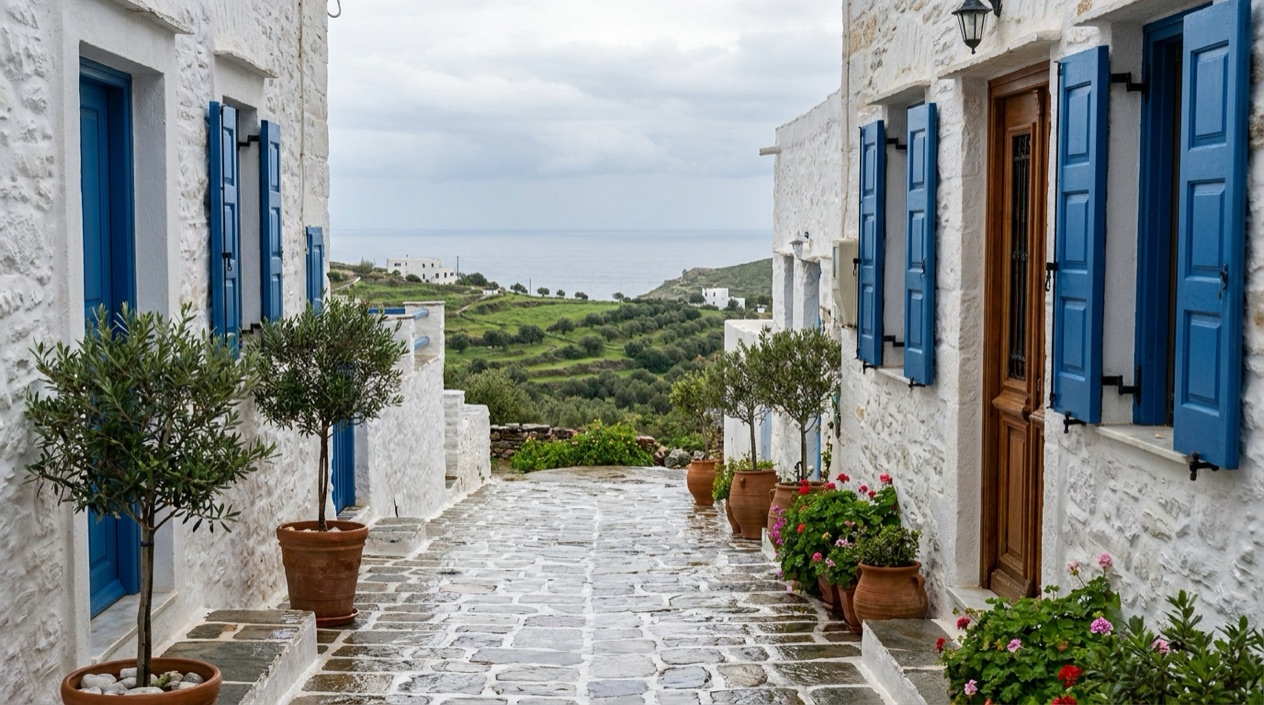
On a spring morning in a Greek village, the kafenio (the neighborhood coffee house) sets its chairs out in the sun, a neighbor hoses down the steps, and the hillside above the last houses is covered in low, scented shrubs. Spring here is a season of in-between weather, and that is exactly why the suitcase question comes up. The short answer is a light wardrobe built in layers, a rain jacket, and shoes that can take stone, dust and mud.
What should you pack for Greece in spring?
Pack for a changeable season: clothes you can layer, one waterproof jacket, comfortable shoes and a small day bag. Spring in Greece sits between a rainy winter and a long dry summer, so the same trip can ask for a sweater in one place and a T-shirt in the next. A suitcase built around a few pieces that mix and match serves you better than one built around a single kind of day.
The reasoning comes from the climate itself. In a Mediterranean climate, rain falls mainly in winter and spring, and rainfall is irregular, varying a great deal from one year to the next. You cannot count on a dry week, and you cannot count on a wet one. Packing for both is the sensible answer.
Layers that work from the coast to the hills
Summer temperatures in Mediterranean climates depend on distance from a large body of water, on elevation and on latitude. The same logic holds in spring: a harbor town on the water and a mountain village are not living in the same weather. Itineraries that mix the two, an island port one day and a monastery or a mountain village the next, call for clothes that can be added and removed.
A reasonable core is a few short-sleeved shirts, a couple of long-sleeved tops, one light sweater or fleece, and one pair of long pants alongside whatever else you like to wear.
A rain jacket and a small umbrella decision
Because spring is one of the seasons when rain falls in this climate, a light waterproof jacket with a hood earns its place in the bag. It folds into a day pack and does double duty over a sweater when the air turns raw. Travelers find a jacket more useful than an umbrella when they are climbing steps, crossing cobbled lanes or standing on a ferry deck.
If you prefer an umbrella, a compact folding one is enough. A full-size one adds bulk without adding much. Whichever you choose, keep it where you can reach it, since a Greek spring can change its mind about the sky.
Shoes for stone, steps and trails
Greek towns and archaeological sites are full of marble, worn paving stones, dirt paths and long flights of steps. Comfortable walking shoes with a grippy sole are the most important footwear you will bring. Smooth leather soles and thin sandals are a poor match for polished stone, which becomes slippery after rain.
A second pair is worth the space: either a pair of sturdier shoes or trail runners if you plan to walk the countryside, or a pair of sandals for warmer afternoons. Broken-in shoes matter more than new ones. Blisters on day two of an Athens walk will cost you more than any missing outfit.
The day bag and small extras
A light day bag with a zipper carries most of what you need once you leave the hotel: the rain jacket, a sweater, a refillable water bottle, sunglasses, a hat and sunscreen. The spring sun can be strong where you stand in the open, on a ruin without trees or on a ferry deck, so the sun gear is worth packing even if the morning starts out gray.
Add a phone charger and a plug adapter for European outlets, a small first-aid kit with blister plasters, and any medication you take in its original packaging. A swimsuit is an optional item, a gamble that depends on where you go and how you feel about cold water. A light towel or sarong is handy if you do decide to take a dip.
What is the weather like?
Spring weather in Greece follows the Mediterranean pattern: the season sits at the tail end of the rainy months and leads into a long, dry summer. Rain still falls in spring, and it falls irregularly, so a wet spring and a dry one can look very different from year to year. Expect some days of full sun and some days that call for a jacket, without a fixed schedule for either.
Rain, drought and the green hillsides
In a Mediterranean climate, summers can go four to six months without significant precipitation, and the rain that feeds the land arrives mainly in winter and spring. That is why spring is the green season in Greece. The hills are covered in maquis, the dense, scented shrubland that is the signature vegetation of the Mediterranean Basin, and the landscape looks greener than it will by the time summer is in full swing.
The irregularity of rainfall cuts both ways. A spring that brings plenty of rain leaves the countryside lush, and a spring with less rain leaves it drier and more golden. When you look at a hillside in Greece, you are seeing the result of the season that came before.
Temperatures that depend on where you stand
There is no single spring temperature for the country. Greece covers sea-level ports, island interiors, plains and mountains, and temperatures in a Mediterranean climate vary with distance from the sea, with elevation and with latitude. A seaside terrace and a mountain monastery will not feel alike on the same day.
Winter temperatures in this climate only occasionally fall below freezing, and snow is generally seldom seen except in some locations. Those locations tend to be the high ground, so if your plans take you into the mountains, you carry a warmer layer there than you would on a coastal island.
Why spring comes before the heat
The hot-summer type of Mediterranean climate, found in much of Greece, is defined by a warm season whose average temperature is above 22°C. Spring is the approach to that season rather than the season itself. The dry months, the strongest sun and the risk of wildfire that comes with dry shrubland and strong winds belong to summer, not to the weeks when the hills are still green.
That is one reason travelers like spring for walking and for visiting open-air sites. You do the sightseeing in a season that is still on its way toward summer. Pack for that rising curve, and expect that the last days of your trip may feel warmer than the first.
A view of the Ionian side
The Ionian Sea view from the island of Lefkada is used as a picture of the Mediterranean biome: shrub-covered slopes dropping to the water. It is a fair image of what many Greek coastlines look like in spring, with scrubby green hillsides above a blue sea. The weather that produces that scene is the one you are packing for, with rain a possibility, sun a probability and a sweater always nearby.
What can you leave at home?
You can leave behind the heavy winter gear, the summer-only wardrobe and most of the “just in case” items that crowd a suitcase. A Greek spring does not call for a bulky parka, thick gloves or a trunk of dressy outfits. Winter temperatures in a Mediterranean climate only occasionally fall below freezing, so a thick winter coat is rarely worth its space unless you are heading into the high mountains where snow can be seen.
Winter bulk and summer extras
A good layering system replaces the big coat. A light jacket over a sweater over a shirt can be adjusted a dozen times in a day, and each piece packs flat. If you are traveling to a mountain area, a warmer mid-layer is a better answer than a heavy coat.
The opposite mistake is packing for midsummer. A suitcase full of tank tops, many swimsuits and heavy sun gear belongs to a season when the dry months have settled in and the heat is at its height. In spring, a couple of warm-weather pieces are enough, and the rest of the space is better used for the layers and rain gear that the season does ask for.
Shoes and clothes you will not wear
High heels, thin-soled fashion sandals and brand-new shoes are the usual casualties of a Greek trip. The streets of old towns, the paths of archaeological sites and the steps of hill villages are hard on them. Leave them at home, and let one pair of good walking shoes and one pair of sandals do the work.
The same goes for clothes you would wear once. Greek restaurants, from the harborside taverna to the village grill, suit a clean, simple outfit, and there is no need for a separate evening wardrobe. A nicer shirt or a dress that packs without wrinkling is plenty. Choose pieces that work in several combinations and you can leave half your usual packing list on the bed.
Things you can find along the way
A small suitcase leaves room for what you will bring home: a jar of thyme honey, a bag of dried oregano, olive oil soap, ceramics and a bottle of local wine or tsipouro. Greek spring food is a reason to travel in itself, with wild greens called horta, fresh herbs, spring lamb around Easter and cheeses such as feta in nearly every salad.
Easter, which moves from year to year, is the big celebration of the Greek calendar, marked with candlelit church services, red-dyed eggs and long family meals. If your trip overlaps it, you will see it in the streets and on the tables, and you will not need to pack anything special for it. Bring curiosity and an appetite instead.
Good to know before you go
Greece uses the euro, and a small amount of cash in your pocket is handy for a coffee at a kafenio, a bakery stop or a village shop. If your plans reach into the Aegean in warmer months, wind and heat are part of that season’s story, but spring packing comes down to layers, a rain jacket and good shoes.
Sources
- Wikipedia, Mediterranean climate (https://en.wikipedia.org/wiki/Mediterranean_climate), checked October 12, 2026