
On the quay at Piraeus, bags get weighed in the hand as much as on any scale, because everything you carry will be lifted up a ramp, stacked in a corridor or stowed on a deck. That is where the packing question gets real in Greece. The short answer is that you pack for the journey between places as much as for the places themselves: the ferry, the boat if you sail, the weather of the month, and the stops on the way.
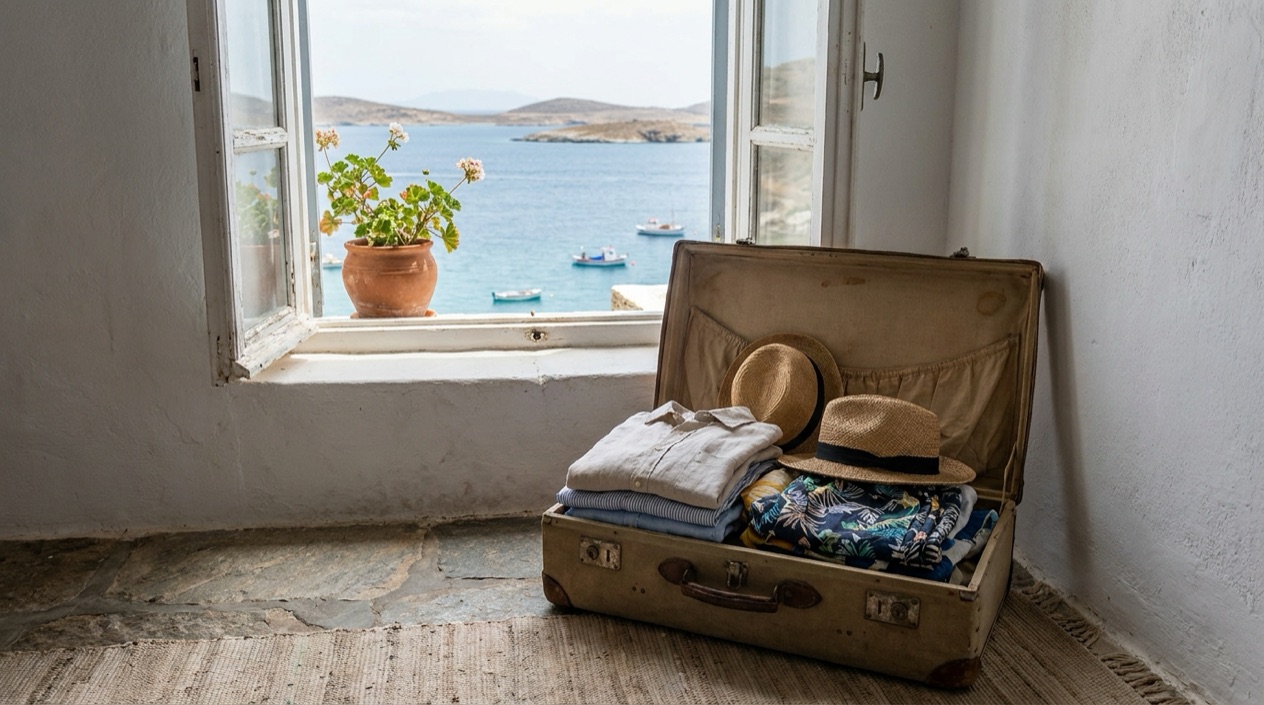
What should you pack for Greece?
Pack for the way you will move around Greece first and for the sights second, because the crossings are where the plan most often changes. Greece is a country of islands, and a trip usually strings several of them together with ferries, flights or your own boat. A bag that is easy to carry on and off, and a plan that leaves room for a delayed sailing, will serve you better than any extra pair of shoes.
Beyond that, the contents of the bag follow the places on your route. An island stay, a few days among ancient sites in Athens or Delphi, and a night near the monasteries of Meteora each ask for slightly different things, so the sensible approach is to start from the itinerary and build the list outward.
If you travel by ferry
Ferries are the thread that ties the islands together, and two details are worth packing around. From January to March, Aegean weather can be extremely rough, and ferries are often kept in port for days at a time. If your trip falls in those months, the useful thing to carry is flexibility: a few extra days of slack, and a bag that holds enough for an unplanned night in a port town such as Piraeus.
The other detail belongs to summer. Ferries in August fill up because of the National Holiday on August 15, so travelers should plan ahead. In practice that means thinking about your sailings before you think about your beach bag, and keeping what you carry compact enough to manage in a busy port, on a ramp and in a ship’s passenger areas.
If you arrive by your own boat
For sailors, the most important things in the bag are papers. Boats arriving in Greek waters must pay the TEPAI boating tax on the day of arrival, and the fine for not paying is high. The tax must be paid for each calendar month a boat stays in Greece, so a long cruise means the payment comes round again with each new month.
Liability insurance is the second item to keep in the chart folder. A boat in Greece must carry liability insurance that explicitly states the coverage is in accordance with Greek laws, so a general policy is not enough if it does not say so in those words. Keep the certificate on board with the rest of the ship’s documents.
Boat papers by flag
What you carry depends on the flag. A boat with an EU flag arriving directly from a Schengen country does not need to check in, but it must have an updated crew list on board. That one sheet of paper is the whole requirement, so it is worth printing a fresh copy before each leg.
A boat with a flag from outside the EU has more to carry and more to do. It must check in at a port of entry, visit customs, buy a transit log, and have that log stamped by the port police at every harbor visited. The transit log then becomes the most important document aboard, and it should travel with the skipper from harbor to harbor.
What layers do you need?
The layers you need depend on the month and on the island, because weather in Greece belongs to each place and changes with the season. A sailing deck, a ruin on a hillside and a village street do not feel the same, and the sensible answer is to pack a base that works indoors and out, then add on top of it.
Think in three parts: what you wear next to the skin, a middle layer you can take off, and an outer layer that deals with wind and water. Each can be small, and each can be worn on its own, which is the whole point of the system on a trip that moves between boats, buses and walks.
The outer layer for crossings
The one weather detail the Aegean gives clearly is its winter roughness. From January to March it can be extremely rough, and sailings are often held in port for days. For a trip in those months, a waterproof outer layer belongs at the top of the bag, along with something to wear under it, since waiting on a quay or a deck is part of the journey.
Even in the months when the ferries keep to a steadier pattern, the deck of a ship is open to the air. A light outer layer you can pull on at the rail and stuff into a daypack afterward does more work than a heavy coat that stays in a suitcase in the hold.
The middle layer on land
On land, the middle layer is the piece that changes with where you are. A town like Athens, an island village and a monastery town such as Meteora each have their own temperature, and a single sweater or fleece, light enough to carry and warm enough to matter, covers the gaps between them.
Choose pieces that mix and match, so that three or four tops and one extra layer can make a week of outfits. Dinner in a taverna, a walk through the ruins and a ride on a ferry can all be done in the same combination, with the outer layer and the middle layer shifting as the day goes.
For sailors, the layers that live on board
On a boat, layers are kept close at hand rather than packed away. A waterproof jacket, a warm layer and a change of clothes in a dry bag turn a rough passage into something manageable. With a boat tied up at a harbor, the same pieces go ashore with you for the walk to the paperwork and the café that follows.
Keep the documents in the same dry place as the clothes. The crew list, the insurance certificate and, for non-EU flags, the transit log all matter more than any piece of gear, and a wet folder at a port police desk is a problem that a little planning avoids.
What can you leave at home?
You can leave at home the tight itinerary, the second suitcase and anything that depends on every ferry sailing exactly as planned. Greece rewards a lighter approach, and the weight you save in the bag matters on quays, ramps and the stairs of island towns.
What stays behind is mostly what you might carry out of habit: duplicate outfits, a bulky coat for a trip in the warm months, and a schedule that has a connection every few hours. The list below is built from what the journey itself asks.
A schedule with no slack
The most useful thing to leave behind is a plan with no room in it. From January to March, ferries are often kept in port for days at a time, so a trip built on a chain of tight connections can come apart on the first rough morning. Leave a spare day or two before a flight home, and you protect the whole trip.
The same logic holds on August 15, when the National Holiday fills the ferries. A route with a single sailing on a given day is the one to worry about, and the way to solve it is to plan the crossing well before you start thinking about what to wear on the other side.
Extra weight for the boat
If you sail, some paper can be left behind and some cannot. An EU-flag boat coming straight from a Schengen country does not need to check in, so there is no clearance paperwork to carry for that arrival, only the updated crew list. Leave out the unnecessary forms and keep the folder thin.
A boat with a non-EU flag cannot skip anything. The transit log, bought at the port of entry after a visit to customs, has to be stamped by the port police at every harbor, so it stays in the bag and never in a locker back at the marina. Pack it with the insurance certificate, which must say the coverage follows Greek laws.
Anything you cannot carry up a ramp
Ferries and ports ask you to lift and walk with your bag, so the rule of thumb is to leave behind anything you cannot comfortably carry on your own. A soft duffel or a small wheeled bag moves through a ship’s corridors and the lanes of a chora, the old hilltop town of a Greek island, far better than a hard case you have to drag.
Consider what you will actually use between stops. A pair of walking shoes, a few light tops, a swimsuit and one outer layer cover most of a trip, and anything beyond that is weight you carry on every crossing. If something turns out to be missing, the islands have shops in nearly every town.
Good to know before you go
Greece uses the euro, and a small amount of cash in your pocket is handy for a kafenio, the traditional coffeehouse, or a bakery stop near the port. On the move, keep your tickets, your boat papers if you sail, and your phone within reach, so that the things you need on a quay or a deck are never at the bottom of a bag. Pack for the crossing, and the rest of the trip tends to take care of itself.
Sources
- Wikivoyage, Greece (https://en.wikivoyage.org/wiki/Greece), checked October 12, 2026