
A bell rings somewhere above a stone village in Epirus, a plate of hot cheese pie lands on a café table, and the only traffic is a man walking a mule path with a bag of greens.
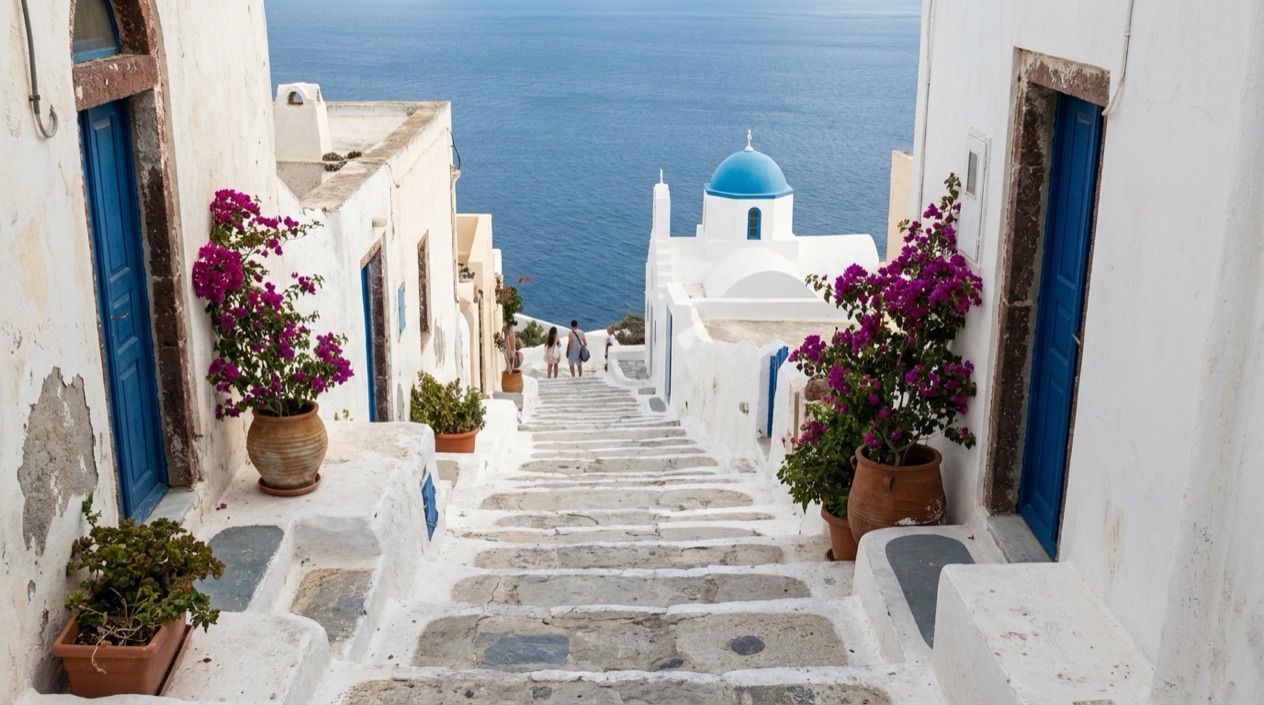
Where can you go beyond the famous islands?
You can go up into the mountains, along the mainland coast, to the pilgrim sites of the north and out on a sailboat among islands visitors never name. Greece is far more than its ferry ports, and each of these directions gives a different trip, with its own food, its own pace and its own kind of landscape.
The trick is to pick one thread and follow it instead of ticking off a list. A week built around trails, or around a long loop of mainland beaches, feels very unlike a week of island hopping, and it is the better way to see what the country holds beyond the famous names.
Mountains, gorges and national parks
The most popular hiking areas in Greece are Mount Olympus, the gorges of Crete, the national parks of Epirus and the lesser-known Rhodope Mountains. They are very different walks. Olympus is a high mountain with forest on its lower slopes. The Cretan gorges cut down toward the Libyan Sea. Epirus offers parkland and stone villages, and the Rhodope range, far to the north, is the one that few travelers have on their list.
A day on the trail usually ends at a village table. In the mountains that means pies baked with wild greens or cheese, grilled lamb, mountain tea and a glass of tsipouro, the clear grape spirit poured in small glasses. Come with proper shoes and a rain layer, because mountain weather changes on its own schedule. The Rhodope, in particular, rewards travelers who like forests and small villages over coastline.
Sacred Greece in the north
Religious tourism in Greece centers on Mount Athos and on the sites that the Apostle Paul visited on his travels, above all Philippi. Mount Athos is the monastic peninsula, a place of Orthodox monasteries that holds its own rhythm of prayer and silence. Philippi is an archaeological site where you walk among ruins tied to Paul’s first steps in Europe.
The Via Egnatia, the old road across northern Greece, is part of the pilgrimage route to Jerusalem. Following its line gives a trip a thread: a town, a ruin, a church, then the next.
The sailor’s Greece
The most popular sailing areas are the Ionian Islands, the Cyclades, the Saronic Gulf Islands, the Dodecanese and the Sporades. The North Aegean Islands are less known for sailing, but the distances between them are greater, so fewer boats are typically present and anchorages are easier to find. For anyone who wants to stop where the harbor is not full, that is the draw.
Timing matters in the Aegean. Spring and autumn are the best times to sail there, because July and August can bring strong Meltemi winds, reaching up to 8 Beauforts, which suit experienced skippers better. The Ionian Islands are ideal for novice sailors thanks to mild winds and short distances.
Which regions suit it?
Epirus, Chalkidiki, the Peloponnese, the islands of the north and a few far-flung islands each suit a different kind of off-the-path traveler. The mainland is where the country opens up most, and the choice comes down to whether you want mountains, a beach, history or the sea itself.
Epirus, Chalkidiki and the Peloponnese
The most famous mainland beaches in Greece are found in Chalkidiki, Epirus and the Peloponnese. That makes these three regions the natural answer for anyone who wants a beach holiday without boarding a boat. Chalkidiki reaches out into the sea in peninsulas, Epirus pairs its coast with the mountains behind it, and the Peloponnese stretches across a long and varied shoreline.
Epirus does double duty, because its national parks are also among the places where Greeks hike. A trip can start with a trail in the morning and end with a swim, followed by a dinner of grilled fish or a slice of pie in a village square. The Peloponnese suits people who want to drive from coast to coast, stopping where a bay or a hill town catches the eye.
Samos, the North Aegean and the Ionian
Samos holds the Tunnel of Eupalinos, a subterranean aqueduct built in the 6th century BC. It is the sort of sight you find when you leave the usual island circuit, an engineering work cut through a hill instead of a column or a temple. Samos sits among the North Aegean Islands, the group whose wider spacing is what makes it appealing for sailors.
Zakynthos, in the Ionian, has the National Marine Park, the primary nesting ground for loggerhead sea turtles in the Mediterranean. The park is a reason to look at the island as a place for nature and not only for its coves. Travelers with an interest in wildlife can come with the hope of seeing turtles, though sightings are never a promise.
Far islands and naturist beaches
The most popular Greek islands for naturist beaches include Crete, Zakynthos, Rhodes, Gavdos and Antiparos. Crete, Zakynthos and Rhodes give the same option on islands with a much bigger range of things to do.
The city side: Piraeus and Thessaloniki
Greek football gives a way into the country’s cities that has nothing to do with ruins. Olympiakos plays at Karaiskakis Stadium in Piraeus, and fourteen clubs play in the Super League, including AEK Athens, Panathinaikos (also in Athens) and PAOK in Thessaloniki. Sixteen clubs play in Super League 2. A match is a way to spend an evening among locals, with flags, songs and a loud crowd.
How do you get there?
You get there by choosing the way that matches the trip: on foot along a mountain trail, by road along a historic route, or by boat among the islands. Each of these off-the-path trips has its own natural rhythm, and the route is often part of the experience.
For the pilgrim sites, the Via Egnatia is the thread. It runs through northern Greece as part of the pilgrimage route to Jerusalem, and it links the region where Philippi stands with the wider story of Paul’s travels. Mount Athos belongs to the same northern map, so the two fit naturally into one journey through the north.
For the trails, the destination is the area itself. Mount Olympus, the Cretan gorges, the Epirus national parks and the Rhodope Mountains are each a place to base yourself and walk out from, and a stay of a few nights in one of them gives a better sense of the landscape than a quick stop.
Under sail
A boat is the one way that turns the whole sea into the itinerary. The Ionian Islands, with their mild winds and short distances, are ideal for novice sailors. The Cyclades, the Saronic Gulf Islands, the Dodecanese and the Sporades are the other favorite areas, and the North Aegean is the choice for anyone who wants more room and fewer boats.
Choose the season with care. In the Aegean, spring and autumn are the best times for sailing, since the Meltemi of July and August can reach 8 Beauforts, which is better for experienced skippers. A boat in the Ionian, by contrast, is the gentler start for a first-time crew.
Good to know before you go
Archaeological sites and museums charge by their visitor numbers, and there are no longer any combo tickets, so each site has its own entry fee. Entrance fees are halved for EU citizens over 65 or teachers accompanying students. Money matters on a trip like this are simple: the fee is set by the site, and the heat and the Meltemi matter most on the water and on the high trails.
| Fee | Amount | Who pays |
|---|---|---|
| Archaeological sites and museums with over 200,000 visitors | €20 | Each visitor, per site |
| Archaeological sites and museums with over 75,000 visitors | €15 | Each visitor, per site |
| Archaeological sites and museums with over 15,000 visitors | €10 | Each visitor, per site |
| Other archaeological sites and museums | €5 | Each visitor, per site |
Sources
- Wikivoyage, Greece, section Do (https://en.wikivoyage.org/wiki/Greece#Do), checked October 12, 2026
- Wikivoyage, Greece, section See (https://en.wikivoyage.org/wiki/Greece#See), checked October 12, 2026
To plan your stay
- Best Time to Visit Greece: September and Late May to Early June
- Arachova: Parnassus Mountain Town, Formaela Cheese, Ski Season and Saint George's Day
- American Airlines Flights to Greece: U.S. Cities, Athens Arrivals and Onward Island Flights
- Greece on a Budget: Cash Machines, Cards, Beaches and Ferries