
A small glass of ouzo turns cloudy as the water goes in, plates of meze land in the middle of the table, and nobody seems to be in a hurry to leave. In Greece the evening is built around a table, a drink and the people sitting at it, and it can drift from a taverna to a café to a bar without a clear line between them. This is the Greece of ouzo on Lesbos, raki after dinner in Crete, iced coffee at every hour and football nights in Athens, Piraeus and Thessaloniki.
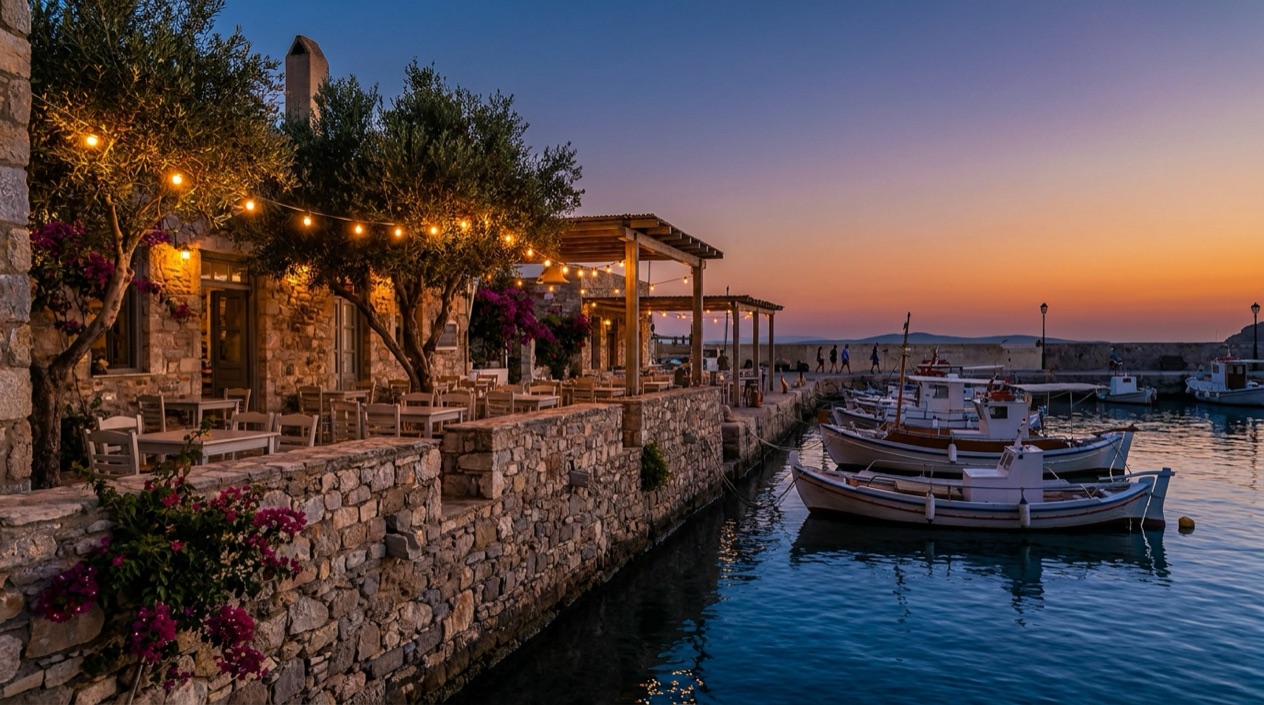
What is nightlife like in Greece?
Nightlife in Greece is mostly a matter of drinking and talking over food, with island bars for a younger crowd and football stadiums as a different kind of night out. Think less of a single club district and more of a series of places you move between, each with its own drink in hand. Sociologists call pubs, bars and clubs third places, spots that are neither home nor work, and the Greek café, kafenio and taverna fit that idea closely.
What you see depends on the place. In a town taverna, families and friends share plates and the table fills with small dishes, bread and carafes. In a bar on an island, the music is louder and the crowd younger. Nightlife entertainment is often more adult-oriented than what happens in the daytime, and that holds here too once the tavernas empty and the bars take over.
The table is the first stop
Many evenings begin with a drink that comes with something to eat. Ouzo, the anise spirit, is poured into small glasses and arrives with meze: grilled octopus, olives, feta, fried zucchini, whatever the kitchen has that day.
Retsina, the resinated white wine, tastes strongly of pine, a flavor that comes from the resin once used to seal wine flasks and bottles. It is an acquired taste, and a carafe of it on the table is a very Greek way to begin.
The pace is slow. You order a few things, then a few more, and the glasses are refilled as the conversation goes on. A glass of water traditionally comes with every drink you order, one glass for each, although in touristy areas you may have to ask for it.
Coffee as part of the night
Cafés have long been part of nightlife culture, and in Greece they still are. Greek coffee, thick and strong and served in a small cup, comes moderately sweet if you do not specify.
Frappé, a shaken iced instant coffee, is popular in the hot summer months and can be ordered with or without milk, sweetened or not. Espresso freddo, simply espresso with ice, and cappuccino freddo, with chilled milk foam, are among the most popular coffees throughout Greece.
A single order can hold a table for a long time, and that is part of the point. Cafés fill with friends who linger over a freddo, which makes the early part of the evening feel like a long, unhurried conversation. One small catch: in mass-sector tavernas and cafés, iced tea typically means instant, so ask twice if you want it brewed.
Island bars and the young crowd
On the islands, bars catering to young people take over the night, with cocktails, shots and loud music. This is where a warning about drinks applies. Genuine imported, non-Greek alcohol is likely to be very expensive in Greece, and if a bottle or a drink is cheap, it may be a locally distilled alcohol with flavorings called bomba, sometimes passed off as whisky or gin.
The practical lesson is to look closely at what a cheap spirit-based drink might really be, and to lean on Greek drinks (ouzo, raki, wine, beer) when the price of an imported brand looks too good. Some nightlife venues also charge a cover charge for admission, a habit of clubs in general worth keeping in mind for the busier ones.
Which cities and islands are best known?
The places that carry the strongest evening traditions are Mytilene on Lesbos for ouzo, Crete for raki, and Athens, Piraeus and Thessaloniki for football nights, while the islands in general host bars for a younger crowd. Each offers a different way to spend an evening, and none of them requires a club at all.
Mytilene on Lesbos: the home of ouzo
Mytilene is particularly famous for its ouzo. The brands people talk about include Mini, Number 12, Sans Rival, Arvanitis, Barba Yianni and Aphrodite, and an evening here naturally turns into a tasting, a few glasses of the cloudy spirit and a plate of seafood or meze beside it.
There is a small cultural point worth knowing. Mainlanders do not drink ouzo with ice, but tourists and Greek islanders generally do, so on an island like Lesbos you will find ice offered without a second thought. Add water, watch it turn white, and sip slowly.
Crete: raki after dinner
In Crete, raki, also called tsikoudia, is traditionally an after-dinner drink, often served with fruit as dessert. It is a spirit with 35 to 40 percent alcohol, served cold in the summer months, and it often arrives at the table without being ordered, a small closing gesture after a meal in a taverna.
You eat, the plates are cleared, the fruit and the raki appear, and the conversation carries on. If you want more music and energy afterward, the island’s bars are the next stop.
Athens, Piraeus and Thessaloniki: football nights
A match is a night out in its own right. Olympiakos plays at Karaiskakis Stadium in Piraeus, while fourteen clubs play in the Super League, among them AEK Athens, Panathinaikos (also in Athens) and PAOK in Thessaloniki. Another sixteen clubs play in Super League 2.
For a visitor, a game offers a way to see how the city spends an evening: the chants, the crowds heading to the stadium and the cafés and tavernas that fill around it before and after. It is a very different mood from an island bar and worth considering if your trip overlaps with the football calendar.
What should you know?
A few habits and warnings make the evenings go better: how drinks are served, what comes with them, what to watch for on the islands and how people behave around nightlife in general. None of it is complicated, and most of it is just a way of fitting in with the table.
Ordering drinks the Greek way
If you want a coffee, the choices are wide, from Greek coffee in a small cup to an iced frappé or a freddo. If you just say Greek coffee without specifying, it usually arrives moderately sweet. For the evening, ouzo, raki, retsina, wine and beer are the natural orders, and Greek drinks are where the value is.
Remember that nightlife venues in general sometimes ask for a cover charge at the door, and that places where the music is loud and the crowd young are the ones where a drink may be something other than what the label says. When a spirit is priced far below what a genuine import would cost, treat the label with suspicion.
Water, ice and small-island quirks
A glass of water comes with a drink as a matter of course, and it is fine to ask for one if it does not appear. On some small islands, tap water is imported and heavily chlorinated, so it does not taste very good, and visitors prefer bottled water. That matters if you are mixing ouzo, which is traditionally cut with water.
As for ice, ouzo with ice is the habit of tourists and islanders, not mainlanders. Neither is wrong, and a waiter will bring what you ask for. Raki, on the other hand, is served cold in the summer months.
Nights on the water
Some travelers spend their evenings at anchor rather than ashore. The most popular sailing areas include the Ionian Islands, the Cyclades, the Saronic Gulf Islands, the Dodecanese and the Sporades. The Ionian Islands suit novice sailors, with mild winds and short distances, while the North Aegean Islands are less known for sailing, but the greater distances between islands mean fewer boats and easier anchorages.
In the Aegean, spring and autumn are the best times for sailing, since July and August can bring strong Meltemi winds, up to 8 Beauforts, which suit experienced skippers better. A quiet dinner on deck and a bar ashore make a very different kind of Greek night.
Good to know before you go
Nightlife in Greece comes down to drinks, tables and company, and the drinks are best kept Greek: ouzo, raki, retsina, wine, and a freddo or a frappé when coffee is called for. Imported spirits that look cheap in island bars may be bomba, so read the price as a clue. In July and August the Meltemi can blow strongly in the Aegean, which matters for anyone planning evenings on a boat.
Sources
- Wikipedia, Nightlife (https://en.wikipedia.org/wiki/Nightlife), checked October 12, 2026
- Wikivoyage, Greece, section Do (https://en.wikivoyage.org/wiki/Greece#Do), checked October 12, 2026
- Wikivoyage, Greece, section Drink (https://en.wikivoyage.org/wiki/Greece#Drink), checked October 12, 2026
To plan your stay
- Best Time to Visit Greece: September and Late May to Early June
- Arachova: Parnassus Mountain Town, Formaela Cheese, Ski Season and Saint George's Day
- American Airlines Flights to Greece: U.S. Cities, Athens Arrivals and Onward Island Flights
- Greece on a Budget: Cash Machines, Cards, Beaches and Ferries