
Somewhere around the middle of the trip you are standing under the rock towers of Meteora, looking up at monasteries set on top of stone pillars, with Kalabaka’s rooftops and the Pinios river below. Behind you are the Athens streets and the oracle’s hillside at Delphi, and ahead are the islands of the Cyclades. This is a fall route that runs from the capital through the mainland’s sacred places and finishes in the Aegean, on Naxos and Santorini.
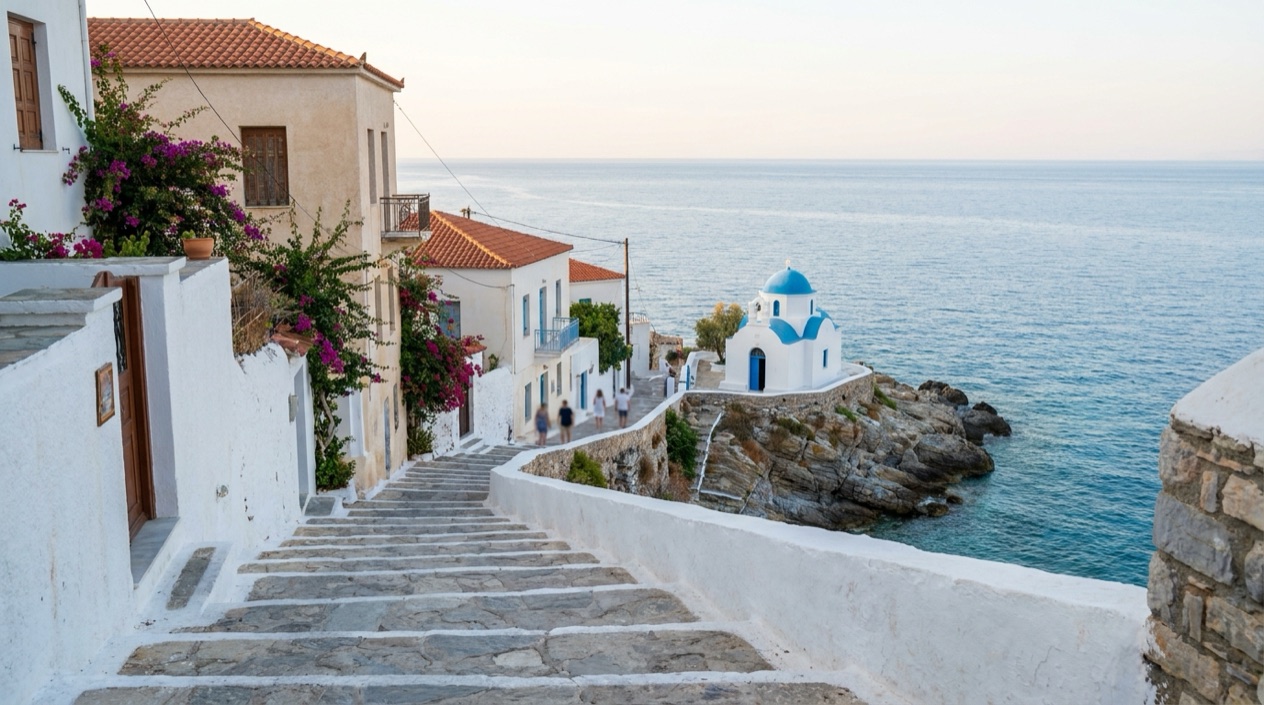
Is 10 Days enough for Greece?
Ten days is enough for one well-chosen line through Greece, but not for the whole country, and this route is built on that idea. It joins the capital, two great sites of the mainland and two islands of the Cyclades, so you see ruins, rock monasteries and the Aegean without spending the trip packing and unpacking every night.
The mainland half is about stone and story. Athens gives you the ancient city and the neighborhoods around it. Delphi was considered the navel of the Earth in antiquity, a spiritual meeting place for the Greeks and home to the most important oracle of ancient Greece. Meteora is the other pole of the mainland, where the monasteries on top of the rock towers are the thing that makes the area so special.
The island half is about water, wine and slow meals. Naxos is the largest island of the Cyclades and the most fertile, so it brings farm food and mountain villages to the table. Santorini lies at the southern end of the Cyclades, built around a caldera with an active volcano, and it is the place for the white wine made from the Assyrtiko grape, a variety native to the island.
Plenty is left for another trip. Crete, the largest Greek island, deserves its own days, with dishes such as dakos (barley rusks under tomato and cheese), gamopilafo (a rich wedding rice) and kalitsounia (small cheese pastries). Rhodes and Lesbos, the fourth and third largest islands, are two more reasons to come back, as is Mykonos, which sits among Tinos, Syros, Paros and Naxos.
Mykonos is also the island with a stated best time: mid-May through June or September through mid-October, when July and August are extremely crowded. A fall trip falls inside that window, which makes it an easy swap for Naxos if you prefer its nightlife and its nickname, the island of the winds.
What the route does not do is try for Crete and the Ionian islands as well. Adding a third island group means more crossings and fewer evenings at a taverna table. The mainland sites also reward a slow pace, since a monastery or an oracle’s terrace is a place to stand and look around, not to tick off.
The itinerary stage by stage
Days 1 to 3: Athens
Spend the first three days in Athens, sleeping in or near the old center so that the sights, the cafés and the metro are all close. The Plaka neighborhood is a top attraction, with picturesque streets, historic landmarks and lively shops, though it gets crowded. Treat it as an evening stroll and a place for a first meal of souvlaki, grilled meat on a skewer, or a spread of meze (small shared plates).
The Athens Metro and the buses carry you across town. Keep the third day loose for a museum, a neighborhood you liked, or a second look at the hill.
That means you can plan open-air visits with confidence, with a light rain layer in the bag for the odd shower. The next stage leaves the city by road.
Day 4: Delphi
Delphi lies on the southwestern slope of Mount Parnassus in Phocis, in central Greece, and it is a UNESCO World Heritage site. The ancient sacred precinct was the seat of the most important oracle of the Greek world, and you move up its slope among terraces, foundations and the remains of buildings dedicated to the god.
The modern town of Delphi sits very close to the archaeological site, spread across two streets lined with traditional small houses, hotels and tavernas. Sleep here and dinner is a matter of choosing a taverna with a window onto the valley. Order a plate of grilled lamb or a bowl of beans, with a glass of local red.
Think of Delphi as a place to read as well as to look. A little background on the oracle and the city-states that sent envoys here makes the stones talk. Ancient Greece was a loose collection of culturally and linguistically related city-states, and Delphi was where they came together.
Days 5 and 6: Meteora and Kalabaka
Meteora is in Thessaly, in northwestern Greece, in the regional unit of Trikala. Kalabaka is the town built at the foothills of the rocks, on the left bank of the Pinios river, and the village of Kastraki is close by. Base yourself in one of them for two nights. Kalabaka is the gateway, with the colossal rocks rising directly over its streets.
Six monasteries remain in the complex, which was added to the UNESCO World Heritage List in 1988. Spend the first day with the monasteries and their views of the rock towers, and keep the second for the surrounding rocks, the village of Kastraki and a long lunch of grilled meats and local cheese pie.
The monasteries have their own rhythms and closing days, so look at the hours of each one before you plan. Pace the two days around that, with the town and its tavernas as your anchor in the evening. After Meteora, the route heads back toward the capital and then to the sea.
Days 7 and 8: Naxos
Naxos is the largest island in the Cyclades, with an area of 170 square miles, and Zas is the highest mountain of the group. The port at Chora is too small for cruise ships, which suits an island you reach by ferry from the mainland. Stay in or near Chora, the island’s main town, and use it as a base for the beaches and villages.
Naxos is the most fertile of the Cyclades, so the table is the point: potatoes, local cheeses, grilled meats and vegetables from the fields. Spend one day around Chora and its harbor and one inland, among the mountain villages under Zas. A rental car or a bus lets you stitch those villages together, though the schedule is yours to check.
The sea is the other half of the day. Come in October and you may still find water that is warm enough to swim in, and the beaches run along the island’s coast. When you are ready, the next stage is a crossing to Santorini.
Days 9 and 10: Santorini and the way home
Santorini is the southernmost of the Cyclades, the largest island of a small, circular archipelago formed by the Santorini caldera, about 120 miles southeast of the mainland. In ancient times it was known as Thera. You can stay on the rim of the caldera, with the active volcano and the sea in front of you.
Use day nine for the caldera towns, the volcano and a glass of Assyrtiko, the white wine from vines that have resisted Phylloxera. Old vines on volcanic soil are the island’s pride, and tasting them in a winery or a taverna tells you more than any sign.
Day ten is the return to the mainland and the journey home. The crossing back covers that stretch of open Aegean, so leave the morning free for packing and a last coffee by the water. Nothing else is scheduled, which is exactly the point.
Getting between stops
| Leg | How |
|---|---|
| Athens to Delphi | By road |
| Delphi to Kalabaka and Meteora | By road |
| Meteora back to Athens | By road |
| Athens to Naxos | By sea, from the Greek mainland |
| Naxos to Santorini | By sea, within the Cyclades |
| Santorini back to the mainland | By sea, across about 120 miles of the southern Aegean |
The mainland legs are by road, whether you drive or take a bus, and Athens has its own metro, buses and tram for the days you stay put. The Athens Metro runs from early morning to just after midnight, and on Friday and Saturday nights lines 2 and 3 stay open later still. On Athens buses, the front door is not used for getting on or off.
The sea legs depend on ferry companies. Blue Star Ferries links the Greek mainland with the Aegean islands, with a fleet of 12 ferries. Golden Star Ferries, founded in 2011 and headquartered in Andros, operates from the mainland to the Cyclades. ANEK Lines runs mainly the Piraeus to Crete and Adriatic routes, so it matters on a Crete trip rather than this one.
Within the Cyclades, Naxos and Santorini are separate islands in the same group, and you cross the water between them. Mykonos, if you pick it instead, lies among Tinos, Syros, Paros and Naxos. Flights serve the larger islands. Heraklion Airport on Crete is the second busiest in Greece after Athens, which is worth knowing if you extend the trip.
What to book before your 10 Days in Greece
Settle three things first: the ferry crossings from the mainland to Naxos and from the islands back, the lodging in Kalabaka or Kastraki, Delphi and the two islands, and the opening hours of the sites and monasteries you plan to visit. The route is a chain, so one fixed link, the crossing to the Cyclades, shapes the days on either side of it.
Adapting the route
With fewer days, drop Naxos and spend the island time on Santorini alone, or leave out Delphi and give Meteora its two nights. With more, the natural addition is a third island group, and Crete is the largest, with its own mountains and a long coastline. The route holds up if you cut a stage because every stage stands on its own.
Season changes the picture. The Athens figures show how far the year swings, from a mild winter to a hot July, and fall sits comfortably between.
| Athens month | Average high (°F) | Average low (°F) | Precipitation (in) | Days with rain |
|---|---|---|---|---|
| January | 56.3 | 44.4 | 2.17 | 7.5 |
| April | 68.4 | 53.2 | 1.10 | 5.5 |
| July | 91.8 | 74.1 | 0.28 | 1.6 |
| October | 75.2 | 61.0 | 1.09 | 3.9 |
In July the air is hot enough that the ruins call for sun protection, and for the lowest chance of rain you would still pay in heat. In January, with many more days of rain, a rain jacket and warm layers are the sensible things to pack. October asks for little: a light jacket and comfortable shoes for the stones.
For a slower trip, cut Meteora to a single night or merge Naxos and Santorini into one island stay. Families can keep the Athens days short and let the islands carry the pace, with beaches and village lunches in place of a monastery schedule. The Aegean has a reputation for wind, and Mykonos is nicknamed the island of the winds, so leave a spare day around the sea crossings in case a ferry plan shifts.
If you would rather see Mykonos, swap it for Naxos: it sits in the heart of the Cyclades and is best from mid-May through June or September through mid-October. The rest of the route stays the same, and the crossings are by sea.
Good to know before you go
Euros are the money of Greece, and tavernas, markets and island shops are where you will use them. The Plaka gets crowded, so give it your evenings with patience. Between the sites and the ferries, the biggest luxury of this route is time at a table, so leave room for it.
Sources
- Wikipedia, Ancient Greece (https://en.wikipedia.org/wiki/Ancient_Greece), checked October 12, 2026
- Wikipedia, ANEK Lines (https://en.wikipedia.org/wiki/ANEK_Lines), checked October 12, 2026
- Wikipedia, Blue Star Ferries (https://en.wikipedia.org/wiki/Blue_Star_Ferries), checked October 12, 2026
- Wikipedia, Fast Ferries (https://en.wikipedia.org/wiki/Fast_Ferries), checked October 12, 2026
- Wikipedia, Golden Star Ferries (https://en.wikipedia.org/wiki/Golden_Star_Ferries), checked October 12, 2026
- Wikipedia, Greek islands (https://en.wikipedia.org/wiki/Greek_islands), checked October 12, 2026
- OASA, Athens urban transport (https://www.oasa.gr/en/), checked October 12, 2026
- Athens Transport, public transport guide (https://www.athenstransport.com/english/), checked October 12, 2026
- This is Athens, the official Athens tourism site (https://www.thisisathens.org/), checked October 12, 2026
- Santorini official guide (https://www.santorini.gr/), checked October 12, 2026
- Visit Greece (GNTO), Santorini (https://www.visitgreece.gr/islands/cyclades/santorini/), checked October 12, 2026
- Wikipedia, Santorini (https://en.wikipedia.org/wiki/Santorini), checked October 12, 2026
- Visit Greece (GNTO), Mykonos (https://www.visitgreece.gr/islands/cyclades/mykonos/), checked October 12, 2026
- Wikipedia, Mykonos (https://en.wikipedia.org/wiki/Mykonos), checked October 12, 2026
- Wikivoyage, Mykonos (https://en.wikivoyage.org/wiki/Mykonos), checked October 12, 2026
- Visit Greece (GNTO), Naxos (https://www.visitgreece.gr/islands/cyclades/naxos/), checked October 12, 2026
- Wikipedia, Naxos (https://en.wikipedia.org/wiki/Naxos), checked October 12, 2026
- Wikivoyage, Naxos (https://en.wikivoyage.org/wiki/Naxos), checked October 12, 2026
- Heraklion airport information (https://www.heraklion-airport.info/), checked October 12, 2026
- Visit Greece (GNTO), Crete (https://www.visitgreece.gr/islands/crete/), checked October 12, 2026
- Wikipedia, Crete (https://en.wikipedia.org/wiki/Crete), checked October 12, 2026
- Meteora, official information (https://www.meteora-greece.com/), checked October 12, 2026
- Visit Greece (GNTO), Meteora (https://www.visitgreece.gr/mainland/thessaly/kalabaka/), checked October 12, 2026
- Wikipedia, Meteora (https://en.wikipedia.org/wiki/Meteora), checked October 12, 2026
- Visit Greece (GNTO), Delphi (https://www.visitgreece.gr/mainland/central-greece/delphi/), checked October 12, 2026
- Wikipedia, Delphi (https://en.wikipedia.org/wiki/Delphi), checked October 12, 2026
- Wikivoyage, Delphi (https://en.wikivoyage.org/wiki/Delphi), checked October 12, 2026
- Wikipedia, Climate of Greece (https://en.wikipedia.org/wiki/Climate_of_Greece), checked October 12, 2026
- Wikipedia, Greek wine (https://en.wikipedia.org/wiki/Greek_wine), checked October 12, 2026
- Wikipedia, Sea surface temperature (https://en.wikipedia.org/wiki/Sea_surface_temperature), checked October 12, 2026
- Hellenic National Meteorological Service (HNMS), climatological normals 1991-2020 for Elliniko station (https://www.emy.gr/climatic-data), monthly mean daily maximum and minimum; rain from the ECMWF ERA5 reanalysis, 1991-2020, grid cell of Athens (Open-Meteo), checked October 12, 2026
- ECMWF ERA5 reanalysis 1991-2020, grid cell of Athens (Open-Meteo), checked October 12, 2026
- Plan de the (duree choisie by the redaction)
To plan your stay
- Best Time to Visit Greece: September and Late May to Early June
- Arachova: Parnassus Mountain Town, Formaela Cheese, Ski Season and Saint George's Day
- American Airlines Flights to Greece: U.S. Cities, Athens Arrivals and Onward Island Flights
- Greece on a Budget: Cash Machines, Cards, Beaches and Ferries