
A white chapel with a blue dome sits above a harbor where fishermen untangle nets, and the smell of grilled octopus drifts from a taverna with its tables set almost on the quay. Elsewhere in the same sea, a pink and yellow baroque facade looks onto a square built for strolling. Greece has thousands of islands, and the ones that draw most first-time visitors sit in a handful of island groups, each with its own look, its own food and its own pace.
Which Greek islands suit first-time visitors?
The islands that suit a first trip are the ones where most of Greece’s tourism is concentrated: Crete, the Dodecanese, the Cyclades and the Western Greek Islands. That is where the hotels, the restaurants and the habit of welcoming visitors are most developed, so a first-timer has a real choice of places to stay and eat. Each group offers a different picture of Greece, and your first island is mostly a question of which picture you came for.
A little of the mainland sits alongside them. The Peloponnese and the Halkidiki peninsula in Macedonia also see visitors, though to a lesser extent. For a first trip built around islands, the four groups below are the place to start.
The Cyclades: white houses and blue domes
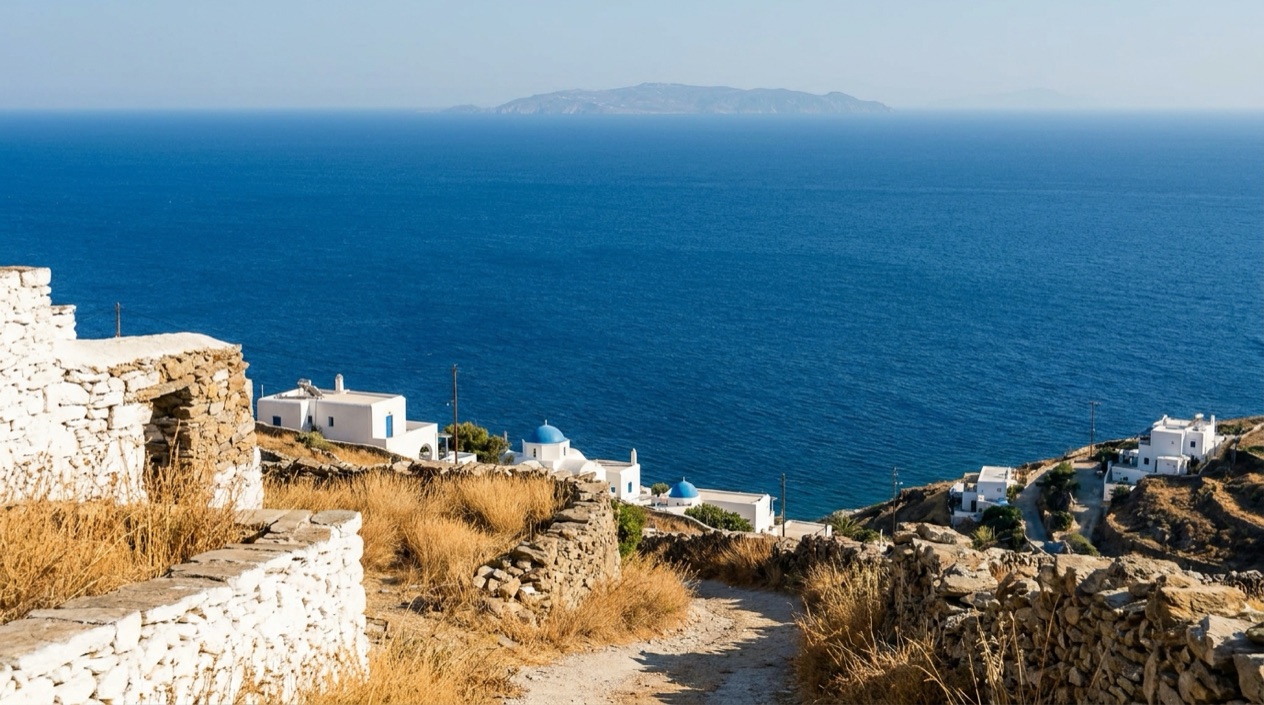
If the Greece in your head is whitewashed cubes stacked on a hillside and a blue-domed church against the sky, that picture belongs to the Cyclades. The whitewashed homes and blue-domed churches characterize this island group and no other part of the country. Paros is one island where you find those Cycladic houses, and Santorini and Naxos belong to the same group.
Days here tend to follow a simple pattern. You wander lanes of whitewashed walls and bright shutters, stop for a coffee or a glass of ouzo (the anise-flavored spirit that turns cloudy with water) and let lunch stretch into the afternoon. Dinner might be a Greek salad with a slab of feta on top, grilled fish, or a plate of small meze to share.
The Cyclades suit travelers who want the classic island image and are happy to spend their days on foot, by the water and at the table. Ermoupolis, a town with Neoclassical architecture, shows that this island world holds more than white cubes.
Corfu and the Western Greek Islands
Corfu looks nothing like the Cyclades, and that surprises many first-time visitors. Its houses and churches are pastel-colored and baroque in style, and the old town carries that look through its narrow streets and squares. It feels more like a small European port town than a village of white cubes.
The Western Greek Islands are the group Corfu belongs to, and the food and the atmosphere have their own character here. Expect cafés in the old streets, a long evening stroll, and tables set out for dinner.
Crete and the Dodecanese
Crete is the large island in this list, and it has its own regional cooking, from raki (the clear spirit poured at the end of a meal) to dishes built around local cheeses, greens and olive oil. Visitors come for towns, coastline, mountain villages and archaeological sites such as Knossos, and the island gives a first trip a lot of variety on a single stop.
The Dodecanese is a chain of islands that includes Rhodes. Rhodes is known for a medieval old town, and the group gives a different feel again, with its own harbors, fortresses and tavernas. Both Crete and the Dodecanese are among the places where Greece’s tourism industry is most concentrated, which means a wide range of places to stay and eat.
How do they differ?
The islands differ first of all in how they look, and the look tells you a lot about the character of each group. The Cyclades are the white-and-blue islands. Corfu and the Western Greek Islands show pastel baroque homes and churches. Crete and the Dodecanese mix harbors, old towns and sites from many periods, so no single image defines them.
Architecture and atmosphere
Whitewashed Cycladic homes line the lanes of Paros and its neighbors, and the effect is of bright walls, flat roofs and blue doors. On Corfu the facades are painted in warm pastel colors and the churches follow a baroque style. Neoclassical buildings appear in the towns of Ermoupolis and Nafplion, which gives a third type of town to look at.
These differences matter when you walk. A Cycladic village feels like a maze of white walls and small squares. A baroque town like Corfu’s feels more like a city of arcades and public squares, built for promenades and a coffee at a corner table.
Food and the table
Every island group cooks with olive oil, tomatoes, cheese, fresh vegetables and whatever came out of the sea that day. Grilled octopus, fried small fish, moussaka (the baked dish of eggplant and a creamy topping) and souvlaki (grilled meat on a skewer) turn up across the country, so you can eat well on any of them. A taverna is the casual restaurant where plates arrive to share, and a kafenio is the traditional coffeehouse where locals linger.
The differences are in the details. Crete has a strong tradition of local cheeses, wild greens and raki. Island by island you find a local pastry, a cheese or a way of cooking a common fish, and part of the pleasure is asking what the place is known for. Ordering what the neighboring table has is a decent strategy too.
Seasons and the feel of the crowds
Timing changes the islands more than the map does. The peak tourist season runs from May through September, and roughly three quarters of all tourists arrive in those months. The great majority of visitors come between April and October, so the islands are at full strength, with restaurants, hotels and beach bars all open for business.
The off season runs from November through February. For visitors from more northerly climates it can be rewarding, with mild temperatures, few tourists and reduced prices. You trade the long summer days for a quieter, slower version of the same islands.
How do you choose?
You choose by deciding what Greece you want to see, and then by matching that picture to the right island group and the right season. Start with the look you have in mind, then think about the food, the pace and the time of year, and the answer usually becomes clear.
Choose by the picture in your head
If you want whitewashed houses, blue domes and village lanes, head for the Cyclades. Paros is a place where Cycladic homes are found, and Santorini and Naxos are in the same group. Nowhere else in Greece has the same look, so this is the group to pick if that image is what you came for.
If you prefer pastel baroque streets, squares and a town that feels almost Italian in its architecture, Corfu is the answer. If you want variety in one place, with towns, ruins, mountains and a long coast, look at Crete. And if medieval walls and old harbors appeal, the Dodecanese and Rhodes fit that taste.
Choose by season and heat
The warmest part of the year starts in mid-July and generally lasts until mid-August. In that stretch, most Greeks avoid heavy physical activity outdoors between 13:00 and 17:00 because of the strong midday sun. On the Aegean islands, the meltemi, the northerly wind of summer, cools the air during the same weeks.
If you do not want to plan around the heat, May, June, September and October still fall inside the main visiting season, and April is part of the wider stretch when visitors come. If you would rather have the islands to yourself, the months from November through February bring mild temperatures, few tourists and reduced prices. Some travelers like that version best because the pace of daily life is easier to see.
Choose by how you like to travel
A first-timer who likes a base and a routine can settle on one island and let the days fall into a pattern of village, beach and taverna. A traveler who likes variety might choose an island with several towns and sites, like Crete. Whichever you pick, the strength of Greece is that each group has its own flavor, and a second trip can take you to a different one.
Whatever the choice, leave room in the day for the habits that make the islands what they are: a slow coffee, a long lunch, an evening walk along the water. Those habits are the same from the Cyclades to Corfu, even when the buildings change.
Good to know before you go
Greece uses the euro, and the islands run on the rhythm of the season, so what is open and how busy it feels depends on the month. The warmest weeks, from mid-July to mid-August, are the ones when the midday sun is strongest and outdoor effort is best left out of the early afternoon.
The northerly meltemi cools the Aegean in those weeks, and it shapes the feel of the days on islands in that sea. In the off season, from November through February, mild temperatures and reduced prices go hand in hand with fewer visitors.
Sources
- Wikivoyage, Greece, section Understand (https://en.wikivoyage.org/wiki/Greece#Understand), checked October 12, 2026
To plan your stay
- Best Time to Visit Greece: September and Late May to Early June
- Arachova: Parnassus Mountain Town, Formaela Cheese, Ski Season and Saint George's Day
- American Airlines Flights to Greece: U.S. Cities, Athens Arrivals and Onward Island Flights
- Greece on a Budget: Cash Machines, Cards, Beaches and Ferries