
In spring, Greek hillsides turn green and speckled with poppies, and on Orthodox Easter night villagers carry lit candles home through the dark, with a lamb turning on a spit the next day. In autumn, the grape harvest fills the air with the smell of crushed fruit, olive nets spread beneath the trees, and the tavernas bring out new wine and quince sweets. Both seasons sit on either side of the long, hot summer, and choosing between them comes down to whether you want the countryside in bloom or the land after a summer of sun.
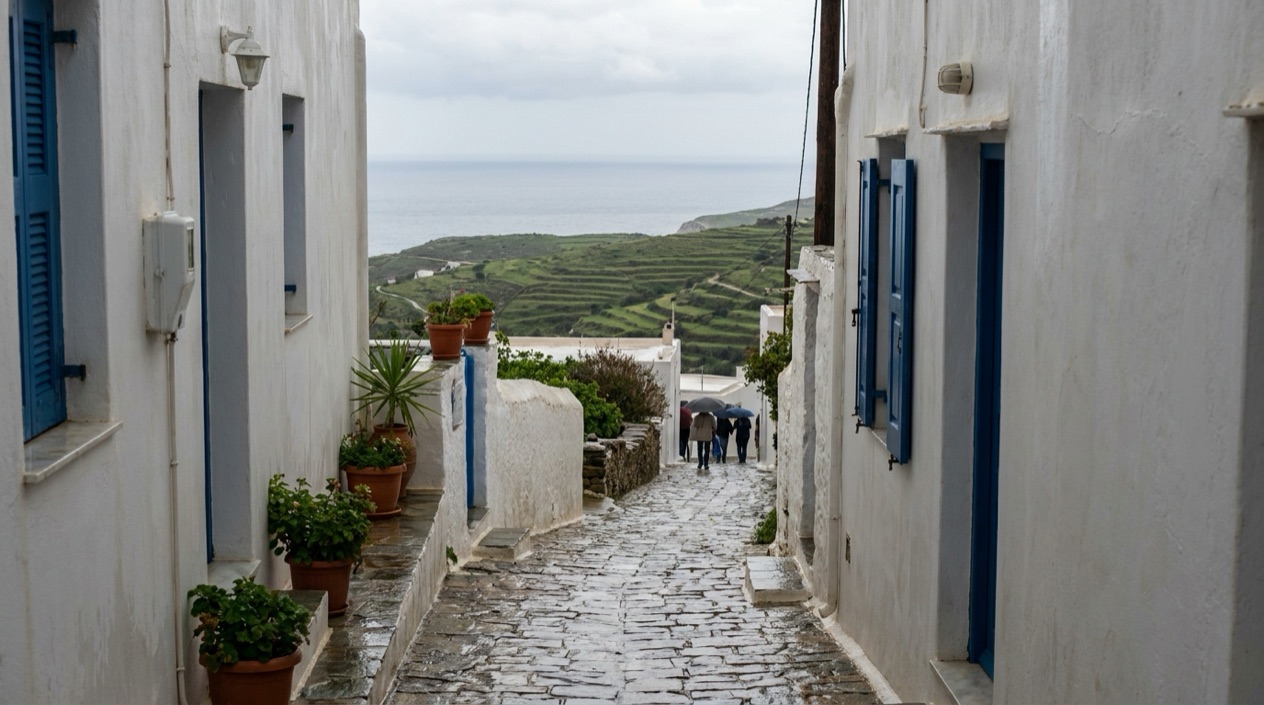
Which is better, spring or autumn?
Neither is a wrong answer, because both seasons give you the sights, the food and the islands without the full weight of midsummer heat.
The difference is in the mood. Spring is a season of beginnings, with fields in bloom, church bells on feast days and menus built on wild greens, artichokes and young lamb. Autumn is a season of gathering, with grapes, figs, pomegranates, chestnuts and the first pressing of olive oil. The table sets the two side by side in words.
| Category | Spring | Autumn |
|---|---|---|
| Landscape | Green hills after the rainy months, wildflowers in the fields | Golden, sun-dried hills after a long dry summer |
| Beaches | The coast with the green hills behind it | The coast after a summer of sun, with harvest villages behind it |
| Vibe | Beginnings, Easter, village feast days | Harvest, wine festivals, a country winding down |
| Things to do | Ancient sites, village walks, Easter celebrations, Independence Day parades | Ancient sites, grape and olive harvests, hill villages, Ochi Day |
| Food | Lamb, wild greens, artichokes, fava, strawberries, cherries, Easter breads | Grapes, figs, pomegranates, chestnuts, mushrooms, new olive oil, quince |
| Weather | Rain still falls in the Mediterranean pattern, warmth builds toward summer | Follows a long dry summer, the heat of the hot season eases |
| Getting there | Airports, ferries and roads link the mainland and islands | Airports, ferries and roads link the mainland and islands |
| Best for | Flowers, hiking, Easter, a green Greece | Harvest, wine, food, slow village days |
Sights, beaches and food
In spring, the sights come with a green backdrop. The slopes around Delphi and the plains below Meteora’s rock pillars are covered in grass and flowers, and the monasteries stand above a landscape that looks freshly washed.
The ruins of Olympia and Mycenae sit among wildflowers, and in Athens the Acropolis rises above a city whose parks and balconies are full of blooms. Villages on islands such as Crete and Naxos feel their gardens come alive, with orange and lemon trees heavy with scent.
The spring table follows the land. Horta, the wild greens boiled and dressed with olive oil and lemon, appear in every taverna kitchen, alongside artichokes, fresh fava and spring peas. Easter brings red-dyed eggs, tsoureki (a sweet braided bread) and magiritsa, the soup eaten after the midnight service. Lamb or goat roasts over coals on Easter Sunday, and strawberries and cherries arrive as the season advances.
In autumn, the same sites look different. The hills have dried to gold, the light is softer, and the Aegean islands take on the look of a season finishing. On the mainland, the vineyards of Nemea and the olive groves around Kalamata and Crete begin their work. Wine villages hold tastings, and in many places families gather to press the first oil of the year, which is eaten on bread with a pinch of salt.
The autumn table is one of figs, grapes, pomegranates, walnuts, chestnuts and mushrooms from the mountain forests. Quince is turned into spoon sweets, and tsipouro and raki, the grape-pomace spirits, are distilled in villages and poured with small plates of meze. Moussaka, grilled fish, souvlaki and gyros are on the table in both seasons, but autumn tastes of the harvest.
Who wins depends on what you want. For flowers, Easter and a green Greece, spring takes it. For wine, oil and a harvest table, autumn does. For the ancient sites, it is a draw, because the stones are the same and only the landscape around them changes.
Things to do
Sights and walking in spring
Spring is the season of walking among flowers. In the mountains, trails on Mount Olympus, which rises to 9,573 feet, pass through green forest, and in the Peloponnese and on Crete the paths between villages are lined with blooming herbs. Greece’s countryside smells of thyme and oregano, and bees work the hillsides.
The calendar adds its own events. March 25 is Independence Day, marked with parades and flags in towns and villages. Orthodox Easter, which moves every year and falls in spring, is the biggest celebration, with processions on Good Friday, candlelit services at midnight and lamb on the spit the next day. May Day is celebrated by gathering wildflowers and making wreaths for doors.
Harvests and festivals in autumn
Autumn is the season for food and drink experiences. Wineries open their doors in places like Nemea, Santorini and Crete, and tavernas pour young wine beside plates of grilled meat and salads. In olive-growing regions, you may see families shaking branches and gathering fruit into nets. Mushroom hunting and chestnut roasting give mountain villages like those on Mount Pelion their own autumn character.
October 28 is Ochi Day, a national holiday with school parades and flags, and the days around it fill small towns with marching bands and families. Athens keeps its theaters, music venues and tavernas going, and the city’s cafés and rooftop bars are good places to spend an evening. Day trips to Delphi, Meteora, Olympia and Nafplio work in both seasons.
Nightlife and evenings
Evenings in Greece are built around the table. A taverna dinner of meze, grilled fish, moussaka and wine can stretch for hours, and after it, people move on to a kafenio (the traditional coffeehouse) or a bar for ouzo and conversation. In Athens, neighborhoods such as Plaka and Psyrri hold bars, live music and late-night dining.
On the islands, evenings revolve around the harbor and the central square of the chora, the main town. Spring evenings carry the scent of blossoms and the sound of Easter services, while autumn evenings bring harvest feasts, wine and music in village squares. Both are good for a slow dinner.
Weather and the best time to go
Greece has a Mediterranean climate, and in its hot-summer form the warmest month is hot, which is why the shoulder seasons appeal to travelers who find midsummer heat too much. The region’s pattern is a long dry summer, often four to six months without significant rain, with rain falling mainly in winter and spring. That shapes the two seasons you are choosing between.
Spring comes at the end of the rainy part of the year, so rain can still fall, and the hills are green because of it. Wildflowers, fresh herbs and full streams are the result. Warmth builds as the season moves toward summer, and a rain jacket is a sensible thing to carry.
Autumn comes after the long dry summer, so the land looks sun-baked and golden. The heat of the hot season eases, and the weeks that follow suit long days of sightseeing and walking. As the season moves toward winter, the rainy part of the year approaches, and the weather becomes more changeable.
Greece covers a wide range of altitudes and coastlines, so the weather depends on where you go. High mountains hold cold temperatures while the southeastern islands are among the warmest places in the country.
| Measure | Value |
|---|---|
| Average annual temperature, Kaimaktsalan (°F) | 39 |
| Average annual temperature, Lindos (°F) | 72 |
| Highest temperature ever recorded, Tatoi and Elefsina (°F) | 118.4 |
| Lowest temperature ever recorded, Ptolemaida (°F) | -18.0 |
| Highest peak, Mount Olympus (feet) | 9,573 |
If walking among flowers and seeing the country green matters most, spring is the pick. If you prefer a landscape of harvest, wine and gold light, choose autumn. For high mountain trails, remember that altitude changes everything, so the weather on the coast is no guide to the weather on a peak.
Getting there and getting around
Greece is a country of islands, mountains, villages and ancient sites, and you reach them by air, by sea and by road. Athens is the base for the mainland sites, and ferries link Piraeus with the islands. The islands of Crete, Santorini, Mykonos, Rhodes, Corfu, Kefalonia and Zakynthos each have their own character and their own way in.
On the mainland, Athens connects to Delphi, Olympia, Mycenae, Epidaurus, Nafplio and Meteora. These are places you can reach from the capital by road, and each is a destination in its own right. In both seasons, the mainland sites are open to the same plans, and the landscape you pass through is what changes, green in spring and golden in autumn.
Between islands, boats are how you move. Piraeus is a port with links to the islands, and a route is always written between two named ports, so look up your own island pair before you plan. Each island has its own ports, roads and local transport, and the smaller the island, the more the plan depends on the harbor.
Once on an island, you move by road, on foot or by boat to the next beach or village. Many towns, called chora, sit above a harbor with stepped lanes, and others are laid out along a bay. Mountain villages, like those on Pelion or in the Peloponnese, are linked by winding roads between olive groves and forest.
Choosing between spring and autumn does not change the shape of the trip. The airports, ports and roads are the same, and so are the islands and mainland sites. What changes is the scene outside the window, which makes the choice a matter of taste more than logistics.
Who should choose which
Choose spring if you love flowers, green hills and walking, if you want to see Greek Easter with its candlelit midnight service and lamb on the spit, or if your ideal table is full of wild greens, artichokes and young lamb. Spring also suits photographers and gardeners, because the countryside is full of color. Travelers who find midsummer heat too much will like the way warmth builds slowly toward the hot season.
Choose autumn if you want the harvest, the wine villages, the olive pressing and the tables heavy with figs, grapes and chestnuts, or if you prefer a landscape of gold light after a long summer. Autumn suits food and wine lovers, and anyone who likes the feeling of a country settling into a slower rhythm. It also brings Ochi Day, with parades and flags in the towns.
Can you combine the two? Yes, for travelers who return, since each visit gives a different Greece. A spring trip built around Easter, wildflowers and mountain trails, followed by an autumn trip built around wine, olives and harvest tables, shows the country in two moods. The ancient sites, the islands and the tavernas stay the same, and the seasons around them do the rest.
Good to know before you go
Greece uses the euro, and prices in tavernas, markets and shops are written in euros. Spring brings Easter, when family gatherings, church services and holiday meals shape daily life, and autumn brings Ochi Day on October 28, a public holiday with parades. Greece’s hot-summer climate is the reason travelers choose the shoulder seasons, and the mountains follow their own, colder pattern, so pack for the place you are going rather than for the country as a whole.
Sources
- Wikipedia, Climate of Greece (https://en.wikipedia.org/wiki/Climate_of_Greece), checked October 12, 2026
- Wikipedia, Mediterranean climate (https://en.wikipedia.org/wiki/Mediterranean_climate), checked October 12, 2026