
Standing beside the Parthenon on the Acropolis, you realize the stones in front of you are only one layer of a much longer story.
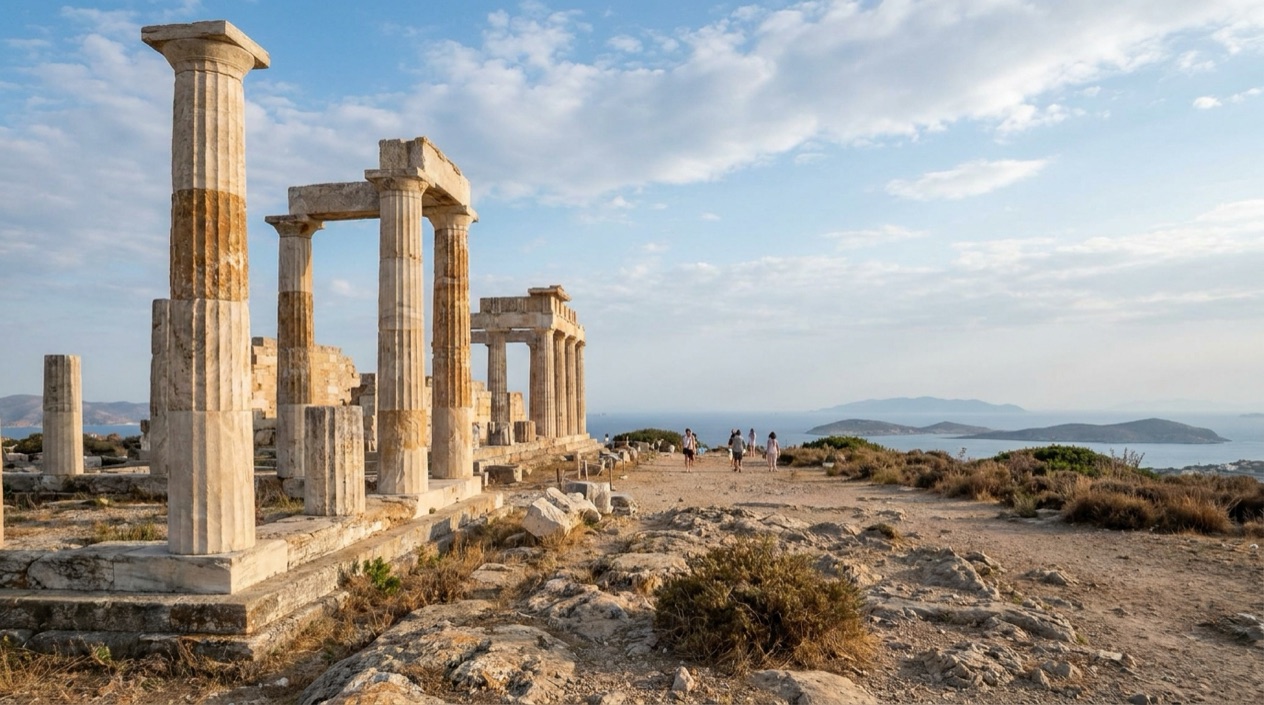
What is the history of Greece?
The history of Greece is the story of a small, mountainous, island-scattered land at the crossroads of Europe, Asia and Africa, where farmers, builders, sailors, empires and rebuilders each left something you can walk through today. It begins long before any temple. The Apidima Cave in Mani, in southern Greece, holds the oldest known remains of anatomically modern humans outside of Africa, dated to 210,000 years ago.
Farming arrived by sea. Agriculturalists from the Near East entered the Greek peninsula from Anatolia by island-hopping through the Aegean, and that habit of moving from island to island shaped the country ever after. With up to 227 inhabited islands and a coastline stretching 8,498 miles, Greece has always been a place where the sea is the road, and where each island and valley developed its own character.
Ancient Greece was never a single tidy country. It was a loose collection of culturally and linguistically related city-states and regions, centered on the northeastern Mediterranean. The cities shared a language, gods and festivals, yet they competed, allied and fought one another. Most of the area was officially unified only once before the Roman period, under the Kingdom of Macedon.
That patchwork explains why a trip through Greece feels like visiting several small worlds. A theatre in the Peloponnese, a temple above Athens and a palace on Crete each belonged to a different community with its own pride. The Greek Dark Ages, which opened the ancient story, gave way to a classical age whose architecture still sets the template that visitors recognize at once.
After antiquity the land passed through the hands of the Byzantine Empire, Frankish and Venetian lords and the Ottomans, and each left its own buildings, churches and street plans. A first self-governed Hellenic state took shape on the Ionian islands, with Corfu as its capital. Later the kingdom moved its capital to Athens and widened its borders, step by step, until it resembled the country you travel in now.
Today Athens is the capital and largest city, Greek is the official language, and Crete is the largest and most populous island. Greek mythology is also part of the landscape. Mount Olympus, the highest mountain in the country, was the home of the Twelve Olympians in ancient Greek religion, so even a view of its summit connects the present to the old stories.
Seeing all of this in order is not necessary. Travelers meet history in fragments, a museum room in Athens one day and a monastery the next, and the table and sections that follow lay those fragments out so you can see how they fit together.
Which periods shaped what you see?
Seven stretches of time account for most of what a visitor sees in Greece: the early farming communities, the Bronze Age palaces, classical antiquity, the Byzantine centuries, the Frankish and Venetian era, the rise of a modern state and its expansion. The table gives the dates the sources agree on, with the places where each period still shows.
| Period | Dates | What it left |
|---|---|---|
| Neolithic farmers arrive from Anatolia | From 7000–6500 BC | Settled farming across the peninsula and islands |
| Minoan palaces burned, Mycenaeans expand into Crete | 1425 BC | Knossos, the one palace that survived the fires |
| Battle of Thermopylae | 480 BC | The pass held by a small Greek force under King Leonidas I of Sparta |
| Kingdom of Macedon unifies most of ancient Greece | 338 to 323 BC | The only official unification before the Roman period |
| Byzantine Greece | AD 324 to 1453 | Orthodox monasteries such as those at Meteora |
| Frankish and Latin Greece, including Venetian possessions | 1204 to 1797 | Venetian-era heritage in the islands |
| First self-governed Hellenic state on the Ionian islands | 1800 | Corfu as its capital |
| Athens becomes the capital under King Otto | 1834 | The seat of government today |
| Balkan Wars | 1912–1913 | Most of Epirus, Macedonia, Crete and the northern Aegean islands join the kingdom |
Ancient Greece and the Bronze Age
Ancient Greece as a whole spans the Greek Dark Ages of the 12th to 9th centuries BC to the end of classical antiquity around 600 AD. Within that span, the Minoans on Crete and the Mycenaeans on the mainland come first. Sir Arthur Evans bought the site at Knossos in 1900 and began digging, which is how the Minoan world re-entered the modern imagination.
The Mycenaeans left a different kind of mark. They buried their nobles in beehive tombs called tholoi, large circular chambers with a high-vaulted roof and a straight entry passage lined with stone. Standing at the doorway of one tells you how seriously these people thought about rank and the afterlife, long before the temples of the classical age.
The classical age and the Macedonian moment
The classical period gave Greece the building style visitors picture. The Parthenon in Athens is famously exemplary of that classical style, and the ancient Theatre of Epidaurus belongs to the 4th century BC. Between them they show how the city-states gave public life, religion and performance permanent stone homes.
Thermopylae belongs to the same world of rivalry and alliance. A small force led by Leonidas held the pass for three days before being outflanked and overwhelmed, and the story still draws travelers to the spot. Later the Kingdom of Macedon brought most of the Greek world under one rule, a rare moment in a history of independent city-states.
Byzantine, Venetian and modern Greece
Byzantine Greece runs from the establishment of Constantinople as capital until its fall. Its clearest legacy for a traveler is the Orthodox monasteries of Meteora, which date to the Byzantine era. Then came Frankish and Latin rule after the Fourth Crusade, including Venetian possessions, which lasted until the Venetian Republic was disestablished.
The modern country grew in stages. The Ionian islands hosted the first self-governed Hellenic state since the Middle Ages, with Corfu as its capital, and King Otto later moved the capital to Athens. After the Balkan Wars most of Epirus, Macedonia, Crete and the northern Aegean islands were incorporated, which is why Crete and the northern islands are Greek today.
Which sites tell the story?
The sites that tell the story best are the Acropolis and its museum neighbors in Athens, the theatre at Epidaurus, Knossos on Crete, the monasteries of Meteora, and a handful of towns whose architecture reads like a page of history. Greece has 21 UNESCO World Heritage Sites, so the list below is a starting point.
Athens: the Acropolis and the National Archaeological Museum
The Parthenon is a temple of Athena on the Acropolis, and it is the clearest place to see what the classical style looked like when it was new. From the rock you look out over a capital that has been continuously rebuilt, which makes Athens a good place to understand how ancient and modern Greece sit on top of each other.
In the National Archaeological Museum the original Antikythera mechanism is displayed in the Bronze collection, with a replica beside it. This device for calculating the movements of planets dates from about 80 BC and was discovered in an ancient shipwreck off the island of Antikythera, between Kythera and Crete. It is a small object that makes the ancient world feel startlingly clever.
Epidaurus, Knossos and the Bronze Age sites
The Theatre of Epidaurus is where you meet ancient Greek public life in its most complete form, a stage built for plays and gatherings. On Crete, Knossos is where Minoan civilization was first uncovered in the modern era, and its survival after the other Minoan palaces burned is part of what makes it a pivotal stop.
Add the Mycenaean beehive tombs if your route allows, since they show a different, more martial culture than the Minoan palaces. Together these places let you follow the story from Crete to the mainland, and from palaces to theatres, without needing any background in the subject.
Meteora, Thermopylae and Mount Olympus
Meteora holds Byzantine-era Orthodox monasteries, a vivid reminder that Greek history did not stop with antiquity. Thermopylae marks the pass where Leonidas and his small force held out for three days. And Mount Olympus, whose Mytikas peak reaches 9,573 feet, is the highest mountain in Greece and the mythical home of the Twelve Olympians.
These three stops tie history to landscape. Each one rests on a physical feature, a rock, a pass and a mountain, that shaped what happened there. They also sit outside the main island circuits, which is useful if you want history that is not tied to a beach vacation.
Towns that read like history books
Architecture carries the later centuries. Neoclassical buildings stand in the cities of Ermoupolis and Nafplio, pastel-colored baroque homes and churches line Corfu, and Ottoman-influenced buildings appear in Grevena and Kozani. The famous whitewashed homes and blue-domed churches belong only to the Cyclades, and you can see Cycladic houses on Paros.
Most of the tourist industry is concentrated in Crete, the Dodecanese, the Cyclades and the Western Greek Islands, with the Peloponnese and Halkidiki to a lesser extent. That means the islands and the historic sites often overlap, so a trip to Crete can include Knossos, and a stay in Corfu brings its baroque streets into your days.
Good to know before you go
Greece keeps summer hours on its history. The peak tourist season runs from May through September, when about three quarters of all tourists arrive, and the vast majority visit between April and October. The warmest stretch begins in mid-July and generally lasts until mid-August, when the northerly meltemi winds cool the country.
In that hottest stretch, most Greeks avoid heavy physical activity outdoors in the strong midday sun, between 13:00 and 17:00, which is worth remembering at an open site like the Acropolis. From November through February, visitors from more northerly climates can find the off season rewarding, with mild temperatures, few tourists and reduced prices. Greece runs on Eastern European Time, two hours ahead of UTC, and three hours ahead in summer.
Sources
- Wikipedia, Ancient Greece (https://en.wikipedia.org/wiki/Ancient_Greece), checked October 12, 2026
- Wikipedia, Greece (https://en.wikipedia.org/wiki/Greece), checked October 12, 2026
- Wikipedia, History of Greece (https://en.wikipedia.org/wiki/History_of_Greece), checked October 12, 2026
- Wikivoyage, Greece, section Understand (https://en.wikivoyage.org/wiki/Greece#Understand), checked October 12, 2026
To plan your stay
- Best Time to Visit Greece: September and Late May to Early June
- Arachova: Parnassus Mountain Town, Formaela Cheese, Ski Season and Saint George's Day
- American Airlines Flights to Greece: U.S. Cities, Athens Arrivals and Onward Island Flights
- Greece on a Budget: Cash Machines, Cards, Beaches and Ferries