
Helicopters and seaplanes suit geographies like the Greek archipelagos, where land and water break into pieces.
Where can you fly by helicopter or seaplane in Greece?
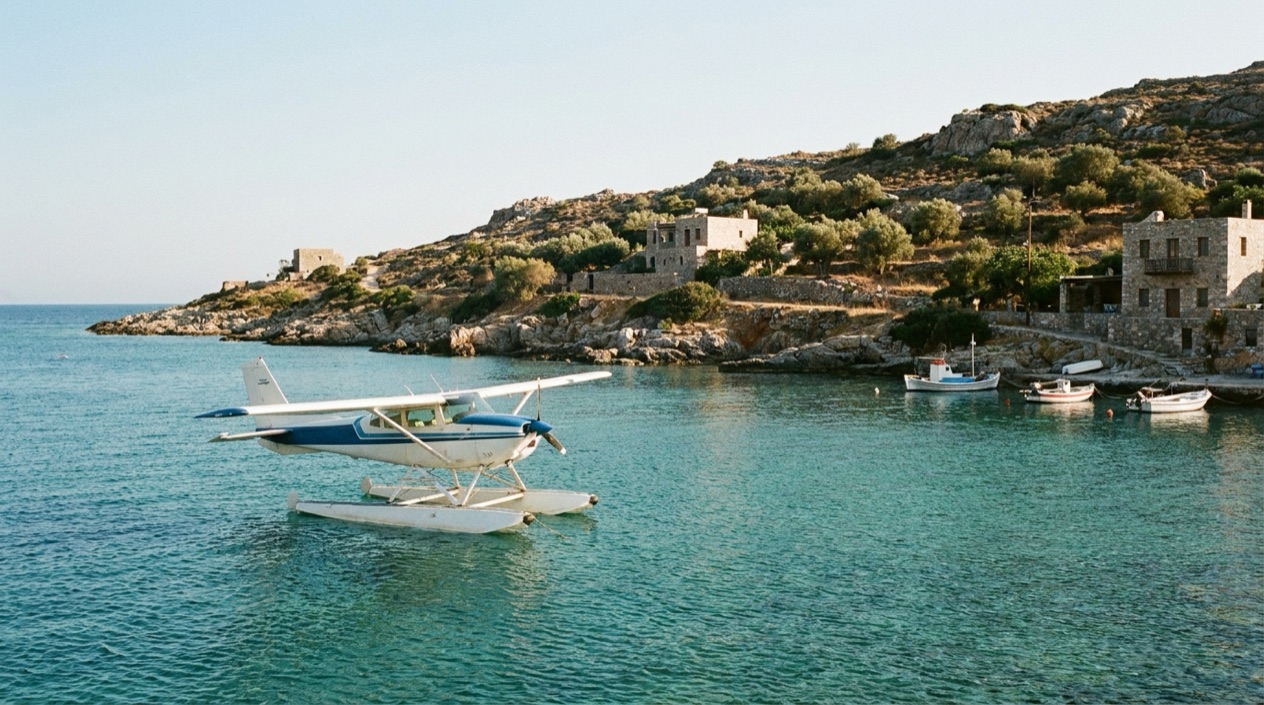
The places that suit these aircraft are the ones where land and water break into pieces: island groups, sheltered bays and coasts where a runway is hard to find. Seaplanes in particular keep a few niche uses in the modern world, and air transport around archipelagos is one of them. Greece, with its scattered islands, is exactly the kind of geography that idea was made for.
Helicopters are used for tourism among other applications, so a scenic flight is one of the things a rotorcraft does well. To judge where each aircraft makes sense, it helps to understand what each one can and cannot do.
What a helicopter can do around the islands
A helicopter gets its lift and thrust from horizontally spinning rotors. That gives it abilities no airplane has: it takes off and lands vertically, hovers, and flies forward, backward and sideways. On an island with a hillside village, a clifftop or a small pad beside a hotel, that means an aircraft can arrive almost anywhere a flat patch of ground exists.
Hovering is the hardest part of flying a helicopter, because it takes constant corrections from the pilot. You notice that as a passenger in the way the aircraft seems to hang in the air, adjusting itself over a coastline or a harbor.
If the engine fails, a helicopter can enter autorotation, where the main rotor keeps turning because of air moving up through it. Helicopters are also used as air ambulances, a use known as MEDEVAC, which is the same flexibility working in a different job.
Seaplanes: floatplanes, flying boats and amphibians
A seaplane is a powered fixed-wing aircraft that can take off and land on water. Seaplanes are usually divided into floatplanes, which sit on pontoons, and flying boats, which have a hull that lets them land on water. Flying boats are generally far larger and carry far more. A seaplane that can also use an airfield is called an amphibious aircraft, or an amphibian.
Water is the limit. Floatplanes cannot handle wave heights typically greater than 12 inches. That matters in a sea as changeable as the Aegean, where the water in a bay can look quite different from one day to the next. It is the reason a seaplane is a matter of conditions, not a guarantee, and why a plan that depends on one should always have another way across.
A Greek seaplane story
Greece has a long relationship with the seaplane. During the Balkan Wars in 1913, a Greek Astra Hydravion carried out a reconnaissance of the Turkish fleet and dropped four bombs. Hydravion is the Greek-flavored word for a water airplane, and it is a reminder that the country has looked at its seas from the air for a very long time.
Today the picture is a quieter one. The idea of hopping between islands by air onto the water lives on as one of the niche uses of seaplanes, while travelers move around the country by ferry, bus and rental car.
Which routes exist?
The routes that carry nearly everyone around Greece are the ferry lines, which run as a hub-and-spoke system with the spokes radiating from Piraeus out to the various island groups.
The ferry spokes from Athens
Athens has three ports: the main port Piraeus, and the outlying Rafina and Lavrio. For central Cyclades islands such as Tinos and Mykonos, it is often better to leave from Rafina.
Choosing the port first, before the island, saves a lot of confusion. The harbor you leave from shapes your whole first day, from the road you take out of the city to the kind of boat waiting at the end of it.
Moving between island groups
The Western Cyclades (Serifos, Sifnos, Milos) and the Central Cyclades (Naxos, Paros, Mykonos) are on different spokes. In summer you can usually get from one island to another in the same group on any day. Boats between the groups, for example Naxos to Sifnos, may be significantly less frequent.
This is the part of an island itinerary where the map misleads. Two islands that look like neighbors can sit on different lines, and an itinerary that stays inside one group tends to flow better than one that jumps across. When a gap between groups looks awkward on the schedule, that is the kind of leg where travelers start to think about other ways across, including the air.
Islands near the mainland by bus
KTEL is the national government-subsidized network of independent businesses that form a dense route system serving almost the entire country. KTEL bus routes from major cities to islands near the mainland, such as Corfu and Cephalonia, include the ferry crossing in the price of the bus ticket. For those islands, a single ticket covers both the road and the water.
On land, most rail traffic is in the Athens-Thessaloniki corridor and their suburban railways. Other lines, like Thessaloniki-Florina, Lamia-Trikala and Thessaloniki-Serres, usually have only one or two trains per day, so the bus network does much of the work away from the main corridor.
How do you book?
Booking starts with knowing exactly which aircraft you are asking for: a helicopter, a floatplane, a flying boat or an amphibian. Each behaves differently, and the differences decide what a flight can do on a given day. A helicopter can land almost anywhere flat, while a floatplane needs water calm enough for its pontoons.
Think in conditions, not just dates
Because a floatplane is limited by waves, the sea on the day matters as much as the date on your confirmation. Keep that in mind when you build the rest of the trip around a flight. A day on the water is a different proposition from a day in the air, and a plan that leaves room to shift is a plan that survives a rough morning.
The same logic applies to the helicopter. Hovering takes constant skill and attention, and the pilot decides what the sky allows. Treat any aerial leg as something that may move, and place the pieces that cannot move, such as a long-haul flight home, well away from it.
Plan ahead around August
Ferries in August fill up because of the National Holiday on 15 August, so travelers should plan ahead. A traveler who thinks in layers does well here: a main plan by sea, with an aerial leg as a treat rather than the thread everything hangs on.
If you add a rental car
Rental car terms in Greece often restrict taking the vehicle on ferries, so a car and an island hop need to be thought through together. About 90% of rental cars in Greece are manual, so for an automatic it is advised to reserve one in advance. Drivers who do not hold an EU driving licence must carry an international driver’s permit obtained in their home country. An aircraft leg can sometimes sidestep the car question altogether, since you arrive on the island and rent there instead of carrying a vehicle across.
Good to know before you go
Winter changes the picture for every kind of island crossing. From January to March, weather on the Aegean can be extremely rough and boats are often kept in port for days at a time, so a schedule built for summer does not carry over. The same sea that holds the ferries in port is the sea a floatplane has to land on, which is why wave limits are worth remembering whenever you plan anything on the water.
Sources
- Wikipedia, Helicopter (https://en.wikipedia.org/wiki/Helicopter), checked October 12, 2026
- Wikipedia, Seaplane (https://en.wikipedia.org/wiki/Seaplane), checked October 12, 2026
- Wikivoyage, Greece, section Get around (https://en.wikivoyage.org/wiki/Greece#Get_around), checked October 12, 2026
To plan your stay
- Best Time to Visit Greece: September and Late May to Early June
- Arachova: Parnassus Mountain Town, Formaela Cheese, Ski Season and Saint George's Day
- American Airlines Flights to Greece: U.S. Cities, Athens Arrivals and Onward Island Flights
- Greece on a Budget: Cash Machines, Cards, Beaches and Ferries