
At dusk in a Greek harbor, rigging clinks against the masts, someone grills octopus on the quay, and crews step off their boats with salt still on their skin and head for the nearest taverna. Yachting here means living on the water and treating islands as stops along a long, slow table. It happens across the Aegean, the Ionian and the Mediterranean, the three seas that border Greece.
How does yachting in Greece work?
Yachting in Greece means taking a boat, whether chartered or joined as a guest, and moving from harbor to harbor, with the sea as your road and the islands as your stops. You wake in one port, sail to another, tie up or drop anchor, and spend the evening ashore. The boat is your hotel, and the itinerary is bent around the places you want to see.
Sailing is a popular sport in Greece, as you would expect from a country whose coast is so long and so broken into bays and islands. That shows in the harbors themselves, where small fishing caiques, sailing boats and larger motor yachts share the same waterfront. Nobody finds it odd that a visitor arrives by water.
Living aboard
Life on a yacht runs on a simple rhythm. Mornings begin with coffee on deck and a look at the day’s plan. Then comes the sail or the motor to the next island, a stop at a bay for lunch, and an arrival in a port where the waterfront cafés are already setting out chairs.
Some travelers hire a professional skipper and sometimes a cook, and simply enjoy the trip. Others prefer to sail the boat themselves with friends or family. Either way, the cabin is small, the deck is where everyone gathers, and the days are shaped by the wind and the sea rather than a timetable.
Evenings in the harbor
What makes a yacht trip feel Greek is the evening. You walk from the quay into the chora, the main village or town of an island, and find a kafenio (a traditional coffeehouse) with old men over backgammon, a taverna with tables spilling onto the stones, and a baker whose shop opens before the harbor wakes.
Dinner is usually a spread of meze, small dishes shared across the table: tzatziki, grilled octopus, fried small fish, a salad of tomato, cucumber and feta. A glass of ouzo or a carafe of local wine goes with it, and the conversation drifts between boats, weather and the next port. Crews from other boats nod to you across the quay.
A sailing nation
The country’s love of the water shows in its sporting record. Greek athletes have won 7 Olympic medals in sailing and 2 in rowing, along with numerous gold medals in world and European championships in both sports. Georgios Zaimis took gold in the Dragon class with the boat Nirefs at the 1960 Games in Rome, sailing together with Constantine II of Greece and Odysseus Eskidioglou.
Anastasios Bountouris competed at six Olympics between 1976 and 1996, the first Greek to do so, and won bronze in 1980 in the Three-Person Keelboat. Sofia Bekatorou and Emilia Tsoulfa won gold in the women’s 470 class at the 2004 Games, and Bekatorou has won 4 world championships. Nikolaos Kaklamanakis took gold in windsurfing and lit the Olympic torch at the opening ceremony in Athens that same year.
Vasileios Polymeros, with Nikolaos Skiathitis, won bronze in men’s lightweight double sculls at those 2004 Games. When you sit on a quay watching young sailors in dinghies tack past the breakwater, you are watching the same tradition that produced these names.
Where do yachts go?
Yachts in Greece go to three seas, the Aegean, the Ionian and the Mediterranean, and each gives the trip a different character.
The Aegean
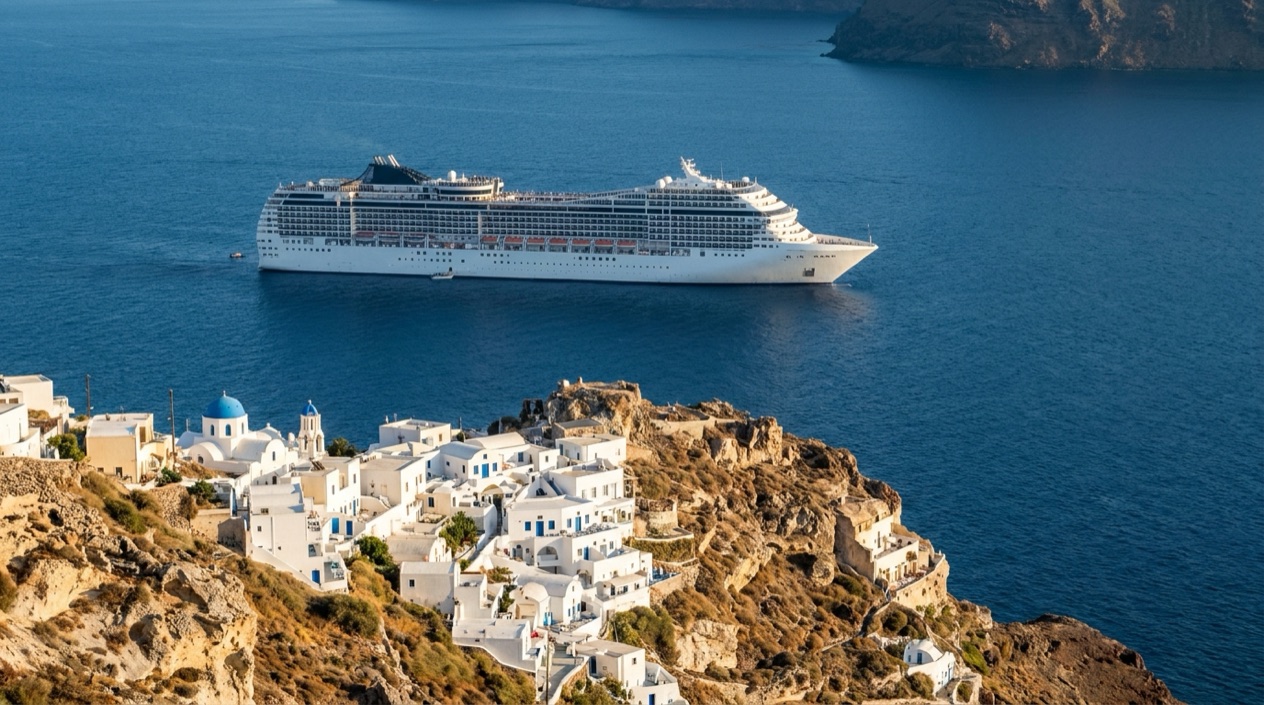
The Aegean is where travelers picture a Greek sailing trip. Santorini, Mykonos and Paros are names that anchor an itinerary, each with a chora of white-and-blue buildings stacked above the harbor, narrow lanes and waterfront cafés. Arriving by boat gives you a different first view of them than arriving by plane or ferry, since you see the whole island rise from the water.
Ashore, the pleasures are simple. You wander the lanes of a chora, climb to a church or a windmill for the view back over the harbor, and sit down to grilled fish or a plate of local cheese. Each island has its own bakery sweets, its own cheese and its own way of cooking, which gives every stop a flavor of its own.
The Ionian
The Ionian Sea belongs to Corfu, Kefalonia, Zakynthos, Lefkada, Paxos and Ithaca, islands with cypress, olive groves and hillsides that run green down to the water. The mood is different from the Aegean, with Venetian-looking old towns, arcaded squares and harbors tucked into deep inlets. Ithaca carries the weight of Homer’s Odysseus, and sailing there feels like following a story.
Evenings in an Ionian port often center on a waterfront taverna. Dishes you may find include pastitsada on Corfu, a slow-cooked meat dish with pasta, and sofrito, veal in a garlic and wine sauce. Kefalonia is known for its savory pies and for its local wines.
The Mediterranean
The third sea, the Mediterranean, brings in the bigger islands, such as Crete with its ports of Chania, Rethymno and Heraklion, and Rhodes with its walled medieval town. These are islands with deep history and a lot to see ashore, and a boat lets you reach them with your own bed waiting at the quay.
Chania’s old Venetian harbor, with its lighthouse and its row of tavernas, is a place to arrive in the evening and stay for dinner. Cretan cooking leans on wild greens, local cheeses, snails, lamb and raki, the clear spirit poured at the end of a meal.
What does it cost?
What a Greek yacht trip costs is built from a few separate pieces: the boat, the crew, the harbors and everything you eat and drink along the way. Each piece can be small or large depending on the choices you make, so the final bill is shaped by your style of travel more than by any single price.
The boat and the crew
The largest part of the budget is the boat itself. A small sailing boat for a group of friends is a very different purchase from a crewed motor yacht with cabins for guests, and the range between them is wide. Size, age, equipment and the season all enter the price.
The next choice is the crew. Sailing the boat yourself keeps that cost off the bill, while hiring a skipper or adding a cook turns the trip into something closer to a floating hotel with service. Travelers split the cost among several couples or a family, which makes a bigger boat a shared pleasure.
Harbors, fuel and provisions
Beyond the boat, a yacht trip brings running costs. Fuel is needed when the wind drops and the engine takes over, and tying up in a harbor can carry a berth fee, while dropping anchor in a bay usually does not. Water and electricity at the quay are part of the same picture.
Provisions are the pleasant part of the budget. A morning at a harbor market or village grocery for tomatoes, bread, cheese, olives, fruit and yogurt with honey keeps breakfasts and lunches aboard simple and delicious. Stocking the galley on the islands also means tasting what each place grows.
Eating and drinking ashore
The last piece is the evening meal. A taverna dinner of grilled fish, meze and wine, repeated night after night, adds up, and so does the coffee at the waterfront café and the pastry from the baker. Some travelers cook on board a few nights to balance the budget, saving restaurants for the islands they most want to taste.
Choosing a mix is part of the fun. A lunch of bread, feta and tomatoes eaten on deck in a quiet bay, followed by a dinner of seafood in a harbor town, gives you both the freedom of the water and the flavor of the shore.
Good to know before you go
Greece uses the euro, and the harbors you visit, from small island quays to the big marinas, are places where you will pay for berths, fuel, groceries and dinners as you go. The sea is something to read each day before you leave port, since sailing here follows the weather and the water more than any plan. Island harbors are social places, and a friendly word with the crew on the next boat is a habit worth keeping.
Sources
- Wikipedia, Sailing in Greece (https://en.wikipedia.org/wiki/Sailing_in_Greece), checked October 12, 2026
To plan your stay
- Best Time to Visit Greece: September and Late May to Early June
- Arachova: Parnassus Mountain Town, Formaela Cheese, Ski Season and Saint George's Day
- American Airlines Flights to Greece: U.S. Cities, Athens Arrivals and Onward Island Flights
- Greece on a Budget: Cash Machines, Cards, Beaches and Ferries