
A first-timer stands at the door of a monastery chapel with bare knees, or at a ferry port watching the departure board and wondering what the weather is doing to the Aegean. These are the small moments when Greece teaches its habits. The short answer is that a few customs around churches, smoking, fire and the sea carry most of the weight, and the rest is long lunches at the taverna and an open mind.
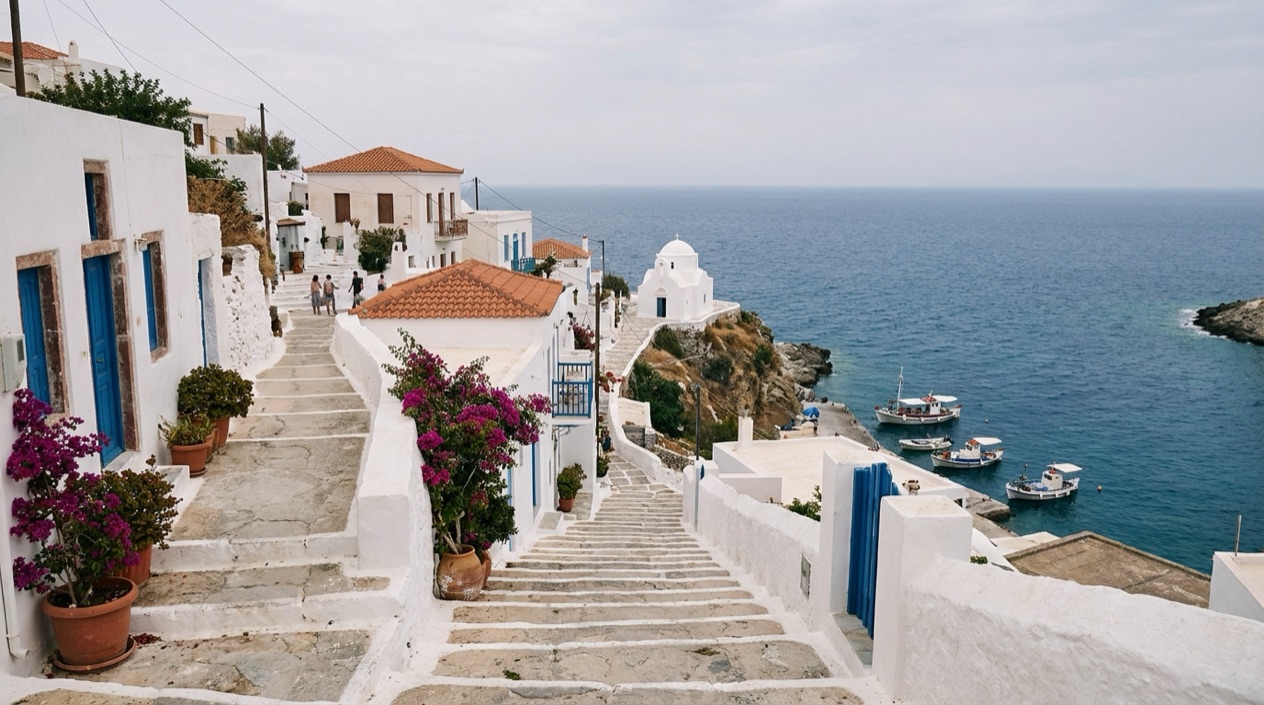
What should first-time visitors know about Greece?
First-timers should know that daily life in Greece rests on a few shared habits: how you dress for a church, where you may smoke, how you behave on a beach and how seriously the country treats fire. Learn those and you will fit in at once. Everything else is the pleasure of the place, from the first plate of meze (small dishes shared across the table) to the last coffee at a kafenio, the traditional café where men and women still linger over a card game or a newspaper.
Eating is where many visits take shape. A taverna table fills with grilled octopus, a bowl of Greek salad crowned with a slab of feta, souvlaki off the grill, or a tray of moussaka still bubbling from the oven.
Ouzo turns cloudy when water is added, and on Crete a small glass of raki often arrives at the end of a meal without anyone ordering it. Ordering several dishes for the table and passing them around is the natural rhythm.
Churches and monasteries
Dress codes for churches in Greece sometimes require women to cover their shoulders and both sexes to cover their knees. A village chapel, a cathedral in a town square and a monastery on a rock can each apply the code in their own way, so a visitor who is dressed for the beach may be turned back at the threshold.
At the entrance of churches and monasteries, especially those receiving most tourist traffic, appropriate clothing is usually available to borrow. You pick it up going in and drop it off on the way out. A light scarf or a pair of long trousers in a day bag still saves you from standing in a borrowed wrap in the courtyard, and it lets you step into any chapel you pass on a walk through a village.
Inside, the habits are quiet ones. People light a thin candle, kiss an icon, make the sign of the cross, and speak softly. You are a guest in a place of worship that is still in daily use, and the smell of beeswax and incense is part of what you came to see.
Beaches, nudism and sunbathing
On all shores of the mainland and on most of the islands, Greece has nudist beaches where nudism is tolerated. They tend to be set apart from the main stretches of sand, and a visitor who walks around a headland may well find one. Tolerated is the right word: it describes an understanding with the neighbors, not an invitation to undress wherever you like.
Topless sunbathing is not accepted outside the tourist areas. A small cove near a village where families swim after church on Sunday is a different setting from a resort beach lined with umbrellas, and reading the people around you is the best guide.
Smoking in public places
Smoking is prohibited by law in all public places in Greece, such as restaurants and cafeterias. Travelers who remember smoky tavernas from older guidebooks should expect the rule to apply, and an ashtray on a table is not a sign that you may light up inside.
A hotline, 1142, can be used to report people and establishments breaking the smoking ban. As a visitor you are unlikely to need it, but it shows that the rule is taken seriously. If you smoke, step outside before you light up, as the locals do.
What mistakes should you avoid?
The mistakes that stand out most are a rude gesture made without knowing it, a spark in dry country and a trip planned as if ferries ran in every kind of weather. None of them takes much effort to avoid once you know about them. Each one can turn a good day into a bad one, and one carries a very large fine.
The wave that is not a wave
Holding up your palm with your fingers extended outward is rude in Greece. It is known as the Mountza and is akin to giving someone the middle finger. A cheerful open-handed wave to a shopkeeper, a waiter or a driver who let you cross the road can land very badly.
The fix is simple. Wave with a loose hand, or keep the palm turned toward yourself, or just nod and smile. Say kalimera, good morning, or efharisto, thank you, and the gesture hardly matters. Parents with small children, who wave at everything, may want to mention it to them before the first harbor stroll.
Fire and the summer ban
During the fire ban in Greece, every outdoor activity that could cause a forest fire is prohibited, including campfires, bonfires, barbecues and cookouts, and fireworks. A beach picnic with a portable grill, a candle-lit evening in a pine grove or a small fire to keep warm are all things the ban covers. Hillsides covered in pine and scrub are exactly the landscapes the rule protects.
In Greece, the fine for causing a forest fire can be €200,000. That figure explains why people there take the matter so seriously. If you see a fire, call 112. Do not wait to see whether someone else has already done it, and do not try to judge the size of the blaze before you ring.
Trusting the ferry in winter
From January to March, Aegean weather can be extremely rough, and ferries are often kept in port for days at a time. A traveler who builds a tight chain of island hops in those months, with a flight home on a fixed day, can find the plan stretched by the sea alone.
The sensible response is to leave slack in the plan. Fewer islands and more time on each give you room if a boat stays at the quay, and a village with a good kafenio, a church to visit and a harbor to watch makes an unplanned extra day a pleasant one.
How do you plan?
Plan Greece around the sea, the calendar and your own pace: choose how many islands you really want, learn when the ferries are under pressure and give each place enough days to feel like somewhere you have been. Greece rewards travelers who go slowly, and the country is made of ports, villages, ruins and tables where it is a pleasure to stay.
Ferries around the August holiday
Ferries in August fill up due to the National Holiday on 15 Aug, so travelers should plan ahead. The day is also a religious feast, and Greeks head for their home islands and villages, which puts extra weight on the boats. If your trip falls around that date, sort out your crossings before you pack.
Around the holiday, many island villages hold a panigiri, a feast with music, dancing and long tables, centered on the village church. If you happen to be in one, the evening can be a highlight of the trip. Planning the crossings early leaves you free to enjoy it instead of worrying about how to get out afterward.
Sailing your own boat
Boats arriving in Greek waters must pay the TEPAI boating tax on the day of arrival, and the fine for not paying is high. The tax must be paid for each calendar month a boat stays in Greece, so a long cruise means paying again as each month begins. Boats in Greece must also have liability insurance that explicitly states coverage is in accordance with Greek laws.
Paperwork depends on the flag. Boats with an EU flag arriving directly from a Schengen country do not need to check in, but must have an updated crew list on board. Boats with a flag from outside the EU must check in at a port of entry, visit customs, buy a transit log, and have it stamped by port police at every harbor visited.
Choosing how much to see
First-timers often try to fit Athens, several islands and a mainland site into one trip. Greece is better seen in fewer pieces. Pair a city with one island, or one island group with a stay on the mainland, and leave days with nothing planned for a swim, a long lunch under a plane tree or a walk to a chapel above the harbor.
Put the fixed points on the calendar first: your flights, the August holiday if you are traveling then, and the winter months when the Aegean can keep ferries in port. Then fill in the days between with places you want to linger in. A plan with space in it survives a delayed boat far better than a full one.
Good to know before you go
A few reminders round out the picture. Topless sunbathing is not accepted outside the tourist areas, and nudism is tolerated on beaches set aside for it. Smoking stays outside restaurants and cafés, with the 1142 hotline available for reports.
Keep the palm of your hand to yourself, carry something to cover knees and shoulders for the chapels you pass, and make a habit of sitting down for a second coffee. Greece is the kind of country where the best moments are the unplanned ones, so leave room for them.
Sources
- Wikivoyage, Greece (https://en.wikivoyage.org/wiki/Greece), checked October 12, 2026