
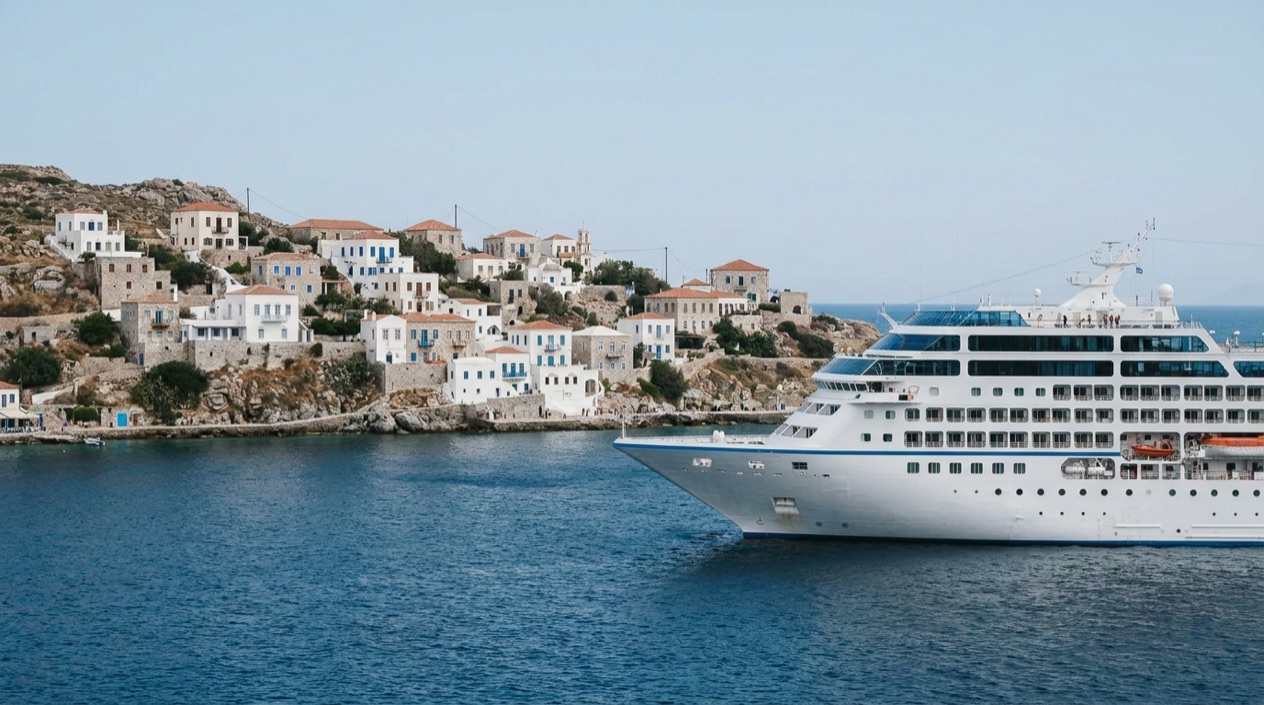
On a cruise, the evening begins with a table set for your assigned dinner seating and a ship sliding out of one port while you eat. Island hopping begins with a ferry ticket in your hand, a harbor café and the question of which island comes next. One trip is a floating hotel that carries you from stop to stop, the other is a route you build yourself across the Greek islands.
Which is better, a cruise or island hopping?
A cruise is better for travelers who want one bed, one bill and a set route, while island hopping is better for travelers who want to choose their own islands and stay longer where they like them. Neither is the better trip in itself. They answer two different wishes: to be carried, or to steer.
A cruise ship is a large passenger ship built for vacationing, usually sailing a round-trip voyage with ports of call where passengers can join shore excursions. Island hopping uses the ferries that tie the mainland to the islands, and the islands to one another. Blue Star Ferries, for example, serves more than 20 destinations in Greece, and ANEK Lines runs Piraeus to Chania and Piraeus to Heraklio.
| Category | A cruise | Island hopping |
|---|---|---|
| Beaches | Time on a beach depends on the length of each port stop and on the shore excursions you take | You choose the island and stay as long as you like on its beaches |
| Vibe | A floating hotel with its own routine, shared with the other passengers | Changing harbors, small hotels and a new village every few days |
| Things to do | Shore excursions from each port of call, plus life aboard | Ruins, villages, hikes, boat trips and evenings on the waterfront, planned by you |
| Food | Dining is included in the cruise price, with set dinner seatings | Tavernas, bakeries and harbor cafés chosen meal by meal |
| Weather | The itinerary follows the dates of the voyage | You can move your route around the season and the forecast |
| Getting there | You board once and the ship does the moving | You move by ferry between ports such as Piraeus, Chania and Heraklio |
| Best for | First visits to the islands and travelers who like a fixed plan | Travelers who like to improvise and linger |
Sights, beaches and food
On a cruise, the sights arrive in installments. The ship ties up at a port of call, passengers go ashore on an excursion, and by evening the next place is already on the horizon.
You see the harbor, the main ruin or the old town of each stop, and the pleasure lies in how many different islands pass by in a single voyage. Beach time is whatever the stop leaves you, so a cruise suits people who like a taste of many places.
Island hopping turns the same sights into places you actually settle into. You can spend days on Crete, the largest Greek island, or move on to Rhodes, the fourth largest, or cross to Lesbos, the third.
You can also wander among the Cyclades, the Dodecanese, the Ionian Islands or the Saronic Islands, groups that each have their own feel. Beaches become part of the rhythm of the trip, a morning swim, a late lunch, a walk through a chora (the main hilltop town of an island).
Food splits the two sides clearly. On almost every cruise ship, dining is included in the fare, and restaurants traditionally run two dinner services, early and late, with a set time for each passenger for the whole voyage. The food is the ship’s, served at the ship’s pace, with the buffet or dining room as a daily anchor.
Ashore, island hoppers eat the way the islands do: a Greek salad with a block of feta on top, grilled octopus drying on a line before it reaches the grill, fava (a purée of yellow split peas), stuffed tomatoes, souvlaki from a counter, moussaka from a taverna kitchen, and loukoumades, little fried dough balls with honey. Each island has its own cheese, its own pie, its own way with fish.
For sights and beaches that stay with you, island hopping wins, because you give each place time to become more than a photograph. For food it wins as well, since meals become part of the travel. The cruise wins on ease, with so much already decided and paid for.
Things to do
A cruise gives you a structured menu of things to do. Shore excursions take passengers from each port of call to a ruin, a village or a viewpoint, and the ship adds its own days of leisure between stops. Evenings are built around the dinner seating, then the lounges and the deck. The entertainment is part of the vessel, which travelers find restful after a day on shore.
On the island-hopping side, your days are yours to shape. In Athens you can see the ancient world, a city that has drawn visitors since Roman travelers came to its centers of philosophy and science.
Mass tourism arrived in modern Greece in the 1960s and 1970s, when hotels and other facilities were built across the country, and the 2004 Olympic Games in Athens gave tourism another push. Today that history shows in the ease of finding a room almost anywhere, from a port town to a village.
Island by island, the things to do change. Crete has its own routes and towns, among them Chania and Heraklio, both reached by ANEK ferries from Piraeus. Rhodes and Lesbos have their own old towns and coastlines. In the smaller island groups you swim from rocks, walk between villages, sit in a kafenio (a traditional coffeehouse) with a Greek coffee, and watch the ferry come in, a daily event in many harbors.
Nightlife follows the same split. Aboard a ship, it is the show, the bar and the deck under the sky.
On the islands, evenings run to long dinners at a harbor taverna, a glass of ouzo with a plate of meze (small shared dishes), a stroll along the waterfront and, in livelier towns, bars that keep going late. Day trips on island hopping are made by boat or by road from where you are staying, and you decide each morning where to go.
Weather and the best time to go
Seasons shape the two trips differently, because on a cruise you pick a voyage date and the ship takes you through whatever the weather brings, while island hoppers can shift the route as the days go by. Greece has hot summers, which are the season of beach days and long swims, and milder, wetter winters, when the islands slow down and the ruins and villages become the main attraction.
For a cruise, the date you book decides the conditions. A summer voyage is a trip built around deck time and swimming off the stops, while a voyage in the shoulder months leans toward sightseeing ashore. The advantage is that the ship carries your bed with it, so a change of weather does not disrupt where you sleep.
For island hopping, the season affects what you plan. Beach-centered stays suit the warm months, and a trip focused on towns, ruins and food can be built for the cooler ones. Each island has its own climate, and each deserves a look at its own numbers before you set a route. Wind, heat and rain can all reshape a day, so a flexible route is a good companion to the season.
Packing follows the season you choose. A summer trip calls for sun protection and swimwear, while a cooler or wetter month calls for warm layers and a rain jacket. In both cases the ship or the ferry is your base for moving, and the weather decides what you do once you step off.
Getting there and getting around
A cruise asks you to arrive once, at the port where the ship begins its round-trip voyage, and then the ship handles every move between islands. You unpack once and the vessel does the traveling, with shore excursions taking you from each port of call to the sights. That single arrival is the main logistical difference between the two ways of seeing Greece.
Island hopping starts on the mainland, most often at the port of Piraeus, from where ferries leave for the islands. Blue Star Ferries is a Greece-based company that connects the mainland with the Aegean Islands, with a fleet of 12 ferries and service to more than 20 destinations. It belongs to Attica Group, which also owns Hellenic Seaways and Superfast Ferries.
For Crete, ANEK Lines is one of the largest passenger shipping companies in Greece, founded in 1967 as a community-based company by residents of Crete. Its domestic routes run from Piraeus to Chania with the ferries Elyros and Kissamos, and from Piraeus to Heraklio with Asterion II. Each route is written between the two ports, so you pick the town where you want to arrive.
Once on an island, you move around by whatever suits the place, and each island has its own way of doing so. Each hop adds a new harbor to find, a new room to settle into and a new set of arrangements for the days ahead. That freedom is the heart of island hopping, and it comes with more small decisions than a cruise ever asks of you.
Who should choose which
Choose a cruise if you want to see several islands without packing and unpacking, if you like having meals included and a routine to lean on, and if shore excursions sound like a pleasant way to meet each port.
Choose island hopping if you like to decide where to stay and for how long, if you want to eat in tavernas rather than a ship’s dining room, and if lingering matters more to you than covering ground. It rewards curiosity, with the island groups, the harbors and the villages all open to your own route. Crete, Rhodes, Lesbos and the Cyclades each offer a different kind of stay.
The two can also be combined. A cruise can be a first taste, a way to see which islands call to you, and a later trip by ferry can then return to those favorites for a longer stay. Or you can island hop for most of a trip and add a ship voyage for a stretch of it. Either order gives you both kinds of Greece, the carried and the chosen.
Good to know before you go
Greece uses the euro, and on a cruise most of the cost of meals is already in the fare, while island hoppers pay for meals, rooms and ferries as they go. The usual habits of travel apply, such as keeping an eye on your belongings in busy places, and on the islands the wind and the heat can change a plan, so a flexible schedule helps. Whichever way you go, the harbors, the food and the sea are the same Greece.
Sources
- Wikipedia, Cruise ship (https://en.wikipedia.org/wiki/Cruise_ship), checked October 12, 2026
- Wikipedia, Tourism in Greece, section History (https://en.wikipedia.org/wiki/Tourism_in_Greece#History), checked October 12, 2026
- Wikipedia, Greek islands (https://en.wikipedia.org/wiki/Greek_islands), checked October 12, 2026
- Wikipedia, Island hopping (https://en.wikipedia.org/wiki/Island_hopping), checked October 12, 2026
- Wikipedia, ANEK Lines (https://en.wikipedia.org/wiki/ANEK_Lines), checked October 12, 2026
- Wikipedia, Blue Star Ferries (https://en.wikipedia.org/wiki/Blue_Star_Ferries), checked October 12, 2026