
Stone ramparts rise over olive groves and red-tiled roofs, and the wind carries the smell of dry thyme across a gate that Byzantine, Frankish, Venetian and Ottoman rulers each held in turn. Greece is dotted with fortresses on rocky hills, harbor mouths and island ridges, and walking through them is one of the best ways to read the layers of the country’s past.
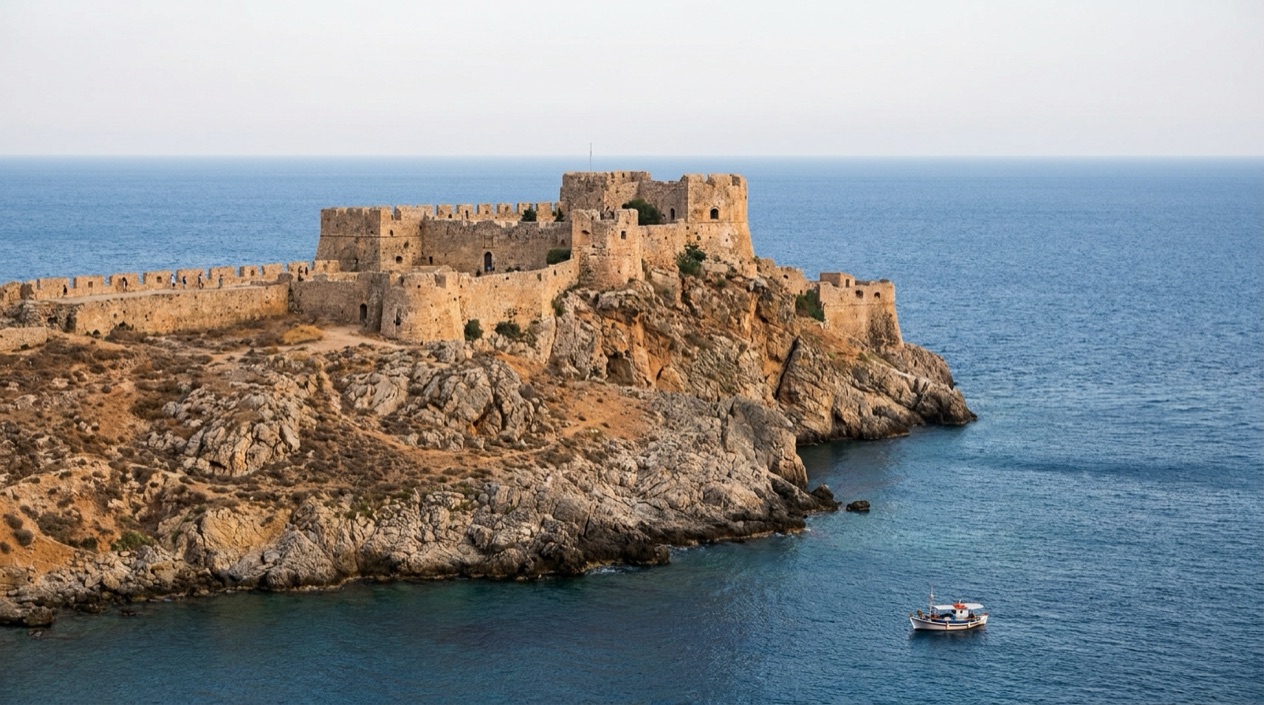
Which castles and fortresses can you visit in Greece?
You can visit fortresses on the mainland and on many islands, built by Byzantine, Frankish, Venetian and Ottoman hands, and some of them rest on foundations from the ancient world. The list is long enough that a trip can be built around castles alone, moving from Corinth to Nafplio, across to Preveza and Arta, and out to Corfu, Kefalonia, Kos, Crete and Amorgos.
What you find at each one depends on who held it. A Venetian fortress tends to mean bastions and harbor defenses, a Byzantine one a hilltop citadel, an Ottoman one a later fort that sits over older walls. Reading those periods on the stones is half the pleasure, and it gives each stop its own character.
The Peloponnese: Corinth and Nafplio
Acrocorinth stands above the town of Corinth and carries elements from the ancient and Byzantine periods. It is a fortress of layers, where later walls grow out of earlier ones, and walking its circuit feels like turning pages in a history book. Bring sturdy shoes, because the ground inside is uneven stone and scrub.
In Nafplio, Acronauplia holds the oldest part of the town’s defenses. Its stones include ancient, Byzantine, Frankish and Venetian work, so a single ridge tells four stories. Down in the old town, the cafés and tavernas serve grilled fish, lamb and plates of meze, which makes a natural pause after time among the ramparts.
Northwest Greece: Preveza, Anthousa and Arta
Around Preveza, two castles bear the name of saints. Agios Andreas belongs to the Ottoman and Venetian periods, and Agios Georgios to the Ottoman period. Together they show how rulers changed hands along this stretch of coast, and visiting both makes a compact comparison of how each held its ground.
In the Preveza regional unit you also find Anthousa Castle, from the Ottoman period, in the village of the same name. Arta Castle in the town of Arta is Byzantine. Arta is a town of old stone bridges and orange trees, and the castle fits into a day of wandering its streets and sitting over a coffee with the locals at a kafenio.
The Ionian and Aegean islands
Corfu has Angelokastro, which dates from the Byzantine and Venetian periods. On Kefalonia, Agios Georgios Castle is of Byzantine and Venetian origin. These are the islands where Venetian influence runs deepest, and you notice it in the food too: Corfu is known for pastitsada, a spiced meat and pasta dish, and Kefalonia for its meat pie.
Farther east, Anthimachia Castle on Kos is Byzantine, while on Amorgos the Acropolis of Arkessini, also called Arkessini Castle, dates from the ancient period. In western Crete, the Aptera Fortress near Chania is Ottoman. Adding one of these to a beach itinerary gives an island trip some history between swims.
Which are best known?
A few names carry most of the weight on a castle itinerary: Acrocorinth, Acronauplia, Angelokastro, Agios Georgios on Kefalonia and the fortress of Arta. Each stands over a town or a landscape you will want to see anyway, which turns a visit into part of a bigger day rather than a detour.
Acrocorinth
Acrocorinth is the fortress above Corinth, and its stones reach back to the ancient and Byzantine periods. It is the kind of place where you stop at every gate to work out which wall came first. The scale of the circuit gives you room to roam, and the fortress belongs to the Peloponnese like few other sites.
Pair it with a visit to the town below, where bakeries sell pies and bowls of lemon-scented soup for lunch. Wear shoes with a grip, since the paths inside follow the natural rock and the old paving.
Acronauplia in Nafplio
Acronauplia is the oldest citadel of Nafplio, with ancient, Byzantine, Frankish and Venetian elements side by side. Few places in Greece compress so many eras into one hill. From the walls you take in the town and the water around it, then drop back down into streets lined with balconies and bougainvillea.
Nafplio rewards a slow evening after the visit. Order grilled octopus, a plate of fried zucchini, a glass of ouzo or a local white wine, and let the day settle at a table in the old town.
Angelokastro on Corfu
Angelokastro is Corfu’s hilltop fortress, from the Byzantine and Venetian periods. Its name means the castle of the angel, and its position over the island gives the visit a sense of height and open air. It pairs well with a day of exploring Corfu’s villages and tasting local specialties such as sofrito, veal in a garlic and wine sauce, and the kumquat liqueur sold in shops across the island.
On Kefalonia, Agios Georgios Castle offers a similar Byzantine and Venetian story. Visiting both makes a theme for an Ionian trip, even if you cross between islands by sea and keep the rest of the days for beaches and villages.
Arta and Preveza
Arta Castle is Byzantine and stands in the heart of a town known for its old bridge. In Preveza, the castles of Agios Andreas and Agios Georgios show the Ottoman and Venetian periods in turn. This corner of Greece draws fewer visitors on castle tours than the Peloponnese, so a trip here feels like discovering something less rehearsed.
Local cooking reflects the region too, with pies, grilled meats and fresh fish from the nearby waters. A stop at a village taverna after the walls rounds out the visit.
How do you visit?
You visit each fortress on its own, paying a separate entry fee at every site, since there are no longer any combo tickets. The fee depends on how many visitors the site draws in a year, which means a busy castle costs more than a small one.
| Site category | Admission |
|---|---|
| Archaeological sites and museums with over 200,000 visitors | €20 |
| Archaeological sites and museums with over 75,000 visitors | €15 |
| Archaeological sites and museums with over 15,000 visitors | €10 |
| Other archaeological sites and museums | €5 |
Entrance fees are halved for EU citizens over 65 and for teachers accompanying students. Because each site stands alone, it helps to plan one or two fortresses a day rather than trying to pack many into the same stretch.
Building a castle route on the mainland
A mainland route can link Corinth and Nafplio, the two fortress towns of the Peloponnese in this list. Acrocorinth gives you the ancient and Byzantine layers, and Acronauplia adds Frankish and Venetian ones. Between the two you can fit the towns themselves, with their markets, bakeries and seafront tavernas.
Another route heads to northwest Greece, joining Arta Castle with the Preveza castles of Agios Andreas and Agios Georgios and the village fortress of Anthousa. These sites reward travelers who like to follow a theme through quieter towns, with coffee in a kafenio and a plate of grilled meat as part of the day.
Adding castles to an island trip
On the islands, a fortress works as a counterweight to beach days. Corfu offers Angelokastro, Kefalonia has Agios Georgios, Kos has Anthimachia Castle, and Amorgos has the ancient Acropolis of Arkessini. Aptera Fortress sits in the Chania area of Crete, which makes it easy to fold into a trip based in that part of the island.
Between visits, linger over island food: a fresh Greek salad with feta, grilled fish, baked vegetables, and honey-drizzled sweets. Wear walking shoes with good soles for the stone, and carry water and sun protection for exposed hilltops.
Good to know before you go
Euros are the currency at every fortress in Greece, and the admission is paid site by site. Many castles are set on rocky ground with uneven paving, so sturdy shoes matter more than anything else you pack. Summer heat can make exposed ramparts hot, and a hat and water bottle are sensible companions for a hilltop walk. Leave time for the towns below the walls, because the tavernas and kafenia are part of the visit.
Sources
- Wikipedia, List of castles in Greece (https://en.wikipedia.org/wiki/List_of_castles_in_Greece), checked October 12, 2026
- Wikivoyage, Greece, section See (https://en.wikivoyage.org/wiki/Greece#See), checked October 12, 2026
To plan your stay
- Best Time to Visit Greece: September and Late May to Early June
- Arachova: Parnassus Mountain Town, Formaela Cheese, Ski Season and Saint George's Day
- American Airlines Flights to Greece: U.S. Cities, Athens Arrivals and Onward Island Flights
- Greece on a Budget: Cash Machines, Cards, Beaches and Ferries