
The ferry docks, the village climbs the hill in front of you, and somewhere up those steps is the small place with ten rooms, a courtyard and a breakfast table set under a vine. That is the picture most travelers have when they type “boutique hotel” and “Greece” in the same search. The short answer: it is a small, personal hotel with a clear character, found mostly in cities and on the more popular islands, and it comes with the same practical quirks as any Greek room.
What is a boutique hotel in Greece?
A boutique hotel in Greece is a small hotel with a strong personality and more personal service than a typical hotel, the same idea the word carries everywhere else. Nothing in the label is a Greek legal category. It describes a style of stay, and each owner fills it in differently.
Boutique hotels first appeared in the late 1970s and early 1980s in cities such as London, New York and San Francisco.
The Morgans Hotel in New York is credited as the first, and the term was coined by Steve Rubell, who compared it to a boutique as opposed to a department store, the comparison made for chain hotels. In Greece that can mean local materials…
Small by design
The usual yardstick is size: fewer than a hundred rooms, and often far fewer. That small scale is what makes the service feel personal. You are more likely to be greeted by name, and the people at the front desk are the people who know the neighborhood.
These hotels are also designed to feel more intimate than many larger chains. In practice you may find a lobby that looks like a sitting room, a handful of tables at breakfast and a staff small enough that everyone knows which guest is arriving on which boat.
Character over uniformity
A boutique hotel usually shows a strong sense of aesthetic and an un-homogenized character. No two look alike. One might be built around stone walls and wooden shutters, another around bright modern design, and a third around the collection of art and ceramics the owners have gathered over the years.
Boutique hotel concepts often reflect the local culture of the neighborhood where the hotel stands. In Greece that can mean local materials in the rooms, island produce on the breakfast table and staff who point you toward the taverna they eat at themselves.
Themes and resort extras
Some boutique hotels are themed. The focus may be nature, the environment, cuisine, history, community and cultural immersion, attentive service or well-being. A hotel built around cuisine, for instance, may center its day on the kitchen and the table, while one built around well-being puts the emphasis on rest and quiet rooms.
In resort destinations, boutique hotels may add amenities such as a spa, yoga and instructor-led painting classes. On a Greek island, that can mean a spa, yoga or an instructor-led painting class built into the stay.
Where are they?
More luxurious accommodation in Greece can usually be found in the cities and on the more popular islands, which makes those the natural first stops for a boutique hunt. The format began as an urban idea, and boutique hotels are considered more trendy and intimate partly because of their city locations.
In the cities
Boutique hotels are commonly found in city centers, and in Greece the cities are where a small design-led hotel makes the most sense. Athens and the other big cities offer the neighborhoods the format is built for, with streets to walk out into and cafés and tavernas within reach of the front door.
One habit to expect, even at the more polished end: in Athens and other big cities, rooms and bathrooms tend to be small, and showers are often a hand-held sprayer. A boutique hotel may handle this with clever design, but it is worth treating the room size as part of the deal.
On the more popular islands
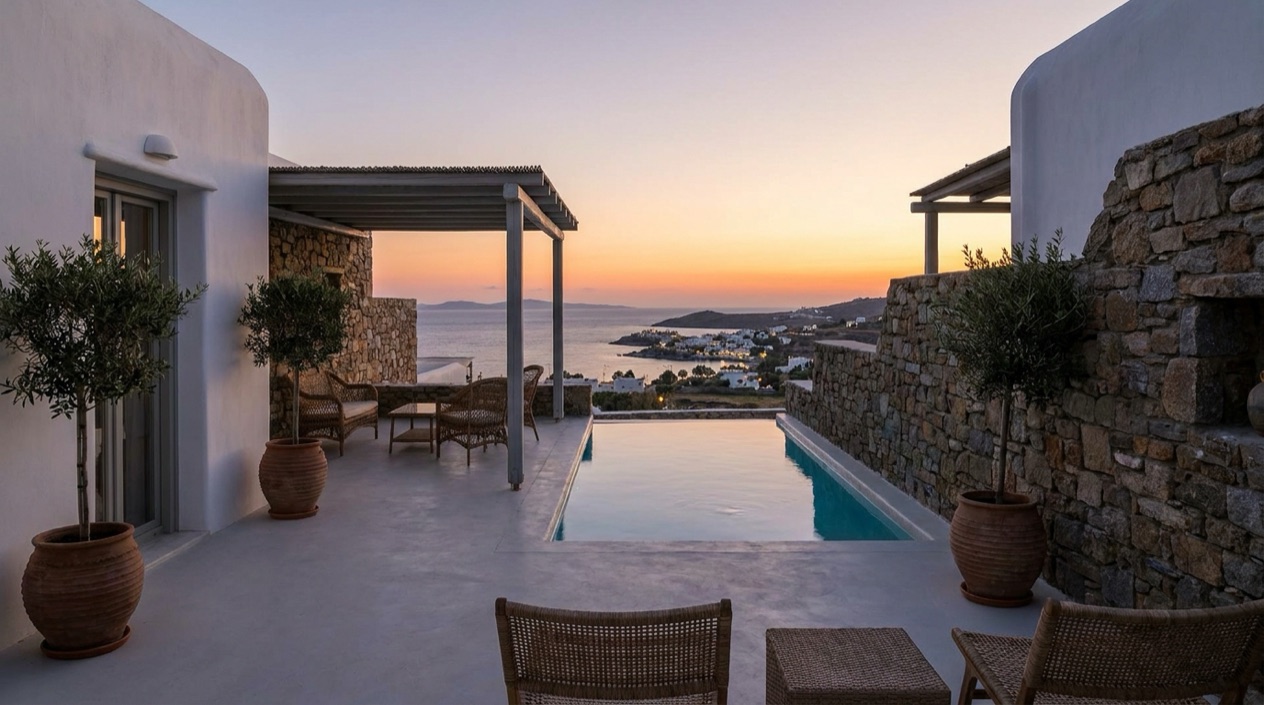
The island version is a small hotel set among the houses of a village or above a harbor, often with a terrace or veranda for breakfast. Greek hotels typically have a balcony, though sometimes a tiny one, or a veranda that is either private or a large one shared by all the rooms.
Because the better-equipped places gather on the more popular islands, those are the islands to search first if a spa, a themed stay or a design hotel is what you want. Travelers are advised to check a hotel’s quality in reliable sources, since the label “boutique” is used loosely and says little about what a given room is actually like.
Villas and resort-style stays by the sea
If a small hotel is not quite the picture you have in mind, renting a villa is the other way to get something personal. A villa in Greece is luxurious accommodation normally near or on the beach, with more space and a great view, and it suits those with a bigger budget.
The trade-off is service. A villa gives you privacy and room, while a boutique hotel gives you a breakfast table, a front desk and other guests at the next table. Some travelers split a trip between the two, a hotel in town and a villa by the water.
What should you know before you book?
Before you book, know that a charming Greek hotel can still have a small room, a tiny balcony and an air-conditioning question, and that most of these points are easy to settle with a short message to the hotel. A few habits of Greek hotels are worth having in mind.
What the room will be like
Rooms and bathrooms tend to be small in Greek hotels, especially on the islands and in Athens and other big cities. Showers are often hand-held sprayers, and at some of the most basic places there is no shower curtain at all. A boutique hotel is likely to sit well above that level, but the small-room habit is general enough to keep in mind.
Closets are often inadequate, and sometimes there is only a wardrobe. If you travel with a large suitcase, plan on living partly out of it. On the plus side, standards of cleanliness are usually good, even in the simpler places, and a balcony or veranda is typical, which gives you a place to sit with a coffee.
Air conditioning and old stone walls
Most Greek rooms have air conditioning. If it matters to you, ask before booking, because some rooms in old traditional buildings with thick stone walls may not need it. That detail matters for boutique stays in particular, since many of them are set in converted old houses.
The question is worth one line in your message: does the room have air conditioning, and is it working in the room you are being offered? A clear answer saves a surprise on arrival.
Booking and getting in touch
Most Greek hotels, even the smaller ones, have websites and will take bookings by email. If an email goes unanswered at a small family-run place, trying another channel is a reasonable next step.
Because a boutique label is applied loosely, read what the hotel says about itself and what independent sources say about it. Travelers are advised to check a hotel’s quality in reliable sources, particularly on the more popular islands where the choice is widest.
Crowded islands and rooms at the port
Walk-in accommodation can usually be found without too much trouble on all but the most crowded islands. On those, rooms can be difficult to find at the peak of the season, and even in the shoulder season on weekends and major holidays. If a particular small hotel is the point of your trip, that is the case for securing it ahead of arriving.
Rooms offered at the port are a different kind of stay from a boutique hotel, but they show how wide the range is. Prices for those can be negotiated, and prices of €20-25 for a room or even a studio are not uncommon in mid-season.
Good to know before you go
Greek hotels are small-scale even at the polished end, so expect a personal welcome, a modest room and a balcony or veranda to sit on. If a spa, a themed stay or a villa by the beach is what you are after, look at the cities and the more popular islands first, and read independent sources before you choose.
Sources
- Wikipedia, Boutique hotel (https://en.wikipedia.org/wiki/Boutique_hotel), checked October 12, 2026
- Wikivoyage, Greece, section Sleep (https://en.wikivoyage.org/wiki/Greece#Sleep), checked October 12, 2026