
A ferry noses into a harbor in the evening, ropes thud onto the quay, and the smell of grilled octopus drifts over from the nearest taverna. Church bells carry across a hillside of cube-shaped houses while someone at a kafenio (a traditional coffeehouse) stirs a small cup of thick coffee. Greece rewards a traveler who moves between its ancient sites, its island groups and its mainland towns, and the months from April through October are when the whole country is open and moving.
What are the best places to visit in Greece?
The best places to visit in Greece are Athens for its ancient sites, a handful of islands such as Santorini, Paros, Syros, Corfu and Zakynthos, and mainland towns like Nafplio. Together they give you marble ruins, harbor towns, tavernas, neighborhoods built in very different styles and, on one island, a nesting ground for sea turtles. Each has its own character, so a trip built from two or three of them feels varied rather than repeated.
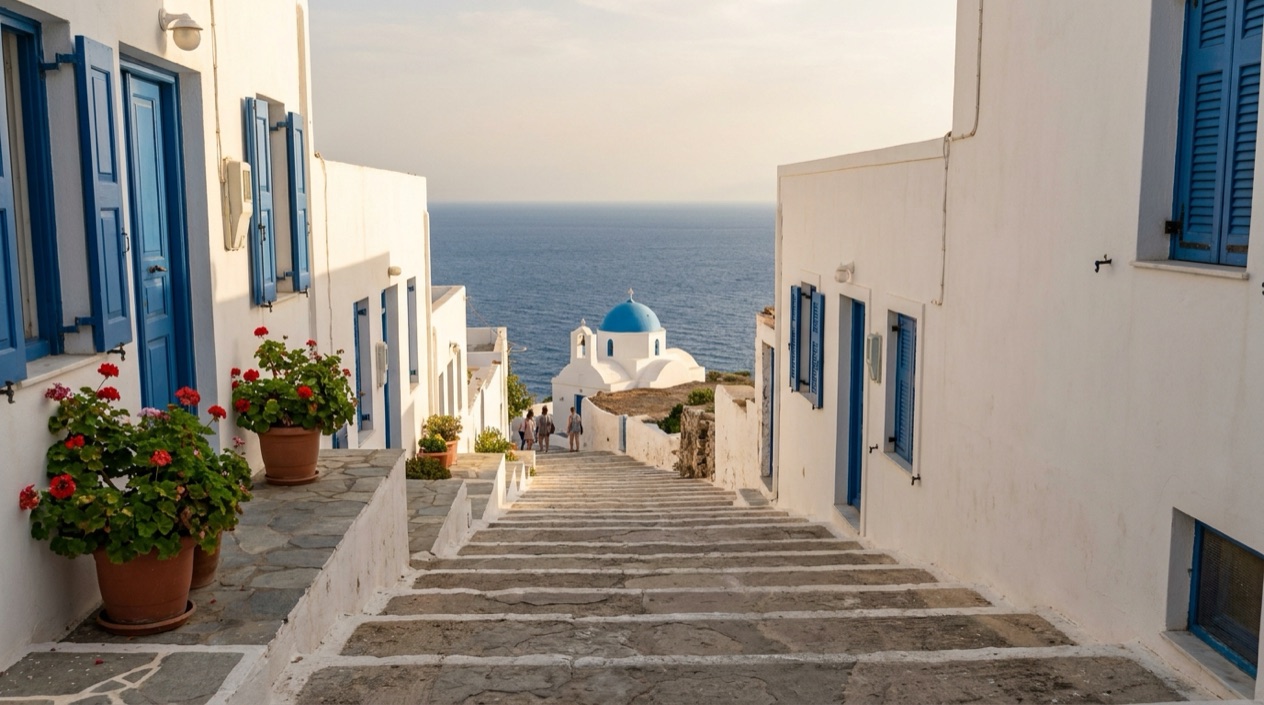
Architecture changes sharply from place to place, which is part of the fun. Cube-shaped white houses and blue-domed churches belong to the Cyclades, pastel baroque facades belong to Corfu, and Neoclassical mansions line the streets of Nafplio and Ermoupolis. Greece also counts 21 UNESCO World Heritage Sites, among the most in Europe and the world, so a ruin or a monastery is rarely far from a good lunch.
Athens
Athens is where the ancient world sits right in the middle of a modern city. The Parthenon rises on the Acropolis above streets of cafés, bakeries and small squares, and the New Acropolis Museum sits below it to the country. Long before today, Roman travelers came here to see the centers of Greek philosophy and science, so you are following a very old habit.
Beyond the monuments, Athens is a city of meals. Expect souvlaki wrapped in pita, spinach and feta pies from neighborhood bakeries, and long tavernas lunches that stretch into the afternoon. The city also hosted the 2004 Summer Olympic Games and the Eurovision Song Contest in 2006, and both left it with a confident, international feel. Athens is also where you meet Piraeus, the port that sends ferries out to the islands.
Santorini
Santorini is the island people picture when they think of the Aegean. Fira, the whitewashed main town, sits on the edge of a cliff, and from Oia you get a panoramic view of the caldera, the great flooded crater around which the island curves. Lanes of white walls, blue doors and domed churches run along the rim.
Away from the rim, Ancient Thera stands on a ridge of Messavouno mountain, a quieter kind of visit made of old stone and wide views. At the table, look for fava (a purée of yellow split peas), small sweet tomatoes and local white wines poured with the evening view. The island has an international airport, and ferries connect it with the rest of the Cyclades.
Paros and Syros
Paros shows the Cyclades at an everyday scale. Whitewashed Cycladic homes cluster around harbors and village squares, and the island has an international airport. The main town, like those of many islands, is the Hora, which means simply the place, and strolling its lanes before dinner is the point of a visit.
Syros is linked to Piraeus by a ferry that takes only 2.5 hours, and its capital, Ermoupolis, is one of the cities with Neoclassical architecture. Instead of Cycladic cubes you find grand town buildings, a stately main square and cafés that feel like those of a mainland city. Syros has an airport with domestic flights only.
Corfu and Zakynthos
Corfu looks different from the Aegean islands. Pastel baroque homes and churches fill its old town, and the island has an international airport. Its kitchen has its own dishes, such as pastitsada (meat in a spiced tomato sauce over pasta) and sofrito (veal in a garlic and white wine sauce), which you will not find on every island.
Zakynthos is known for its National Marine Park, the primary nesting ground for loggerhead sea turtles in the Mediterranean. You may spot turtles in the water around the island, though sightings are never a promise. The island is among the Western Greek Islands, where much of the country’s tourism is concentrated.
Which come first?
The places that come first, judging by where visitors actually gather, are Crete, the Dodecanese, the Cyclades and the Western Greek Islands, followed by the Peloponnese and the Halkidiki peninsula in Macedonia. Most of the country’s tourists and tourism industry are concentrated in those regions. That tells you where the ferries, flights and places to stay are densest, and where a first itinerary has the most choices.
A first trip often pairs one of these island groups with a few days in Athens, since the capital is where many journeys begin. The sections that follow describe what each region offers, so you can decide which one deserves your first days.
The Cyclades
The Cyclades are the Greece of postcards: white houses, blue domes, windmills and harbors with fishing boats. Santorini, Paros, Syros and Mykonos belong here, and the whitewashed homes and blue-domed churches characterize only this region. Mykonos is also ranked among the most LGBT-friendly destinations in Europe and the world.
Each island has its own personality, from Syros with its grand Neoclassical town to Paros with its village lanes. Ferries link the islands with one another and with Piraeus, and several have airports, which makes the group easy to string together into one trip.
Crete and the Dodecanese
Crete is a large island with its own cooking and its own towns, among them Heraklion, Chania and Rethymno. It is also home to the Minoan palace of Knossos. Menus lean on olive oil, wild greens, cheese pies and raki, the clear spirit that often arrives free at the end of a meal.
The Dodecanese is a chain of islands that includes Rhodes, Kos, Karpathos, Kalymnos, Leros and Kastelorizo. Rhodes, Kos and Karpathos have international airports, while Kalymnos, Leros and Kastelorizo have airports with domestic flights only.
The Western Greek Islands
The Western Greek Islands, which include Corfu, Kefalonia and Zakynthos, face the sea on the other side of the country from the Aegean. Corfu has its baroque old town and Zakynthos its turtle park, while Kefalonia offers a long coastline and a quieter pace. All three have international airports.
These islands suit a trip built around one base rather than constant ferry hopping.
The Peloponnese and Halkidiki
The Peloponnese draws fewer visitors than the islands but carries a great deal of history. Nafplio, with its Neoclassical buildings, is the gateway to places such as Mycenae and Epidaurus, and Olympia belongs to the same region. It is a good fit for travelers who care more about ruins and old towns than about beach days.
Halkidiki is a peninsula in Macedonia, and it gets less attention than the islands. Together with the Peloponnese it forms the part of mainland tourism that sits behind the island groups in the country’s visitor numbers.
How do you choose?
You choose by season, by how you want to move between places, and by what you want to do with your days. A traveler after ancient stones, a traveler after harbor towns and one after turtles or snow each end up somewhere different. The decision gets easier once you set those three things side by side.
By season
Tourism in Greece peaks from May through September, when approximately 75% of all tourist visits happen, and the vast majority of visitors come from April through October. The warmest stretch runs from mid-July to mid-August, the season of the meltemi, the annual north wind. If you want the islands in full swing, those months are when everything is running.
Visitors from more northerly climates will find the off season, from November through February, rewarding. Temperatures are mild, tourists are few and prices are reduced. That is the moment for Athens, for mainland towns like Nafplio and for ruins you can look at without a crowd of tour groups.
By how you travel
Ferries serve every Greek island, though routes and frequencies vary with the time of year. If you plan to hop, remember that the main town of many islands is called the Hora, so a sign pointing to the Hora means the island’s chief town. Several islands also have airports, which gives you another way to reach them.
International airports serve Corfu, Karpathos, Kefalonia, Kythira, Kos, Lemnos, Lesbos, Mykonos, Paros, Rhodes, Samos, Skiathos and Santorini. Domestic flights only reach Astypalaia, Chios, Ikaria, Kalymnos, Kasos, Kastelorizo, Leros, Milos, Skyros and Syros. Evvia is so large and so closely tied to the mainland that it is grouped with Central Greece and Northern Greece.
By what you want to do
For ancient history, start in Athens and add the Peloponnese, or add Samos, where the Tunnel of Eupalinos is a subterranean aqueduct built in the 6th century BC. For city life with a young energy, Thessaloniki was the European Youth Capital in 2014. For nature, Zakynthos and its turtles make a clear reason to go.
Skiathos and Mykonos are ranked among the most LGBT-friendly destinations in Europe and the world. In winter, the main ski destinations are Arachova, Kalavryta, Karpenisi and Metsovo, a side of Greece that surprises people who know only the beaches.
Good to know before you go
Prices in Greece are in euros. From mid-July to mid-August, most Greeks avoid heavy physical activity outdoors between 13:00 and 17:00 because of the strong midday sun, and visitors planning ruins or hikes in those weeks follow the same rhythm. Each archaeological site and museum charges its own entry fee, and there are no longer any combo tickets.
| Fee | Amount | Who pays |
|---|---|---|
| Archaeological sites and museums with over 200,000 visitors | €20 | Each visitor, halved for EU citizens over 65 or teachers accompanying students |
| Archaeological sites and museums with over 75,000 visitors | €15 | Each visitor, halved for EU citizens over 65 or teachers accompanying students |
| Archaeological sites and museums with over 15,000 visitors | €10 | Each visitor, halved for EU citizens over 65 or teachers accompanying students |
| Other archaeological sites and museums | €5 | Each visitor, halved for EU citizens over 65 or teachers accompanying students |
Sources
- Wikipedia, Tourism in Greece (https://en.wikipedia.org/wiki/Tourism_in_Greece), checked October 12, 2026
- Wikivoyage, Greek islands (https://en.wikivoyage.org/wiki/Greek_islands), checked October 12, 2026
- Wikivoyage, Greece, section See (https://en.wikivoyage.org/wiki/Greece#See), checked October 12, 2026
- Wikivoyage, Greece, section Understand (https://en.wikivoyage.org/wiki/Greece#Understand), checked October 12, 2026
To plan your stay
- Best Time to Visit Greece: September and Late May to Early June
- Arachova: Parnassus Mountain Town, Formaela Cheese, Ski Season and Saint George's Day
- American Airlines Flights to Greece: U.S. Cities, Athens Arrivals and Onward Island Flights
- Greece on a Budget: Cash Machines, Cards, Beaches and Ferries