
A Greek city announces itself through small things: the clink of coffee glasses on a café terrace, plates of grilled octopus carried past stone walls, a church bell somewhere above the rooftops. Some of these cities sit under ancient hills, others curl around Venetian harbors or line streets of pastel baroque houses. Greece has several to choose from, and each one rewards a different kind of traveler.
Which are the best cities in Greece?
There is no single best city, but a handful stand out for what they let you do: Athens for the ancient world, Thessaloniki for food, Nafplio and Corfu Town for architecture, and Chania and Heraklion for Crete. Most of Greece’s tourism is concentrated in Crete, the Dodecanese, the Cyclades and the Western Greek Islands, and to a lesser extent in the Peloponnese and the Halkidiki peninsula.
Athens
Athens is where the ancient sites and the modern city sit side by side. The Acropolis and the Parthenon rise above neighborhoods such as Plaka and Monastiraki, where lanes fill with taverna tables, souvenir shops and the smell of grilled meat. You can follow a day of ruins with a plate of souvlaki or gyros, wrapped in warm pita and eaten standing up.
The city also has museums, cafés and a lively evening life that does not depend on antiquities.
Thessaloniki
Thessaloniki is a city to eat in. Bakeries sell bougatsa, a flaky pastry filled with cream or cheese, and meze tavernas serve small plates meant to be shared over ouzo or tsipouro. The waterfront promenade is where people stroll when the day cools, and the city’s churches and old walls give the center a layered look. It is a good pick for travelers who care more about food, street life and everyday Greek rhythms than about a checklist of famous ruins.
Nafplio
Nafplio, which also appears as Nafplion on many maps, is one of the cities with Neoclassical architecture. Its old streets are lined with elegant façades, balconies and flowering vines, and its squares fill with café tables. It sits in the Peloponnese, a region that draws tourists to a lesser extent than the islands.
Nafplio is a natural base for travelers who want a town with character and a calmer feel than the island hubs. Expect to spend your time on slow walks, seafood lunches and long coffees.
Corfu Town
Corfu is known for pastel-colored baroque homes and churches, and the old town on the island is where you see them best. Arcaded streets, narrow alleys and shuttered windows give it a look found nowhere else in the country. In the cafés you can try local pastries and strong coffee while the town goes about its day.
Chania and Heraklion on Crete
Chania is built around a harbor, with restaurants, shops and old stone buildings facing the water. Heraklion is a larger working city with museums and the road to Knossos.
Cretan food is part of the draw, with dishes built on olive oil, fresh vegetables, cheese and the local spirit raki, often poured at the end of a meal.
How do they differ?
They differ first in how they look, then in whether they sit on the mainland or an island, and finally in how the seasons treat them.
Architecture
Neoclassical buildings mark Ermoupolis and Nafplio, giving both a formal, orderly look with tall façades and tidy squares. Ermoupolis is on the island of Syros and is a good example of a Cycladic town that does not look like the postcards you may know.
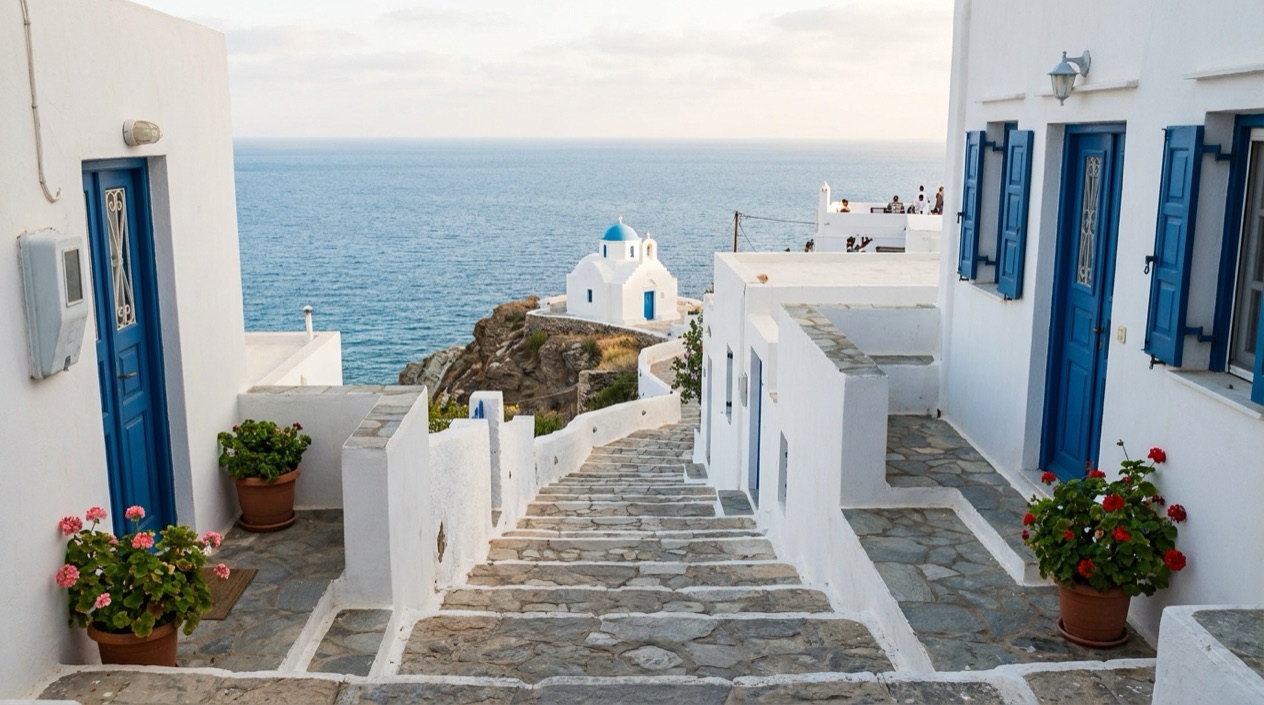
Corfu offers pastel baroque houses and churches. Ottoman-influenced buildings appear in Grevena and Kozani, towns that sit away from the tourist routes. And the famous whitewashed homes and blue-domed churches belong only to the Cyclades, where Paros has its Cycladic houses and Fira, the white capital of Santorini, stands at the edge of a high cliff.
Mainland cities and island towns
Mainland cities such as Athens and Thessaloniki are places of daily life first. People commute, shop at markets and sit in cafés, and the sights fit around that routine.
Island towns tend to revolve around the harbor and the water. In Chania, Corfu Town and Ermoupolis the port shapes the streets, the restaurants and the evening walk. Travelers often pair a town with beaches or villages on the same island, which makes the stay feel broader than a single city visit.
Seasons and crowds
Peak season runs from May through September, when approximately 75% of all tourists arrive, and the vast majority of visitors come between April and October. The island towns feel that rhythm most strongly, since their cafés, harbors and old streets are the places everyone heads for.
From November through February the off season can be rewarding, with mild temperatures, few tourists and reduced prices. City life carries on in places like Athens and Thessaloniki, and an old town without crowds is a different experience altogether.
How do you choose?
Choose by what you most want to do, then by the time of year. A traveler who wants ancient sites and big-city evenings points to Athens, one who wants food and street life to Thessaloniki, and one who wants a calm, handsome town to Nafplio, Corfu Town or Chania.
If you care about history and ruins
Athens gives you the Acropolis and the Parthenon in the middle of the city, and Heraklion gives you the road to Knossos. Nafplio puts you in the Peloponnese, where the old world and the Neoclassical town share the same region. Each ancient site charges its own entry fee, so a long list of visits is worth planning around.
Samos has the Tunnel of Eupalinos, a subterranean aqueduct that shows how much engineering lies behind the ancient world. It is a reminder that Greece’s past is not limited to the well-known sites.
If you care about food and atmosphere
Thessaloniki is the pick for bakeries, meze and long evenings out. Chania and Corfu Town add the harbor setting, with dinner by the water and coffee in an old square. Athens covers everything from a quick gyros to a long taverna meal, and its range is part of its appeal.
If you plan to be in Greece during the off season, a city is often the better base than an island, since city life carries on whatever the month. Mild temperatures and reduced prices make slow wandering pleasant between November and February.
If you care about nature and wildlife
Zakynthos is home to the National Marine Park, the primary nesting ground for loggerhead sea turtles in the Mediterranean. Zakynthos Town can serve as a base for travelers who want a harbor town combined with that natural setting.
Santorini’s Fira offers the cliff-edge views the island is known for. Paros adds whitewashed Cycladic homes in a gentler setting. For a trip that blends town and landscape, pairing a city with one island is a natural plan.
Good to know before you go
The warmest time of year starts in mid-July and generally lasts until mid-August, and the annual meltemi winds from the north cool Greece during that stretch. Most Greeks avoid heavy physical activity outdoors between 13:00 and 17:00 in those weeks because of the strong midday sun, so a sightseeing day often pauses for lunch. Each archaeological site and museum charges its own entry fee, and there are no longer any combo tickets.
| Fee | Who pays |
|---|---|
| Archaeological sites and museums with over 200,000 visitors | Each visitor, per site |
| Archaeological sites and museums with over 75,000 visitors | Each visitor, per site |
| Archaeological sites and museums with over 15,000 visitors | Each visitor, per site |
| Other archaeological sites and museums | Each visitor, per site |
| Reduced entrance fee | EU citizens over 65, teachers accompanying students |
Sources
- Wikivoyage, Greece, section See (https://en.wikivoyage.org/wiki/Greece#See), checked October 12, 2026
- Wikivoyage, Greece, section Understand (https://en.wikivoyage.org/wiki/Greece#Understand), checked October 12, 2026
To plan your stay
- Best Time to Visit Greece: September and Late May to Early June
- Arachova: Parnassus Mountain Town, Formaela Cheese, Ski Season and Saint George's Day
- American Airlines Flights to Greece: U.S. Cities, Athens Arrivals and Onward Island Flights
- Greece on a Budget: Cash Machines, Cards, Beaches and Ferries