
Somewhere in the middle of this trip you are sitting on the stone seats of an ancient theatre in the Peloponnese. Behind you lie the streets of Athens, ahead lie the sacred valley of Olympia and the slopes above Delphi.
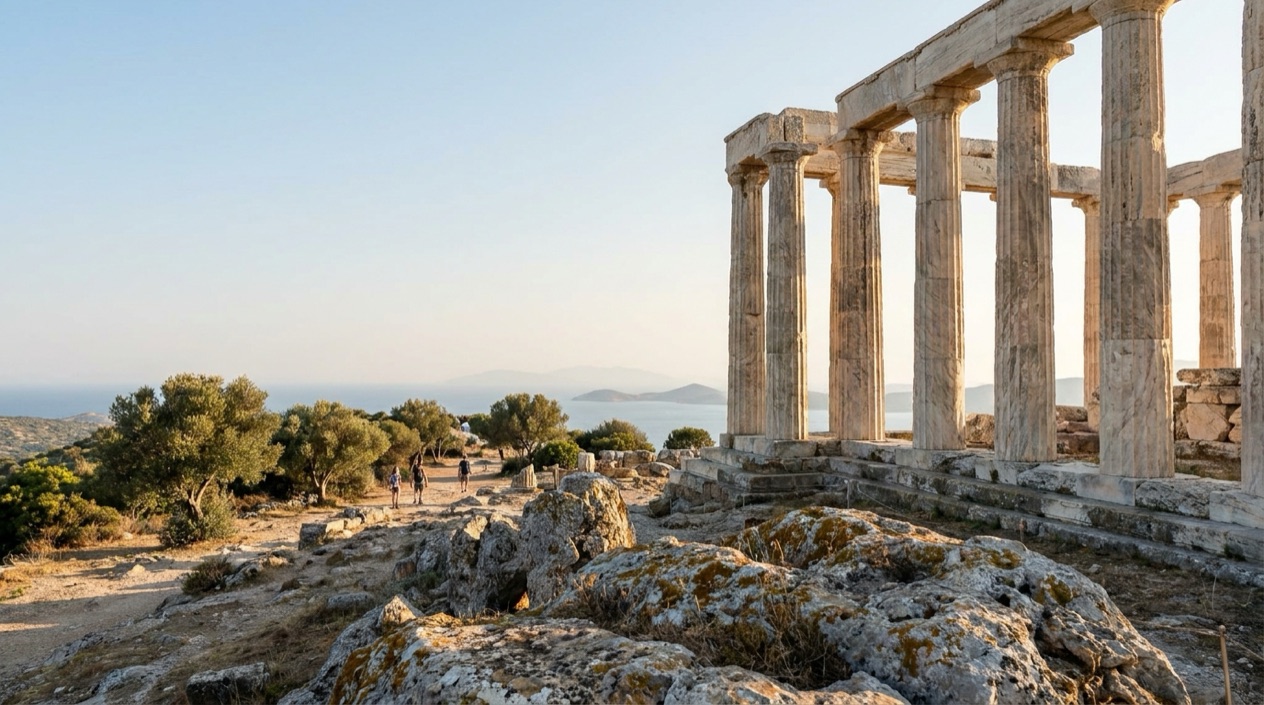
Is 10 Days enough for Greece?
Ten days is enough for the ancient Greece of the mainland, and it suits anyone who wants theatres, sanctuaries, citadels and a taverna table every night more than a week on a beach. The plan loops out of Athens through Corinth, Epidaurus and Mycenae, on to Olympia, up to Delphi, and back to the capital. It is a trip of stone, hillsides and long lunches.
The ancient world these places belonged to was never one country. Ancient Greece was a loose collection of culturally and linguistically related city-states and regions, centered on the northeastern part of the Mediterranean, and it lasted from the Greek Dark Ages to the end of classical antiquity. Traveling this route, you see that patchwork in person: each stop was its own world with its own gods, its own rivalries and its own reasons to be famous.
What the route leaves out is the islands. Crete, the largest Greek island by both area and population, sits at the southern edge of the Aegean, and Rhodes, Lesbos and Euboea are all large islands in their own right. Each deserves a trip of its own, with ferries from Piraeus and days built around the sea instead of ruins. Treat this mainland loop as the first chapter, and the islands as the next one.
The mainland route also gives you a good range of ancient personalities. Delphi was considered the navel of the Earth and housed the most important oracle of ancient Greece. Olympia is the birthplace of the Olympic Games. Epidaurus is a healing sanctuary with a famous theatre, and Mycenae is the citadel of a far older world. Few itineraries hold so many separate stories in so little space.
Pacing matters more than distance here. The days are built around one major site each, with a second smaller stop where the map allows, so nobody has to rush through a sanctuary to catch the next one. Nights are spent in small towns where dinner is the evening’s main event, and where the ruins and the hotels sit close enough that you can end the day on foot.
The itinerary stage by stage
Days 1 to 3: Athens
Start in the capital and give it three days, because it is the stage that sets the tone for the rest. The official tourism guide of the city points to the Plaka neighborhood as a top attraction, with picturesque streets, historic landmarks and lively shops, though it gets crowded. Use it for wandering, for a first plate of souvlaki or a spread of meze (small shared dishes), and for the feeling of being somewhere very old that still has a Saturday night.
Spend the days on the ancient sights that make Athens what it is: the Acropolis with the Parthenon, the ancient agora below it, and the museums that hold what came out of the ground. Move around by metro, which runs from early morning until just past midnight and stays open later on Friday and Saturday nights on lines 2 and 3. Sleep in or near Plaka, where you can walk home after a late taverna dinner.
Keep the third day looser. It is a good moment for a kafenio (a traditional coffee house) stop, a slow lunch, or a second look at a museum you only skimmed. The next stage begins with leaving the city by road, so pack the night before.
Day 4: Corinth and Epidaurus
Day four heads into the Peloponnese. Corinth has two faces. The modern city was rebuilt after the great earthquake of 1858, with parks, squares and a lively harbor, while the archaeological sites lie a little outside it.
Ancient Corinth was a city-state of the classical world, and its story ended in the Battle of Corinth in 146 BC. Walk the ruins for the sense of a rich trading port, then take a coffee in the modern town.
Epidaurus follows. The Ancient Theatre was built about 340 to 330 BC as part of the Sanctuary of Asklepios, and the sanctuary and theatre were inscribed as a UNESCO World Heritage Site in 1988.
, and wander the sanctuary grounds around it.
Spend the night in the Argolis region, in a small town or village where dinner is grilled meat, local cheese and vegetables from the plain. The next morning you are close to Mycenae.
Day 5: Mycenae
Mycenae lies about 75 miles from Athens and 7 miles north of Argos, which makes Argos a natural place to eat before or after. The citadel belongs to a world older than the theatres and temples of the days before, and it feels different: heavy stone, big gestures, a hilltop meant to be seen from far away. Walk up through the ruins and look out over the plain that its rulers once watched.
Give the afternoon to Argos or to the road toward Olympia. A town lunch of grilled lamb, lemon potatoes and a salad of tomatoes and cucumbers is the right counterweight to a morning among rocks. Sleep wherever the road leaves you, in a modest hotel on the plain or in a larger town on the way.
Days 6 and 7: Olympia
Olympia is a small town in Elis, in the western Peloponnese, in the valley of the Alfeiós River and around 11 miles from the Gulf of Kyparissia in the Ionian Sea. The ancient site is the birthplace of the Olympic Games, the top athletic event of antiquity. The town around it is built to serve visitors, with hotels, tavernas and a main street where you can eat well without going far.
Spend the first day among the ruins, walking the sanctuary grounds and imagining the athletes who arrived here from every corner of the Greek world. Keep the second day for the museums and for the valley itself, with a long lunch under a canopy of vines. The pace here is slower than in Athens, which suits a mid-trip pause.
Days 8 and 9: Delphi
Delphi is an ancient sacred precinct on the southwestern slope of Mount Parnassus in Phocis, central Greece, and it was a spiritual meeting place for the Greeks. Its oracle was the most important of ancient Greece, and the site was designated a UNESCO World Heritage Site in 1987. You climb through the ruins along the sacred way, with the mountain above you and the valley opening below.
The modern town lies very close to the site and spreads across two streets lined with traditional small houses, hotels and tavernas. You can sleep and eat within sight of the ruins, which gives the two days here a calm rhythm. Use the first for the archaeological site and the second for the town, the surrounding mountain, and a dinner of grilled meat, bean soup or a plate of fried cheese.
Day 10: Back to Athens
The last day is the road back to the capital. Plan it around your flight, not around a sight, and use any spare hours for a final stroll through Plaka or a last coffee near Syntagma. The Athens tramway returned to Syntagma on 19 November 2020, which gives you one more way to move around the center.
Getting between stops
| Leg | How | Stop |
|---|---|---|
| Athens to Corinth | By road | Archaeological sites a little outside the modern city |
| Corinth to Epidaurus | By road | Ancient theatre and sanctuary on the Argolid Peninsula |
| Epidaurus to Mycenae | By road | Citadel about 75 miles from Athens |
| Mycenae to Olympia | By road | Ancient site in the western Peloponnese |
| Olympia to Delphi | By road | Sacred precinct on Mount Parnassus |
| Delphi to Athens | By road | Capital and the end of the loop |
Every leg between the ancient sites is made by road, and the loop is built that way on purpose. The places on this route sit in countryside and small towns, away from the harbors, so a vehicle and a driver, or a bus, is how you link them. Within Athens, the metro, the tramway and the buses take over. On buses, remember that passengers cannot use the front door to get on or off.
Flights matter at the two ends of the trip, since you arrive and leave through the capital. The ferries only come into play if you add an island.
ANEK Lines operates passenger ferries mainly on the Piraeus to Crete and Adriatic routes, while Blue Star Ferries serves more than 20 destinations between the mainland and the Aegean Islands, and Golden Star Ferries runs from the mainland to the Cyclades. Those are options for a later trip, not part of this loop.
What to book before your 10 Days in Greece
Settle the lodging for the two Athens stays first, then the beds in the small towns at Olympia and Delphi, where the places to sleep are few and close to the sites. The sites themselves are what the days are built around, so check each one’s current admission before you set off.
Mycenae has a published fee, shown at the end of the page. Leave Day 3 and Day 9 loose so the trip has room to breathe.
Adapting the route
Delphi and Mycenae are comfortable, but the seasons change how it feels, and Athens is the place where the numbers show it. The table gives the capital’s own figures for four months. Away from the capital, the hill sites at Delphi and Mycenae are open to whatever the weather brings, so the table is a guide to the mood, not a forecast for every stop.
| Athens | Average high (°F) | Average low (°F) | Precipitation (in) | Days with rain |
|---|---|---|---|---|
| January | 56.3 | 44.4 | 2.17 | 7.5 |
| April | 68.4 | 53.2 | 1.10 | 5.5 |
| July | 91.8 | 74.1 | 0.28 | 1.6 |
| October | 75.2 | 61.0 | 1.09 | 3.9 |
Spring and autumn
April and October are the months where this route makes the most sense. Highs sit in the upper 60s in April and the mid-70s in October, and rain days are few enough that you can plan outdoor sites without worry.
In October you are also past the summer heat, and the days of walking up through Delphi or across the citadel at Mycenae are comfortable. In April you may meet a few showers, so a light rain jacket earns its place in the bag.
Summer and winter
July is the month to plan carefully. The average high in Athens is in the low 90s, with very little rain, so sun protection, a hat and plenty of water are part of every day. Put the open-air sites at the start of your outings and keep a shaded lunch for the middle. Those who dislike heat will find the loop easier in spring or fall.
January brings highs in the mid-50s and more rain days, so pack warm layers and a rain jacket. The ancient sites keep their character in cold weather, and the tavernas feel cozier. Allow more slack in the plan, since a wet day may change what you want to do outdoors.
Shorter, longer, slower
With fewer days, drop Corinth and keep Epidaurus and Mycenae together on one day, then choose either Olympia or Delphi for the far stage. With more days, add a second night at Epidaurus or at Argos, or spend the extra time on an island, since the mainland loop lets you finish in Piraeus and start a ferry journey from there.
For a slower trip, stay two nights in each stage instead of moving every day. The route already gives two days each to Olympia and Delphi, and the same rhythm can apply to the Argolis stage.
Good to know before you go
Pay for meals and small purchases in euros, and carry a few coins for the small towns at Olympia and Delphi. Mycenae lists its own fees by season and category of visitor, shown here for the months from April to October. In some of the same months, non-EU children under 6, EU residents under 26 and people with disability enter the site free.
| Fee | Amount | Who pays |
|---|---|---|
| Mycenae archaeological site, April to October | €12 | Adult |
| Mycenae archaeological site, April to October | €6 | EU seniors and non-EU visitors aged 6 to 25 |
Sources
- Wikipedia, Ancient Greece (https://en.wikipedia.org/wiki/Ancient_Greece), checked October 12, 2026
- Wikipedia, ANEK Lines (https://en.wikipedia.org/wiki/ANEK_Lines), checked October 12, 2026
- Wikipedia, Blue Star Ferries (https://en.wikipedia.org/wiki/Blue_Star_Ferries), checked October 12, 2026
- Wikipedia, Fast Ferries (https://en.wikipedia.org/wiki/Fast_Ferries), checked October 12, 2026
- Wikipedia, Golden Star Ferries (https://en.wikipedia.org/wiki/Golden_Star_Ferries), checked October 12, 2026
- Wikipedia, Greek islands (https://en.wikipedia.org/wiki/Greek_islands), checked October 12, 2026
- OASA, Athens urban transport (https://www.oasa.gr/en/), checked October 12, 2026
- Athens Transport, public transport guide (https://www.athenstransport.com/english/), checked October 12, 2026
- This is Athens, the official Athens tourism site (https://www.thisisathens.org/), checked October 12, 2026
- Visit Greece (GNTO), Delphi (https://www.visitgreece.gr/mainland/central-greece/delphi/), checked October 12, 2026
- Wikipedia, Delphi (https://en.wikipedia.org/wiki/Delphi), checked October 12, 2026
- Wikivoyage, Delphi (https://en.wikivoyage.org/wiki/Delphi), checked October 12, 2026
- Visit Greece (GNTO), Olympia (https://www.visitgreece.gr/mainland/peloponnese/olympia/), checked October 12, 2026
- Wikipedia, Olympia, Greece (https://en.wikipedia.org/wiki/Olympia,_Greece), checked October 12, 2026
- Wikivoyage, Olympia (https://en.wikivoyage.org/wiki/Olympia), checked October 12, 2026
- Wikipedia, Mycenae (https://en.wikipedia.org/wiki/Mycenae), checked October 12, 2026
- Wikivoyage, Mycenae (https://en.wikivoyage.org/wiki/Mycenae), checked October 12, 2026
- Visit Greece (GNTO), Epidaurus (https://www.visitgreece.gr/mainland/peloponnese/epidaurus/), checked October 12, 2026
- Wikipedia, Epidaurus (https://en.wikipedia.org/wiki/Epidaurus), checked October 12, 2026
- Wikivoyage, Epidaurus (https://en.wikivoyage.org/wiki/Epidaurus), checked October 12, 2026
- Visit Greece (GNTO), Corinth (https://www.visitgreece.gr/mainland/peloponnese/korinthos/), checked October 12, 2026
- Wikipedia, Corinth (https://en.wikipedia.org/wiki/Corinth), checked October 12, 2026
- Wikivoyage, Corinth (https://en.wikivoyage.org/wiki/Corinth), checked October 12, 2026
- Hellenic National Meteorological Service (HNMS), climatological normals 1991-2020 for Elliniko station (https://www.emy.gr/climatic-data), monthly mean daily maximum and minimum; rain from the ECMWF ERA5 reanalysis, 1991-2020, grid cell of Athens (Open-Meteo), checked October 12, 2026
- ECMWF ERA5 reanalysis 1991-2020, grid cell of Athens (Open-Meteo), checked October 12, 2026
- Plan de the (duree choisie by the redaction)
To plan your stay
- Best Time to Visit Greece: September and Late May to Early June
- Arachova: Parnassus Mountain Town, Formaela Cheese, Ski Season and Saint George's Day
- American Airlines Flights to Greece: U.S. Cities, Athens Arrivals and Onward Island Flights
- Greece on a Budget: Cash Machines, Cards, Beaches and Ferries