
Stand in the theater at Epidaurus, clap once on the stage, and the sound carries to the highest row of stone seats. Around you the hillside is full of pine and cicada noise, and the ruins feel like places people once argued, prayed and watched plays. Greece spreads these sites across Athens, the Peloponnese, Crete, the islands and the northern mountains, so a trip becomes a choice of which strands of the ancient world to follow.
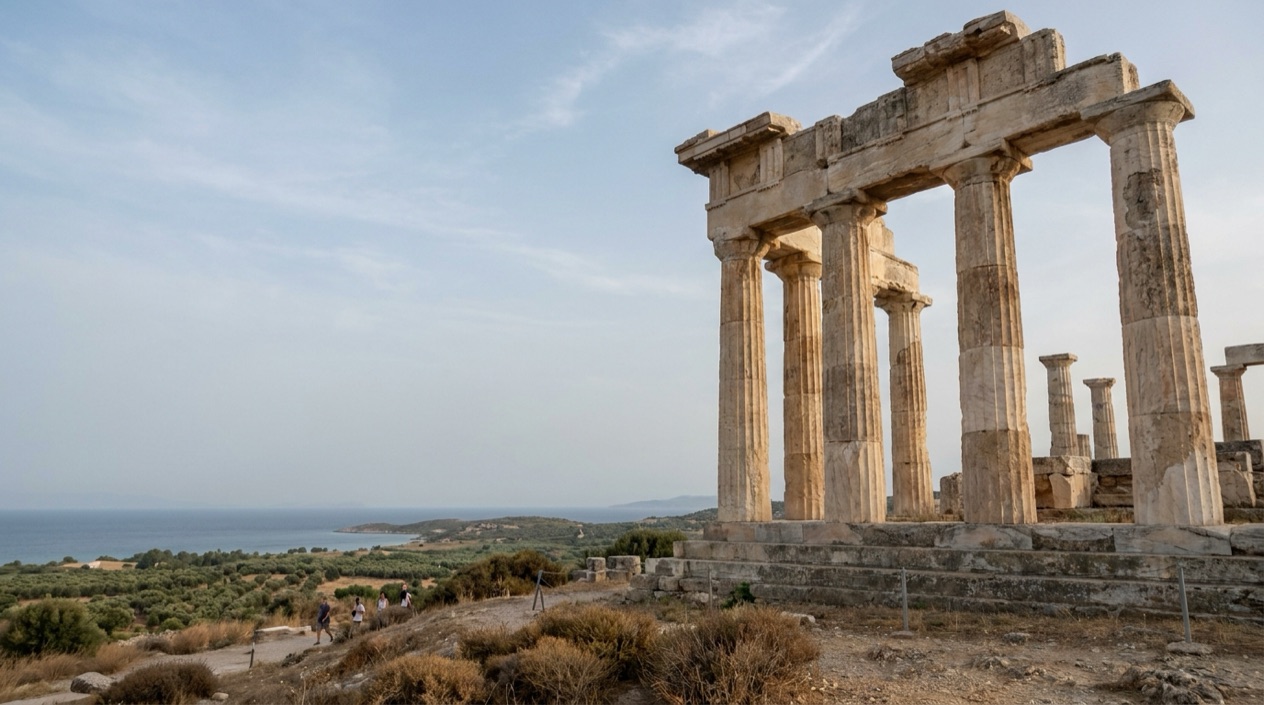
Which ancient sites should you visit in Greece?
The ones that match what draws you: temples and the Classical city in Athens, theaters and sanctuaries in the Peloponnese, palaces on Crete, walled towns on the islands, or Roman and early Christian ruins in the north. Ancient Greece was never one tidy kingdom.
It was a loose collection of related city-states and regions, centered on the northeastern Mediterranean, and most of that world was unified only once before Rome, under Macedon. That patchwork is why the remains lie scattered, and why the country has 21 properties on the World Heritage List.
Each place gives you something different to look at. Some are single temples on a ridge, some are whole sanctuaries with treasuries and running tracks, and some are medieval towns built on far older foundations. Picking two or three regions and seeing them properly works better than touching every famous name.
Athens and the Peloponnese
Athens is where most trips begin. The Acropolis rises over the modern city, and its buildings include the Parthenon, the Erechtheion, the Propylaia and the Temple of Athena Nike, all from the 5th century BCE. You walk up through the gateway and the marble underfoot, then stand among temples that you have seen in photographs your whole life.
In the Peloponnese the ruins sit in green hills. The theater at Epidaurus dates to the 4th century BC and is still shaped like a perfect bowl of stone seats. Olympia, the sanctuary where the original games were held, has the stadium, the training grounds and the toppled drums of columns lying in the grass.
Mycenae, behind its Lion Gate, offers a rougher, older fortress feel. Deep in the mountains of Arcadia stands the Temple of Apollo Epicurius at Bassae, built in the 5th century BCE and the first site in Greece inscribed on the World Heritage List, in 1986.
Delphi and Crete
Delphi was the sanctuary of Apollo, where visitors once came to consult the oracle. Today you climb a winding sacred way past the foundations of treasuries to the temple terrace, with a theater and a stadium higher up the slope. It is a site you read through its layout, one step at a time, and the mountain setting is part of the story.
On Crete, Knossos is the palace of the Minoans, and it looks unlike anything on the mainland. Reconstructed red columns, painted walls and a maze of rooms and storerooms give you a vivid sense of a Bronze Age court, though much of what you see is a modern interpretation. The Heraklion archaeological museum holds the finds that came out of such palaces.
Island towns and sanctuaries
Some island sites are whole living towns. The Medieval City of Rhodes is surrounded by a wall of 2.5 miles built by the Knights Hospitaller, and you walk its cobbled lanes between knightly inns and old mosques. The Old Town of Corfu has roots going back to the 8th century BCE, though its buildings are mostly Venetian and 19th century, so it reads as layers rather than a single age.
On Patmos, the Monastery of Saint John the Theologian was founded in the late 10th century and has been a pilgrimage place ever since. On Samos, the Tunnel of Eupalinos is an underground aqueduct from the 6th century BC, a piece of ancient engineering you enter rather than look at from outside. Each island offers one or two ancient or medieval anchors, and a day built around one of them gives the island its shape.
Northern Greece and the mountains
Philippi was founded in 356 BCE by Philip II of Macedon and later became an early center of Christianity, so the ruins carry both Greek and early church traces. Nearby you are in Macedonian country, where the stories of Alexander’s family belong.
Meteora in Thessaly is a different kind of heritage. Twenty-four Orthodox monasteries stand on the rock formation, many of them built on almost inaccessible peaks in the 15th century. Mount Olympus, home of the Twelve Olympians in ancient Greek religion, is also on the World Heritage List, one of three mixed sites with Meteora and Mount Athos. Here the landscape itself is the monument.
Which are best known?
The Acropolis of Athens is the best known, and the Parthenon, a temple of Athena, is famously the textbook example of the Classical style. Almost every ancient-Greece trip starts there, and the rest of the country tends to be measured against what you see on that rock.
The Acropolis and the Parthenon
The Parthenon is the largest presence on the hill, but the Acropolis is a group of buildings, not a single one. The Propylaia is the monumental gateway you pass through, the Temple of Athena Nike perches at the edge, and the Erechtheion is the one with the porch of sculpted female figures. Walking between them, you notice how the temples were placed to be seen from the city below.
The city itself spreads out beneath you from the walls. Rooftops, hills and apartment blocks run to the horizon, a reminder that Athens has been continuously lived in. The site suits anyone who wants the most recognizable image of ancient Greece in person, and it pairs naturally with the museums dedicated to what was found here.
Epidaurus and its theater
The ancient Theatre of Epidaurus dates to the 4th century BC and is the one many people have in mind when they picture a Greek theater. The seats curve up in even rows, and the stage below looks small against the hillside. It is a place to sit and look rather than hurry through.
Walk to the top row, then back down to the circle in the center, and you understand why the place is remembered for its acoustics. Around the theater, the surrounding sanctuary has the remains of buildings that belonged to the healing cult of the site, with scattered stones and foundations under trees.
The Antikythera mechanism
Not every well-known piece of ancient Greece is a ruin. The Antikythera mechanism, a device for calculating the movements of planets dating from about 80 BC, was found in an ancient shipwreck off the island of Antikythera, between Kythera and Crete. The original is displayed in the Bronze collection of the National Archaeological Museum of Athens, with a replica beside it.
Seeing it, you find a corroded lump of bronze with the faint traces of gears. The museum gives it a place among statues and weapons, which makes the point that the ancient world was also one of clever machines.
Olympia, Delphi and Mount Olympus
Olympia and Delphi are the two sanctuaries most people add after Athens. Olympia is the home of the ancient games, with a stadium and a training ground you can walk across. Delphi is the oracle of Apollo, laid out up a steep slope. Both are known more for atmosphere than for intact buildings.
Mount Olympus belongs to the same story. In ancient Greek religion it was the home of the Twelve Olympians, and today it is a mountain you see from the plain or a place to approach through its trails and villages. Together these names give a map of the gods, the games and the stories.
How do you plan?
Plan by region and by theme, not by checklist. Ancient Greece covered a wide area, from the Dark Ages through the Classical period to the end of antiquity, so the sites you choose define which chapter you step into. A single base in Athens covers the Classical city, while the Peloponnese, Crete and the islands each deserve their own stretch of the trip.
Choose a theme
If the Classical period is your interest, build around Athens, Epidaurus and Bassae, the temples and the theater. If you prefer religion and myth, Delphi, Olympia and Mount Olympus fit together. For palaces and older worlds, add Mycenae on the mainland and Knossos on Crete.
For layered towns, Rhodes and Corfu are good fits. For monasteries and pilgrimage, look to Patmos and Meteora. A museum visit helps: the National Archaeological Museum in Athens holds the Bronze collection and the Antikythera mechanism, and gives context for what you later see in the field.
Pair sites with the landscape
Many sites are in the countryside, so pairing them with a village lunch or a stretch of coast makes the day more than a ruin visit. Around Epidaurus and Mycenae, olive groves and orange trees line the roads.
On Samos, the tunnel connects to a hillside village. On Zakynthos, the National Marine Park is the primary nesting ground for loggerhead sea turtles in the Mediterranean, an example of how nature and history can share an island.
On Santorini, the whitewashed capital, Fira, stands on the edge of a high cliff, and the island’s setting is as much a draw as its ruins. Think of each destination as a place where the ancient story sits inside a landscape, and let that landscape decide the rest of the day: a meal of grilled fish, a swim, a walk.
Fit the pieces together
A sensible route moves from Athens into the Peloponnese, then to Delphi, with Crete or an island as a separate chapter. The northern sites of Philippi, Meteora and Olympus form their own loop. Keep a few spare hours around the bigger sites, because they reward wandering past the main path.
Sturdy shoes matter on marble and loose stone. A water bottle and sun protection are sensible for open hillsides with little shade. Beyond that, let each place set the pace: some invite a long stay, others a quiet look and a coffee afterward in a village kafenio, the traditional neighborhood coffeehouse.
Good to know before you go
Entrance fees are paid in euros, and the amount depends on how many visitors a site or museum receives. There are no longer any combination tickets, so each site charges its own entry fee. Fees are halved for EU citizens over 65 and for teachers accompanying students.
| Fee | Who pays |
|---|---|
| Sites and museums with over 200,000 visitors | Each visitor |
| Sites and museums with over 75,000 visitors | Each visitor |
| Sites and museums with over 15,000 visitors | Each visitor |
| Other archaeological sites and museums | Each visitor |
| Reduced entry | EU citizens over 65, teachers accompanying students |
Sources
- Wikipedia, Ancient Greece (https://en.wikipedia.org/wiki/Ancient_Greece), checked October 12, 2026
- Wikipedia, List of World Heritage Sites in Greece (https://en.wikipedia.org/wiki/List_of_World_Heritage_Sites_in_Greece), checked October 12, 2026
- Wikivoyage, Greece, section See (https://en.wikivoyage.org/wiki/Greece#See), checked October 12, 2026
To plan your stay
- Best Time to Visit Greece: September and Late May to Early June
- Arachova: Parnassus Mountain Town, Formaela Cheese, Ski Season and Saint George's Day
- American Airlines Flights to Greece: U.S. Cities, Athens Arrivals and Onward Island Flights
- Greece on a Budget: Cash Machines, Cards, Beaches and Ferries