
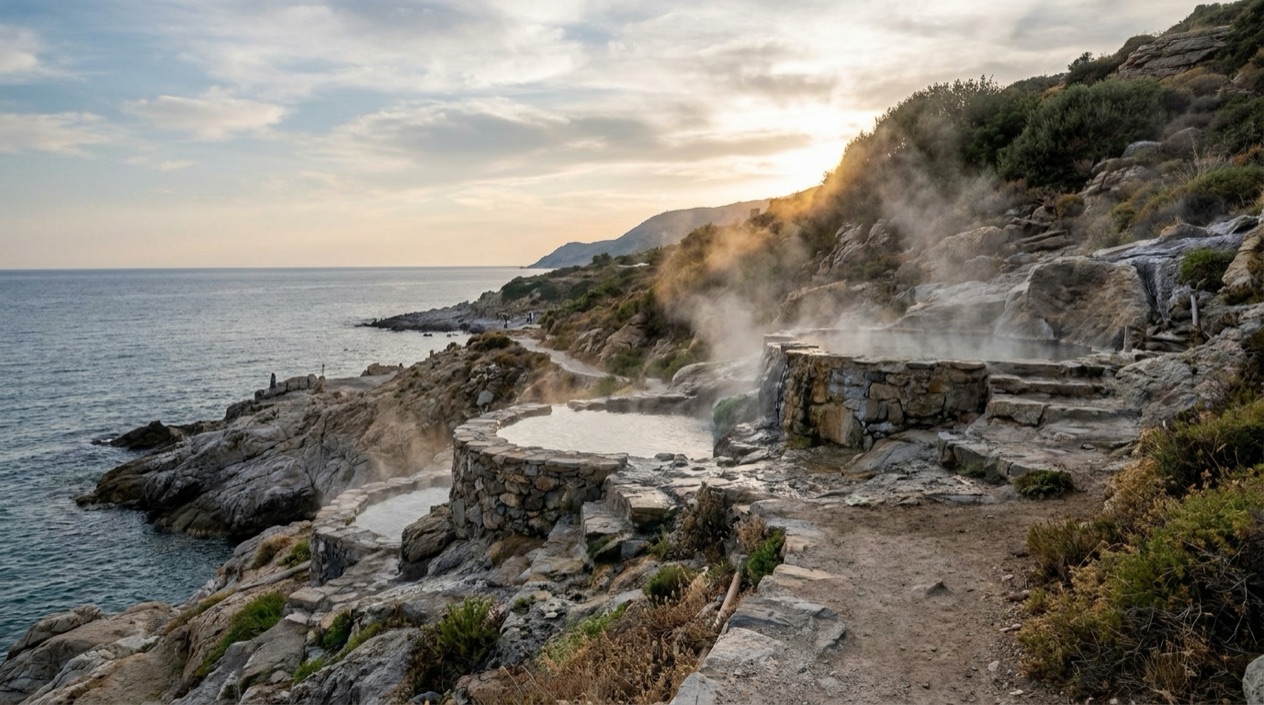
Steam, mineral water and the smell of pine drift together on Ikaria, an island where a soak in a spring is part of a slow, unhurried day. The mountains rise steeply behind the harbor town, and the streams run down green slopes toward the sea. A visit to the hot springs here is less a single stop than a way of settling into the island’s rhythm.
Is visiting Ikaria hot springs worth it?
Yes, if you like trips built around restoring yourself rather than ticking off monuments, and if you are happy to spend time on an island that moves at its own pace. The springs fit naturally into Ikaria’s reputation as one of the world’s five Blue Zones, places where people reach extraordinary ages. The island is said to have the highest share of residents in their 90s anywhere, and a warm mineral bath sits comfortably beside the long lunches, the mountain walks and the dancing that people link with that long life.
What sets Ikaria apart from other Aegean islands is that it is not built around a single beach resort scene. The landscape is made of sandy beaches, flowing streams, mountains and verdant slopes, so a day by the springs can be followed by a village festival or a walk under trees instead of another hour on a sunbed.
Ikaria also lies between Mykonos and Samos, yet it feels like a different world from the party islands on either side. If you want a spa-like pause inside a wider island trip, this is a place that rewards it.
For travelers who prefer a fixed program, the springs alone may feel modest. For those who enjoy wandering, eating local food and meeting the island in its villages, they are one thread of something larger.
What to see at Ikaria hot springs
Therma and the mineral waters
The spa settlement of Therma is the name most closely tied to Ikaria’s hot springs, and the word itself is Greek for warm baths. The place has long drawn people who come to ease sore joints and tired bodies, and the old bathing tradition gives the village a mild, restful character that suits the whole island.
What you notice first is the contrast between the clean mountain air and the faint mineral scent of the water. Look for the bathing houses and the pools where visitors gather, and for the way locals treat the waters as an ordinary part of the week rather than a show. Opening arrangements and any rules for bathing are not something to assume, so read the signs on the spot.
Agios Kirykos, the island’s main port
Agios Kirykos is the principal town, the main port and the seat of the municipality. It is where many visits begin, with cafés facing the harbor, small shops and the everyday business of an island capital. Sitting here with a coffee or a glass of ouzo, with the boats coming and going, is a good way to arrive before heading to the springs.
The town gives you a first sense of Ikaria as a working place rather than a resort. Listen for the mix of voices at the harbor tables, and notice how conversation seems to stretch out, which is part of what the Blue Zone reputation is about.
The Raches region and its villages
The Raches region and its villages are the part of Ikaria that is most popular among visitors, for its traditional settlements and cultural events. Stone houses, narrow lanes and village squares set the scene, and it is here that the island’s social life is easiest to see.
Raches pairs well with a spring visit because it shows the other side of the island’s wellbeing, the shared table and the music. Look for the village cafés and the squares where events gather. A day of bathing followed by an evening among the villages gives a fuller picture of why people speak of Ikaria with such affection.
The Aitheras mountains, streams and the Drakanon tower
The Aitheras mountain range crosses Ikaria from east to west, and its highest summit reaches 3,402 feet. These mountains feed the streams and keep the slopes green, which is why the island looks so wooded compared with many of its neighbors. The springs belong to this landscape, and seeing the ridge from the road gives context to the water that warms beneath it.
History is present too. The Drakanon tower, part of a phryctoria, an ancient system of fire-signal and semaphore towers, dates to the Hellenistic period, in the 4th century BC. Legend adds its own layer, since Icarus is said to have fallen near the island after flying too close to the sun, which is how Ikaria got its name.
How to get to Ikaria hot springs
You reach the springs by first reaching Ikaria, an island in the North Aegean and one of the East Aegean Islands, west of Samos and south of Chios. It lies between Mykonos and Samos, and about 10 nautical miles southwest of Samos, so Samos is the nearest island neighbor in the Aegean.
By sea, the principal arrival point is Agios Kirykos, the main port and the capital of the island. This is where the island’s harbor life is concentrated, and it is the natural place to orient yourself on arrival, find a café and plan the rest of your stay.
By air, Ikaria has an airport, built in the 1990s. Crossing times, schedules, operators and fares are not something to guess, so look them up for your own dates once you decide how you want to arrive.
Once on the island, the springs sit within a landscape of mountains and slopes, with villages scattered along it. Getting between the port, the spa settlement and the villages of the Raches region is part of the experience of a larger island trip. Fitting the springs into a stay of several days, instead of a single stop, gives you room to see the island’s wider character.
When to visit Ikaria hot springs
There is no single moment that decides the visit, but the island’s festivals are the best reason to choose your dates with care. Ikaria is known for its panigyria, traditional festivals with dances, music and local food and drink, and they are among the largest in the Aegean islands. Timing a soak in the springs around one of these gatherings turns a quiet wellness stop into a full cultural experience.
The panigyria tend to center on village squares, with long tables, live music and dancing that goes on for hours. If your trip includes one, the contrast with the calm of the springs is striking, and many travelers find the two make a natural pair. The Raches region in particular is known for cultural events.
Because nothing here fixes opening hours, a best hour for the water or a season for the springs, the sensible approach is to plan around what you want from Ikaria in general. If you are drawn to festivals, plan for the festival dates. If you prefer walking in the Aitheras mountains and along the streams, plan for the weather you like best for hiking. The springs then become a welcome pause in either trip.
The surrounding scenery also changes the feel of a visit. Green slopes and flowing streams give the island a fresh look, and a stay that leaves room for both bathing and wandering will feel more complete than a rushed one.
Tips for your visit
Bring a swimsuit and a towel if you plan to bathe, and something to change into afterward, since the point of a spring visit is to leave relaxed rather than hurried. Comfortable shoes will serve you in the villages, where lanes are narrow, and on any walk into the hills.
Leave generous time. The island suits a slow schedule, and the best moments tend to come between plans, over a coffee in Agios Kirykos or a long meal in a village square. Pair the springs with a visit to the Raches villages, a look at the Aitheras mountains and, if the dates line up, a panigyri.
Food belongs in the plan. Ikaria’s Blue Zone fame is tied to how people eat and live, so look for local products on village tables, from vegetables and greens to cheese, bread, honey and local wine. Sitting down for an unrushed meal is as much a part of the island as the water.
For families and for anyone with limited mobility, details about access to the pools, paths and buildings are best confirmed locally, since nothing here says how each spot is reached. The same goes for parking, guides and any restriction on bathing. Treat the first conversation with your hotel or a local café owner as a useful step.
Good to know before you go
Ikaria is a Greek island, so the euro is the currency, and a small supply of cash alongside a card is a sensible habit in village settings. The island has a small year-round community of 8,843 residents at the last count, so services are those of a quiet place rather than a resort.
Greece sees strong summer winds on many Aegean islands, and a hot day or a windy crossing can affect plans, so keep your schedule flexible. A relaxed approach is, after all, what the island seems to teach.
Sources
- Wikipedia, Ikaria (https://en.wikipedia.org/wiki/Ikaria), checked October 12, 2026
- Visit Greece (GNTO), Ikaria (https://www.visitgreece.gr/islands/north-aegean-islands/ikaria/), checked October 12, 2026
- Wikivoyage, Ikaria (https://en.wikivoyage.org/wiki/Ikaria), checked October 12, 2026
To plan your stay
- Best Time to Visit Greece: September and Late May to Early June
- Arachova: Parnassus Mountain Town, Formaela Cheese, Ski Season and Saint George's Day
- American Airlines Flights to Greece: U.S. Cities, Athens Arrivals and Onward Island Flights
- Greece on a Budget: Cash Machines, Cards, Beaches and Ferries