
The road down the Mani Peninsula bends between stone villages and the open water of the Laconian Gulf, then drops toward Dirou Bay, where the land hides a second world under it. At the Diros Caves, the visit moves from daylight into passages of rock, water and formations that took ages to grow. It is a trip for travelers driving through Mani who want a landscape that is underground rather than on the horizon.
Is visiting the Diros Caves worth it?
Yes, if you like places where the scenery is the rock itself and the story reaches back before written history. The caves suit travelers who are already exploring Mani by car and want one stop that is nothing like the stone towers and hill villages around it.
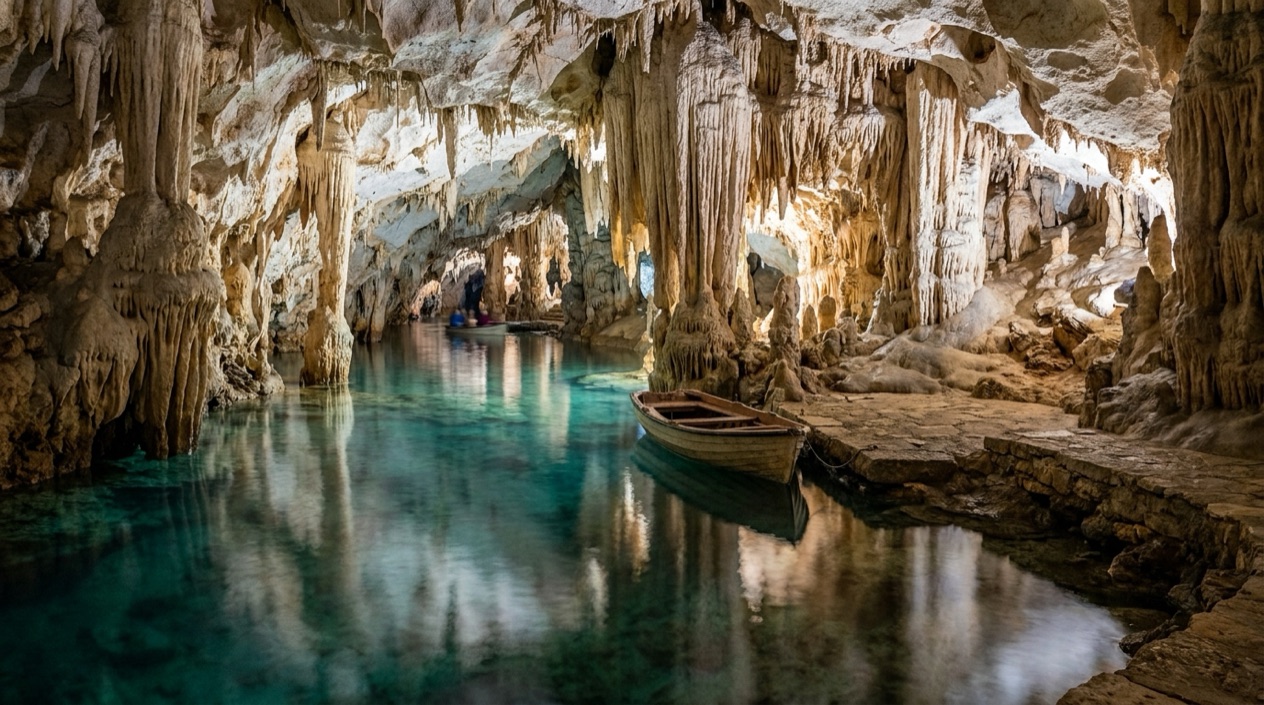
What sets the Diros Caves apart is how much of the system has been opened up. About 16,000 feet of passages are exposed and reachable by small boats and through narrow passageways, so the visit is partly a journey over underground water and partly a walk among stone. Many caves in Greece are a single chamber. Here you move through a network, and the way you travel through it is part of the experience.
There is also the human side. Archaeological research has shown that the caves served as places of worship in Paleolithic and Neolithic times, and people in ancient times believed they were the entrance to the underworld.
You do not need to know any of that to enjoy the formations, but it changes how the dark water and the hanging stone feel once you are inside. People once stood here and thought they were near the edge of the living world.
The Mani Peninsula is a place of long, winding drives and unhurried stops, and the caves fit well into a day spent moving along its roads. If you are looking for a beach day or a hike, this is a different kind of outing, and a good one to set against them.
What to see at the Diros Caves
The Diros Caves lie on the shores of Dirou Bay, about 12 miles south of Pollapolis, between the Tower and Areopoli. The visit is built from water, passages and stone, and each of these gives you something different to look at.
The boat passages and narrow corridors
The caves are reached by small boats and through narrow passageways, which means the first thing you notice is how close the rock is. The boats slide through channels of dark water where the ceiling and walls press near, and the guiding eye goes from the surface of the water to the stone overhead.
Look at how the passages change shape as you go. Some stretches feel like corridors, others open into larger chambers where sound carries differently. The mix of travel by water and on foot gives the visit a rhythm that a single walkway could not, and it is the reason people who have been to other caves still remember this one.
Stalactites and stalagmites
One part of the Diros Caves is surrounded by formations of stalagmites and stalactites, the columns that rise from the floor and the spikes that hang from the ceiling.
Take time to look at the colors and textures rather than the shapes alone. Stone that has been touched by water for ages carries bands of tone, ridges and curtains, and the sense of slow growth is the real subject. Once you have seen the formations from the boat, you start to notice smaller ones along the walls.
Alepotrypa, Glyfada and Katafygi
Near Pyrgos Dirou and on the shores of Dirou Bay are three caves: Alepotrypa, Glyfada (also called Vlychada), and Katafygi. The names appear on maps and in conversation, and it helps to know that they belong to the same stretch of coast and the same story of water working through limestone.
Each name carries its own associations. Alepotrypa, whose name means fox hole in Greek, is tied to the archaeological findings about early worship. Glyfada is the name you will often see on signs and in descriptions of the boat journey. Katafygi means refuge, a word that fits a cave that sheltered people through the long past of Mani.
The cave as entrance to the underworld
Archaeological research has shown that the caves were places of worship in Paleolithic and Neolithic times, and ancient inhabitants believed they led to the underworld. Standing near dark water under a low roof, it is easy to see how the belief took hold. The echo of a voice, the cool stillness and the sense of depth all suggest a threshold.
This is the layer of the visit that goes beyond scenery. You are in a place where people gathered, performed rituals and imagined the dead passing below the ground. Holding that thought while the boat glides through the dark makes the quiet between guide commentary feel full rather than empty.
The tower of Pyrgos Dirou
In the village, the 1832 complex of the armatolos Sklavounakos in Petrovouni features a six-storey tower, possibly the tallest in Mani. An armatolos was a local armed leader, and the tower tells you about the Mani of fortified families and stone houses built to be seen from far away.
Pyrgos Dirou is a small community, with a population of 542 at the last census, and the old school of the village has been designated a historic preserved monument. Together with the tower, these give you a reason to look at the village itself rather than only drive through it on the way to the water.
When to visit the Diros Caves
The caves themselves are underground, so the time of year shapes the journey to them more than the visit inside.
Think of the day in two parts. The first is the road, which winds with coastal stretches from Kalamata through Kampos, Kardamyli and Stoupa toward Oitylo. The second is the cave, where the stone and the water set the scene. A day with clear weather rewards the drive, and the cave offers a different kind of experience whatever is happening overhead.
Mani is a sparsely populated place with narrow, winding roads, and distances take longer than expected. That is a good reason to treat the caves as one stop within a larger day rather than the only thing planned. Leave room on either side for the villages, for a meal and for the road itself, which is part of why people come.
The caves are a place to visit when you are in the area rather than a reason to build a whole season around. If your trip takes you along the peninsula, whatever the month, the Diros Caves belong on the list. Travelers who combine them with the stone settlements of Inner Mani, such as Areopoli, tend to come away with the fullest picture of the region.
There are no special dates tied to the caves in what we know, so the choice is yours. Pick the stretch of the year when you want to be on the Mani roads, and let the underground visit be the counterpoint to a day spent in the open air, among towers, lanes and the gulf.
Tips for your visit
A car is the easiest and most practical way to explore the Mani Peninsula, and it is strongly recommended since public transport is limited. From Kalamata the road reaches Oitylo via Kampos, Kardamyli and Stoupa, and from Oitylo a cross-peninsular road runs northeast to Gytheio. Plan the day around the car, and give the winding roads the time they ask for.
If you do not drive, KTEL buses connect Kalamata and Sparta with Areopoli several times per day, and day return trips are usually possible. Areopoli sits about 16 miles from Pyrgos Dirou, so the bus gets you to the region rather than to the caves directly.
Combining the caves with Areopoli and the villages
Areopoli is one of the villages of Mani best explored on foot, along narrow lanes and old mule paths, and it pairs naturally with the caves in the same outing. Wandering its stone streets gives you the above-ground counterpart to the underground visit, and the contrast is part of the pleasure.
From Oitylo the road continues south toward Cape Matapan via Areopoli, Gerolimenas and Vatheia, then loops back north to Gytheio along the east coast via Kokkala, Kotronas and Skoutari. That loop gives you a way to extend the day if you want to see more of the peninsula after the caves.
Walkers and the E4 path
Walkers will be interested to know that the Peloponnese section of the E4 European long-distance path runs via Sparta and Kastania to Gytheio in northeast Mani, and then continues by ferry to Crete. It passes through the region rather than the caves, but it shows how much of Mani is made for travel on foot.
For families and for anyone with limited mobility, the main thing to keep in mind is how the caves are reached: by small boats and through narrow passageways. Think about what that means for you and the people you are traveling with, and let it guide how you shape the day around it.
Good to know before you go
Greece uses the euro, and the villages of Mani are small, so it is sensible to arrive with a plan for meals and fuel along the winding roads before you reach the quieter stretches. Pyrgos Dirou is a community of modest size, and the surrounding peninsula is sparsely populated.
Allow the drive its full length, since the narrow, winding roads make distances stretch. The reward is a day that moves from coast to village to underground water, with the tower of Pyrgos Dirou and the three caves of Dirou Bay as its anchors.
Sources
- Wikipedia, Pyrgos Dirou (https://en.wikipedia.org/wiki/Pyrgos_Dirou), checked October 12, 2026
- Wikipedia, Mani Peninsula (https://en.wikipedia.org/wiki/Mani_Peninsula), checked October 12, 2026
- Wikivoyage, Mani Peninsula (https://en.wikivoyage.org/wiki/Mani_Peninsula), checked October 12, 2026
To plan your stay
- Best Time to Visit Greece: September and Late May to Early June
- Arachova: Parnassus Mountain Town, Formaela Cheese, Ski Season and Saint George's Day
- American Airlines Flights to Greece: U.S. Cities, Athens Arrivals and Onward Island Flights
- Greece on a Budget: Cash Machines, Cards, Beaches and Ferries