
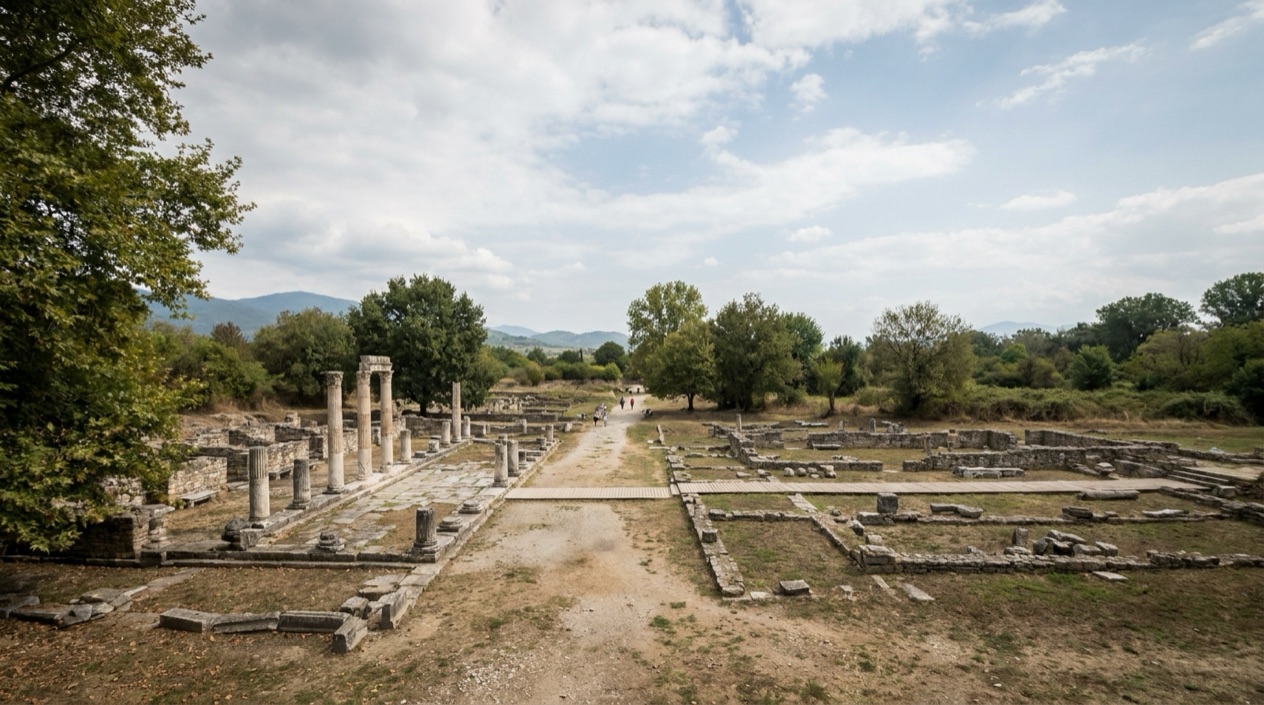
Dion sits at the foot of Mount Olympus, and on a clear day the mountain fills the sky behind the ruins like a stage set for the gods. Stones of a sacred city lie scattered among trees and grass, and the village that shares the site is quiet around them. A visit here is a slow wander through a place the ancient Macedonians held holy, followed by a museum that holds some of the most unusual objects found in northern Greece.
Is visiting Dion worth it?
Yes, if you like ancient places best when they still carry a story, and if the idea of standing in front of the mountain of the gods appeals to you. Dion was the sacred place of the ancient Macedonians, the sanctuary of Zeus where kings made splendid sacrifices. That is a different note from sites built around a palace or a fortress, and it shapes everything you see.
The setting does much of the work. Olympus is the mythical mountain of the gods in Greek mythology, and Dion lies at its foot, so the legend and the landscape meet in one glance. You do not have to know a single myth to feel it, but if you do, the ruins gain a second layer. The name of the village itself still echoes the king of the gods.
What sets Dion apart from other ancient sites in the region is that it is both a park and a museum, with the finds from the ground displayed close to where they came from. The Archaeological Park of Dion shows much of the ancient city, and the Archaeological Museum of Dion holds objects such as a rare bronze hydraulic organ. Together they let you move between the place and the things people made and used there.
It also has a history that stretches across several worlds. Alexander the Great assembled his armies here before his campaign to Asia in 334 BC, and Octavian later founded a Roman colony on the same ground.
Visitors who enjoy seeing how one place was reused and renamed by different rulers will find plenty to think about.
Dion also pairs well with the mountain itself. Litochoro, on the eastern foothills of Olympus, serves as the main gateway to the mountain, so a stay in the area can mix archaeology with views of the highest peaks in Greece.
What to see at Dion
The Archaeological Park holds much of the ancient city, and the museum holds the finds. Four things give the visit its shape: the sanctuary and the sacred city, the theatre and the wall, the House of Dionysos with its mosaic, and the hydraulis in the museum.
The sanctuary of Zeus and the sacred city
Dion is best known for its great ancient Macedonian sanctuary of Zeus, and this is the heart of the story. The kings of Macedon came here to celebrate the new year of the Macedonian calendar at the end of September, with sacrifices on a grand scale. Picture crowds, smoke from altars and processions, all under the mass of Olympus.
Around the sanctuary lay an entire city, and much of it is visible in the park today. Look for the way foundations, paved lines and low walls mark out streets and buildings you now have to imagine in full. The Romans later settled here as well, when Octavian founded the Colony of Colonia Julia Augusta Diensis, so the layers of two cultures sit side by side.
The theatre and the wall
The theatre and the city wall are the parts of Dion where modern excavation picked up speed. Systematic exploration of the site only began in 1928, and work resumed in 1960 under G. Bakalakis in the area of the theatre and the wall. That later campaign gave the site much of the readable shape it has now.
A theatre tells you what a place did for pleasure and for ritual, and a wall tells you what it feared and what it wished to protect. Take the time to stand where an audience once sat and look out toward the mountain, then follow the line of the wall to see how far the ancient city reached. These two monuments together explain a great deal about how Dion was organized.
The House of Dionysos and its mosaic
Excavation of the House of Dionysos revealed a mosaic of exceptionally fine quality. A mosaic like this is a portrait of a household, a statement of taste by the people who lived there, set into the floor of a room meant for guests. The name of the house points to the god of wine and festivity, and the picture suits that spirit.
Look closely at how small pieces of stone are arranged to create shape, shadow and movement. Mosaics reward patience, since details appear the longer you stand with them. It is one of the clearest windows at Dion into daily life and not only into royal ceremony.
The hydraulis in the museum
A rare bronze hydraulis, a hydraulic musical pipe organ, was found in a former workshop at Dion and is now in the Archaeological Museum. It is the object people remember from the visit, because an instrument powered by water feels almost impossibly inventive for the ancient world. Seeing it in person turns a line in a history book into something with weight and metal.
The fact that it came from a workshop is part of the charm. It suggests that music was made, repaired and perhaps tested in the city, and not only played for kings. The museum is also the place to see other finds from the site, so it works well as a companion to the walk through the ruins.
When to visit Dion
The ancient calendar gives the clearest answer. The Macedonians marked the new year at the end of September, and the kings of Macedon came to Dion to celebrate it with sacrifices. If you like your sites to carry a date, late September is the moment the place was most alive in antiquity, even though nothing replaces the ceremonies today.
Travelers who want clear views of Olympus should keep an eye on the sky on the day, since the mountain is the backdrop to everything in the park. A clear day shows the peaks, while cloud can hide them completely.
It also helps to think of Dion as part of a longer story. Alexander the Great gathered his armies here on the eve of his campaign to Asia in 334 BC, so a visit in autumn can feel connected to departures and beginnings. The English traveler William Martin Leake first identified the site on December 2, 1806, among the ruins beside the village then called Malathria, which is a reminder that Dion was forgotten for a long time before it was understood.
If your trip also takes in the mountain, remember that the peaks are on a larger scale than the ruins. Mytikas rises to 9,572.60 feet and is the highest peak in Greece, and a day spent among the monuments of Dion is a gentler counterpoint to that height. Plan both in the same stay and let the weather decide the order.
Tips for your visit
Think of Dion as two visits in one, the park and the museum, and give each its own attention. The park is where you see foundations, the theatre, the wall and the House of Dionysos, while the museum is where the hydraulis and other finds are kept. Moving between the two helps the ruins make sense.
Before you go, it helps to know a few names. Zeus, Dionysos, Alexander the Great and Octavian all have a place in the story, and recognizing them turns scattered stones into a narrative. Even a quick read about the sanctuary of Zeus and the mythical mountain next door gives the visit more depth.
Combining Dion with Litochoro and Olympus
Litochoro is a town on the eastern foothills of Mount Olympus and serves as the main gateway to the mountain, which makes it a natural companion to Dion in the same trip. Olympus has 52 peaks and deep gorges, and Mount Olympus and its surroundings are listed as a mixed UNESCO World Heritage Site. Olympos National Park protects the mountain, so the area offers far more than one day of exploring.
One practical point matters if you plan to use public transport. Bus service in Litochoro does not operate on Sundays or holidays, so plan around that if you depend on buses in the area. Katerini, the larger town in the Pieria regional unit, is also nearby.
What to bring and who it suits
A site made of open ground and scattered ruins calls for sun protection, water and a hat in warm weather. These are simple habits for any archaeological park and not rules of the site.
Children who like myths tend to enjoy Dion, because the gods, the mountain and an organ powered by water give them something to picture. Older visitors who enjoy history will appreciate the layers from Macedonian and Roman times. Bring a notebook or a camera for the mosaic, since you will likely want to remember its details.
A short history to carry with you
A little background makes the stones speak. Dion was the sacred place of the Macedonians, then a Roman colony, then a village called Malathria until 1961, when it was renamed Dion. Those shifts of name and ownership explain why the site is a patchwork of eras and not a single monument.
The archaeological work is also recent in historical terms. The site was identified in 1806, systematic exploration started in 1928, and excavations resumed in 1960, which means new understanding is still arriving. Keep that in mind as you walk, since what you see is one stage in a long conversation between the ground and the people studying it.
Good to know before you go
Dion lies in the municipality of Dion-Olympos in the Pieria regional unit, and the village that shares its name sits beside the ruins. The museum and the park are separate places, so allow yourself to move between them. Carry some euros for small purchases in the village, and keep in mind that bus service in Litochoro does not run on Sundays or holidays.
Sources
- Wikipedia, Dion, Pieria (https://en.wikipedia.org/wiki/Dion,_Pieria), checked October 12, 2026
- Visit Greece (GNTO), Mount Olympus (https://www.visitgreece.gr/mainland/macedonia/litochoro/), checked October 12, 2026
- Wikipedia, Mount Olympus (https://en.wikipedia.org/wiki/Mount_Olympus), checked October 12, 2026
- Wikivoyage, Mount Olympus (https://en.wikivoyage.org/wiki/Mount_Olympus), checked October 12, 2026
To plan your stay
- Best Time to Visit Greece: September and Late May to Early June
- Arachova: Parnassus Mountain Town, Formaela Cheese, Ski Season and Saint George's Day
- American Airlines Flights to Greece: U.S. Cities, Athens Arrivals and Onward Island Flights
- Greece on a Budget: Cash Machines, Cards, Beaches and Ferries